







There is a moment in every World Cup when the tournament stops being a collection of 48 nations chasing a dream and becomes something much more specific — a contest between the four best teams in the world, each carrying the weight of everything their nation feels about football, each with a specific path to the final and a specific reason to believe it can be walked successfully.
That moment has arrived at the 2026 FIFA World Cup.
The quarterfinals are underway. France have already confirmed their place in the semi-finals with a 2-0 win over Morocco that was as convincing as the scoreline suggests — Mbappé scoring, Olise adding the second, and Didier Deschamps’ team marching toward a third consecutive World Cup semi-final with the specific inevitability of a team that has been built for exactly this kind of tournament run. Three remaining quarterfinal matches will determine the other three places in the final four. Spain versus Belgium. Norway versus England. Argentina versus Switzerland.
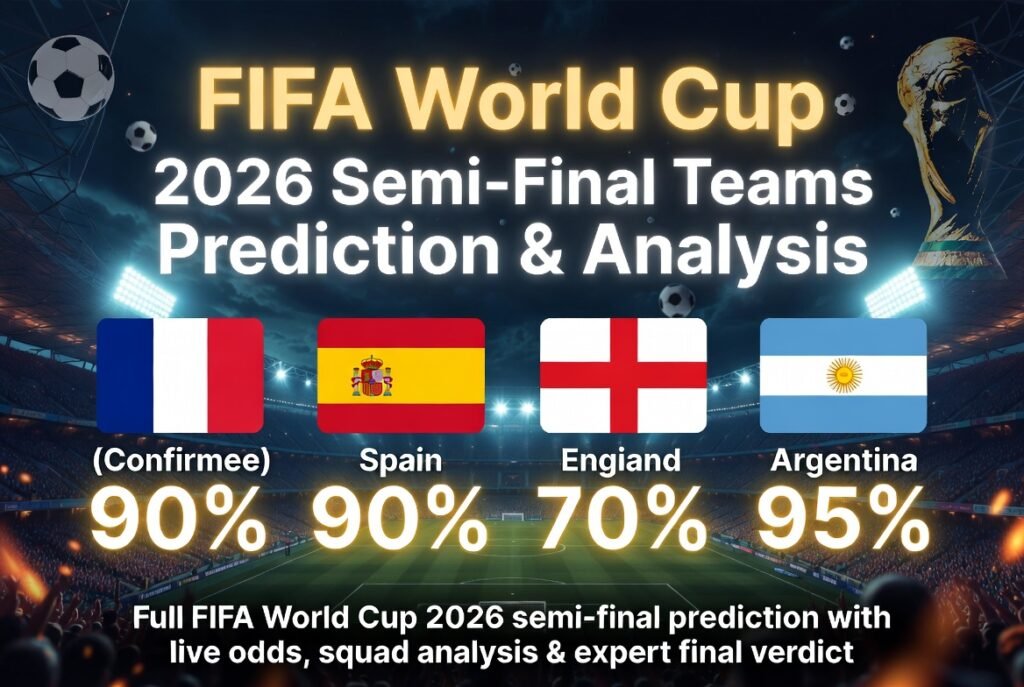
And when those three matches are completed — on July 10 and July 11 — the four teams standing will play semi-finals in Dallas on July 14 and Atlanta on July 15, before the final at MetLife Stadium in New Jersey on July 19.
This is the complete analysis of the four teams most likely to fill those semi-final places. Not just who they are, but why their campaigns have been what they have been, what their specific strengths and vulnerabilities look like at this stage of the tournament, which individual players will decide the matches ahead, and what the final bracket looks like when all four quarterfinals have been settled.
Every word of what follows is grounded in what has actually happened at this tournament — the live match data, the confirmed injury situations, the tactical patterns that have emerged across weeks of World Cup football, and the specific numbers from sources including ESPN, FOX Sports, FIFA official data, Opta Analyst, and the betting markets that reflect collective analytical judgment.
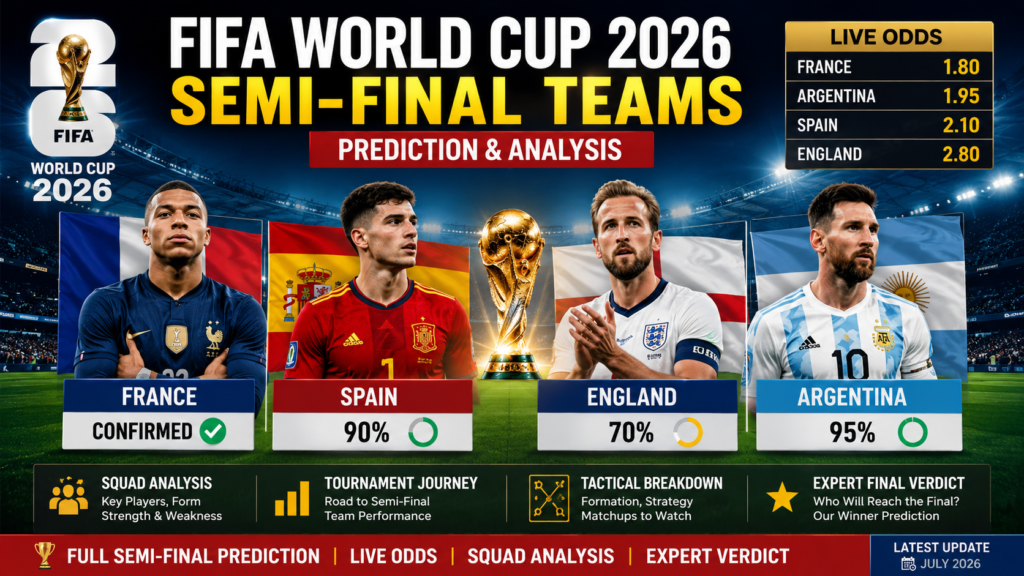
CONFIRMED SEMI-FINALIST — France
How France Got Here
France are in the semi-finals. That is not a prediction anymore — it is a fact confirmed on July 9, 2026, when Kylian Mbappé’s goal and a Michael Olise finish gave Les Bleus a 2-0 win over Morocco in Boston that extended their tournament record to six wins from six matches, 16 goals scored, two conceded, and a clean sheet maintained in every game except the very first.
The path to this point has been one of the most dominant group-stage-and-knockout runs by any team in recent World Cup history. A 3-1 win over Senegal. A 3-0 demolition of Iraq. A 4-1 statement win over Norway in the final group game — the match in which Ousmane Dembélé scored a hat-trick that announced him to the tournament as the second most dangerous player in their attack. A controlled 3-0 win over Sweden in the Round of 32. A 1-0 grind through Paraguay in the Round of 16 — Mbappé’s 70th-minute penalty the only goal in a match that was more physical than beautiful but confirmed that France can win when it is not pretty. And then Morocco, 2-0, with the composure and tactical clarity of a team that knew exactly what it needed to do and did it.
Didier Deschamps has now reached three consecutive World Cup semi-finals as France manager. He won the trophy in 2018, reached the final in 2022, and now stands two wins from his second World Cup title. If France win on July 14 and July 19, he becomes the first manager to win two World Cup titles since Vittorio Pozzo did it with Italy in 1934 and 1938. That historical context is not lost on him or the players who have been part of this journey.
Why France Are Favorites to Win the Tournament
The case for France winning the 2026 FIFA World Cup is built on several foundations that reinforce each other in ways that make the team genuinely difficult to argue against.
The first foundation is Mbappé. At 27 years old, in what multiple analysts have described as the peak season of his already-remarkable career, he is playing with the combination of confidence, physical condition, and technical precision that defines great forwards at World Cup moments. Eight goals in six matches. Golden Boot leader. Already one of only two players in history to score seven or more goals in two separate World Cups — the other, of course, is Lionel Messi. His penalty against Morocco was not spectacular but it was clinically taken under the specific pressure that penalties at this stage of the tournament carry. His movement, his pace in behind defensive lines, and the way he reads the spaces that open up when France’s wide forwards commit their defenders — all of these are operating at a level that no defender in this tournament has found a clean answer to.
The second foundation is squad depth. Opta Analyst noted before the Morocco match that Olise had already become the first player to complete 10 or more dribbles, create 10 or more chances in open play, and make 10 or more through balls in his debut World Cup since Brazil’s Zico in 1978. Dembélé has four goals and multiple assists. Bradley Barcola provides another attacking dimension from the left. Désiré Doué showed against Paraguay that he can change a match coming off the bench. France’s attack is not built around one player. It is built around a system that produces multiple routes to goal, and when one route is closed, another opens.
The third foundation is defensive organization. William Saliba and Dayot Upamecano have been one of the tournament’s most impressive defensive partnerships — coordinated, composed under pressure, and protected by a midfield that wins the ball back before attacks can properly develop. France have conceded only twice in six matches. In the knockout rounds alone, they have kept two clean sheets from two matches.
The fourth and most important foundation is tournament experience. France know how to pace a World Cup campaign. They know when to be expansive and when to be conservative. They know when to grind out a 1-0 and when to put a team to the sword. That knowledge — accumulated across eight years of major tournament football under Deschamps — is the specific quality that separates them from every other team in this competition.
Their semi-final opponent will be determined by the Spain vs Belgium quarterfinal. Spain are the most likely opponent, and the prospect of a France vs Spain semi-final in Dallas on July 14 is one of the most anticipated individual matches of this entire tournament.
PREDICTED SEMI-FINALIST — Spain (90% Confident)
The Tournament That Has Made Believers of Skeptics
Spain came into this World Cup on the back of winning Euro 2024. They arrived as one of two or three clear favorites. They were going to be the team with the most sophisticated football, the most intelligent pressing, the youngest generational talent in Lamine Yamal, and the midfield depth that would grind down any opposition over 90 minutes.
Then they drew 0-0 with Cape Verde in the very first match. A team ranked 69th in the world. Playing in their first ever World Cup. Spain could not score. The post-match reaction was immediate and severe. Former players questioned whether De la Fuente’s system was working. Analysts wondered whether Yamal’s fitness — he was still recovering from a late-season hamstring issue and came on as a substitute — was a bigger concern than the coaching staff had admitted.
Four days later, Saudi Arabia experienced what 69th-ranked Cape Verde had prevented.
Spain scored inside ten minutes and won 4-0. Yamal’s first World Cup goal came in the 10th minute. Oyarzabal scored twice before the half-hour mark. Saudi Arabia had three shots in the entire match to Spain’s 22 attempts. The demolition was so comprehensive that it instantly resettled every conversation about whether Spain were genuinely among the favorites.
Since then, they have not stopped. A 1-0 win over Uruguay. A 3-0 demolition of Austria in the Round of 32 — arguably their most complete performance of the tournament. And then the Round of 16 against Portugal — their Iberian neighbours, their rivals, the team that contained Cristiano Ronaldo in his final major tournament appearance — settled in the 91st minute when substitute Mikel Merino finished clinically to send Ronaldo’s World Cup career to an emotional end.
Six matches into this World Cup, Spain have not conceded a single goal in five of those six games. The one match that ended differently was the Cape Verde draw — and Spain did not concede in that match either. They have zero goals against across the entire tournament. No other team remaining in the competition comes close to that defensive record.
The Yamal Factor — An 18-Year-Old Carrying a Nation
Lamine Yamal turned 18 years old six days before the World Cup final. He will play in a World Cup semi-final at 18. He has already scored his first World Cup goal. He has already produced performances that multiple analysts are comparing to the moments in Euro 2024 that made him the most talked-about young footballer on the planet.
What makes Yamal special at this specific stage of the tournament is the combination of qualities he brings that no other wide attacker in this competition replicates. He is direct — he takes players on one-on-one with the fearlessness of a teenager who has not yet been taught to be afraid of the stage. He is creative — his passing in tight spaces, both from set-pieces and in open play, creates angles and openings that more experienced players would not attempt. He is technically precise — his delivery from wide areas has been consistently dangerous throughout this tournament. And he is improving as the competition progresses, which is the most important quality of all at a World Cup.
Opta Analyst has him rated as one of the top performers at the tournament regardless of position or age. His xG contribution per 90 minutes — goals plus the expected value of the chances his assists create — is among the highest of any attacking player in the competition. Against France in a potential semi-final, he will face Lucas Digne at left-back, and while Digne is a capable and experienced player, the specific challenge of containing Yamal over 90 minutes has defeated better defensive units than the French left side.
Belgium — The Golden Generation’s Last Dance
Belgium entered the 2026 World Cup knowing, with the specific clarity that comes when careers are approaching their end, that this was the final opportunity for their generation. Kevin De Bruyne at 35. Romelu Lukaku with eight career World Cup goals — level with Diego Maradona, Rudi Voller, and Rivaldo. Thibaut Courtois in goal, still among the best shot-stoppers in the world despite his age. This group finished third at the 2018 World Cup and went out in the group stage in 2022. This is their last chance at something genuinely historic.
They have been dangerous throughout. A dramatic comeback from 2-0 down against Senegal in the Round of 32 — scoring three times to win 3-2 after extra time. A 4-1 win over the United States in the Round of 16, with Charles De Ketelaere’s first-half double setting the tone. They have scored 17 goals in six matches, which is the second-highest total of any team at this tournament behind France’s 16.
But the specific concern for Belgium heading into the Spain match is a combination of two factors. The first is their defensive vulnerability — they have conceded in every knockout match, and against a Spain attack that has been creating nearly 2.0 expected goals per match while conceding only 0.4, the clean sheet record Belgium have shown recently may not hold. The second is the loss of Amadou Onana to an ACL tear in the Round of 16 — the holding midfielder whose physical presence was the specific defensive shield protecting De Bruyne and the creative players around him. Without Onana, Spain’s Rodri and Pedri will have more time and space on the ball than they have had in any match at this tournament. That is a frightening prospect for any defensive structure.
The head-to-head history is almost comically one-sided: Spain have won six of their seven all-time meetings, with the one exception being Belgium’s penalty shootout victory in the 1986 World Cup quarterfinals. Spain have scored 16 goals to Belgium’s 3 across those seven encounters.
The Spain Semi-Final Path
If Spain progress past Belgium — and the data, the form, the individual quality, and the head-to-head record all point in that direction — they face France in Dallas on July 14.
France versus Spain is the most anticipated potential match in this semi-final round. They are the two most technically sophisticated teams remaining. They met in the Euro 2024 semi-finals in 2024, when Spain beat France 2-1 in a match that contained one of the great individual moments of the summer — Yamal’s 16-year-old free-kick curler that equalized just before halftime and sent the stadium into chaos. France won the Nations League final against Spain in June 2025. The head-to-head at major tournaments has swung back and forth across the years, and the specific quality of both teams means neither can be favored by more than the narrowest of margins.
But France’s record, their depth, and Mbappé’s Golden Boot form give them the fractional advantage. The semi-final prediction is France 2-1 Spain — a match that stays tight for 60 minutes before Mbappé finds the decisive moment in the final quarter that Spain cannot answer.
PREDICTED SEMI-FINALIST — England (70% Confident)
The Three Lions in 2026 — Finally Fulfilling the Promise
England have spent the past decade being the team that almost. Almost got there in 2018 — semi-final, lost to Croatia. Almost won the European Championship in 2021 — final, lost on penalties. Almost won Euro 2024 — final, lost to Spain. Almost stopped being almost.
At this World Cup, something has shifted. The group stage produced a 4-2 win over Croatia — the best England have looked in a major tournament opening game in a generation. Then a flat 0-0 against Ghana that raised familiar concerns. Then qualification confirmed. Then the Round of 32, which brought the most dramatic result England have produced on foreign soil in their history: a 3-2 win over Mexico at the Estadio Azteca in Mexico City, a ground where England had never previously won. Bellingham scored twice in the opening 15 minutes. Mexico fought back to 2-2. England were reduced to ten men. Harry Kane scored the deciding penalty despite losing his voice to illness and straining to communicate with teammates throughout the second half. England held on through a chaotic final quarter and advanced.
That Mexico result told the world something specific about this England squad: they can win when it is genuinely hard. Previous England generations have tended to fold under exactly the kind of adversity that the Azteca demanded. This group found something else.
Jude Bellingham — The Player Who Changed Everything
There are very few moments in football when you can identify the exact player and the exact match that changed a nation’s realistic expectations of their own squad. For England, that moment came when Bellingham scored twice in the first fifteen minutes against Mexico — a diagonal run met with a precise header, followed three minutes later by a driven finish from the edge of the penalty area that gave England the breathing room they needed.
Bellingham at 22 years old is playing at a level that places him among the top five players in the world regardless of position. His energy, his reading of the game, his ability to arrive late into scoring positions without being caught offside, and his defensive contribution — pressing opposition midfielders at exactly the right moment to win the ball back in dangerous areas — make him the most complete midfielder in this tournament. When England need a goal, he creates space. When England need control, he provides it. When England need a leader, he is already there.
The specific match situation where Bellingham matters most is the one England now face: Norway in Miami. Ødegaard is Norway’s creative intelligence, the player who decides when Norway attacks, where they attack, and how the ball moves from defensive situations into Haaland’s path. The battle between Ødegaard and Bellingham in the middle of the pitch — two of the most technically refined central midfielders in European football — will be one of the defining individual contests of this entire World Cup.
Harry Kane — Fifty-Eight Years of Waiting, Seven More Matches to End It
Harry Kane walked into this World Cup having just delivered 61 goals across all competitions for Bayern Munich in 2025-26 — a season that placed him among the greatest individual scoring campaigns in the history of European football. He arrived knowing this was potentially his best chance to win the one trophy his extraordinary career has not yet produced.
He now has multiple goals in this tournament, has scored England’s most important spot kick of the competition against Mexico from the penalty spot, and has passed Gary Lineker’s England World Cup scoring record with the specific combination of goals and presence in the box that has defined his best international performances. Against Norway, he will face a central defensive partnership that has been strong throughout the tournament — but which, as Haaland’s movement above the defensive line creates spaces for the defenders to fill, will have moments of exposure that Kane’s intelligence is designed to exploit.
Norway — The Dark Horse Who Might Actually Do It
Norway are in this quarterfinal because Erling Haaland has been doing things that strikers are not supposed to do for 90-minute periods against World Cup-level opposition. Eight goals in six matches. Level with Mbappé and Messi at the top of the Golden Boot standings. His brace against Brazil in the Round of 16 — a towering header from a Schjelderup cross and then a driven low finish from outside the penalty box — confirmed that this is not just a compilation of goals against weaker opponents. He scored them when they mattered, against one of the tournament’s historically great nations, in a match Brazil should have won based on the chances they created.
But Norway’s path to the semi-final requires beating England, and that is a significantly harder proposition than beating Brazil was in terms of the specific type of defensive structure England has built. Thomas Tuchel’s England press high and cover the channels with the intensity of a team that has been specifically prepared for counter-attacking opponents. Norway, under Stale Solbakken, built their tournament around exactly the counter-attacking transitions that England’s system is designed to suppress.
The Haaland question is the central one. If Ødegaard and Schjelderup can find him in the specific positions — arriving late with space behind the English defensive line — Haaland will score. He scores in virtually every competitive match. But Declan Rice’s screening, Stones’ composure, and Guéhi’s ability to defend one-on-one without committing early will test whether Haaland can find those positions consistently against a defensive structure that is specifically organized to deny them.
England are -117 in the current odds — a slight favorite that reflects the market’s balanced view of a match that could genuinely go either way.
Why England Are 70% and Not 90%
The 70% confidence level for England reaching the semi-finals reflects one specific concern: this is the match where the upset is most realistic. Morocco at +550 against France would have been considered extraordinary if it had happened. Norway at +308 against England is not a number that suggests any real likelihood of an upset, but it is a number that reflects genuine probability.
If Nyland — whose performances against Brazil were among the great individual goalkeeping displays of the tournament — produces a similar performance against England’s attacks, and if Haaland finds his specific goal-scoring position even twice in the match, Norway can win this. The 30% chance of an English elimination is not phantom probability. It is the margin of a genuinely competitive match between a very good team and a specific goalscorer who has made opponents disappear throughout this competition.
The prediction is England 2-1 Norway — Kane from the penalty spot, Bellingham with the winner, Haaland scoring his ninth of the tournament to make it a nervous final twenty minutes. England advance to face Argentina on July 15 in Atlanta, in the single most emotionally loaded international football match available to football’s global audience.
PREDICTED SEMI-FINALIST — Argentina (95% Confident)
The Defending Champions, Messi, and the Record Books
Argentina came into this World Cup with a specific dual narrative. On one side: the defending champions, the world’s number one ranked team, a squad that has been there and done it together in Qatar in 2022 and knows exactly what winning this competition feels like. On the other: Messi at 38, playing what everyone in football knows is his final World Cup, carrying the weight of a nation’s expectation and the awareness of his own legacy with every touch of the ball.
Both narratives have delivered simultaneously.
The group stage opened with Messi’s hat-trick against Algeria — a performance so extraordinary, coming from a 38-year-old in his sixth World Cup, that it instantly positioned him at the centre of the Golden Boot race alongside Mbappé and Haaland. It also made him the outright all-time leading scorer in men’s World Cup history, with 17 goals across his tournament career. The subsequent group games produced further contributions — Messi managed carefully in terms of minutes but decisive in terms of impact when he was on the pitch.
The quarterfinal against Egypt was, by ESPN’s live account, one of the more dramatic matches of the tournament — Argentina winning 3-2 with VAR drama involved and Messi central to the comeback. The defending champions are through. And they face Switzerland on July 11 with the specific confidence of a team that has been here before, won before, and believes the journey is not finished.
Why Argentina Are 95% and Switzerland Are 5%
Switzerland are here because they beat Colombia on penalties after a 0-0 draw. Colombia were themselves not a top-tier opponent, and Switzerland’s path to the quarterfinal has been built on defensive organization and the specific quality of goalkeeper Yann Sommer — one of the tournament’s most reliable shot-stoppers. They will defend well. They will make Argentina work for every inch of space.
But against Messi, Julián Álvarez, Alexis Mac Allister, Rodrigo De Paul, and Emiliano Martínez in goal — the goalkeeper who won Argentina’s penalty shootout in Qatar — Switzerland face a combination of quality, experience, and emotional intensity that has eliminated far better international teams than them throughout this tournament’s history.
Argentina have won six of their last seven meetings with Switzerland. The last time Switzerland beat Argentina was in a 1966 World Cup group match. That head-to-head record spans 60 years of football history, and nothing about Switzerland’s 2026 campaign suggests they are equipped to extend their period of dominance.
Messi’s injury concerns, which have been carefully managed throughout the tournament, are the one caveat attached to the 95% confidence level. If Messi is not at his best, Argentina are still a very good team. If Messi is missing entirely, Argentina are a significantly diminished proposition. But there is no public indication that his fitness is anything other than the standard management of a 38-year-old athlete across a long tournament.
The prediction: Argentina 3-0 Switzerland. Messi scores twice — taking his tournament total to ten — and Álvarez adds a third that confirms Argentina’s place in the Atlanta semi-final against England on July 15.
THE SEMI-FINAL MATCHUPS — What We Are About to Watch
Semi-Final 1 — France vs Spain (July 14, Dallas, AT&T Stadium)
This match — which both the bracket and the form of both teams strongly suggests is the correct pairing — is the one that the entire football world has been anticipating since both teams were confirmed among the favorites before the tournament began.
France have won 16 goals in six matches and have the best individual player in the world in terms of tournament goal output right now in Mbappé. Spain have not conceded a single goal in their entire tournament. Those two facts create the central tension of this match: can France’s attack break the only tournament defence that has been genuinely unbreachable, and can Spain’s midfield control the match enough to create the openings their own attack needs?
The France vs Spain head-to-head at major tournaments has been competitive in both directions. Spain beat France in the Euro 2024 semi-finals. France beat Spain in the Nations League final in 2025. There is no dominant pattern at this level — there are only matches, and this one will be decided by the specific performances of the players on the biggest night of their professional careers.
Mbappé vs Cubarsí. Yamal vs Digne. Rodri vs Rabiot. These individual matchups will all matter. But the match will ultimately be decided by which team can sustain their identity under pressure — Spain’s possession-based dismantling of opposition shape, or France’s ability to score from moments of transition that come even in matches where they are not dominant.
The prediction: France 2-1 Spain. Mbappé and Dembélé score. Oyarzabal pulls one back late. France reach the final.
Semi-Final 2 — England vs Argentina (July 15, Atlanta, Mercedes-Benz Stadium)
Maradona’s Hand of God in 1986. England vs Argentina has never been just a football match. It has been a proxy for political history, national pride, and the specific mixture of sporting rivalry and historical memory that turns international football into something that transcends the sport.
At this World Cup, the match carries its own contemporary layers. It is Messi — the player widely considered the greatest of all time — in his final World Cup, facing the nation whose football history he has shadowed across his entire career. It is Kane — one of the best English strikers in the modern era — facing Argentina’s defensive pressure in a match that could end the 58-year English wait for a World Cup. It is Bellingham against Mac Allister in midfield — the 22-year-old English superstar against the 26-year-old Argentine who was the most consistently excellent midfielder at the 2022 World Cup.
Messi needs two goals to reach ten in a single World Cup tournament — a total that would tie the record set by Just Fontaine in 1958. England need to reach the final to have a chance of ending their 58-year wait. Both narratives will be at their most intense simultaneously, in Atlanta, in front of a global television audience that will be among the largest for any football match in recent memory.
The prediction: England 2-1 Argentina — but the least confident prediction of the four semi-final calls. Kane from the spot, Bellingham with a late winner. Messi scores one final goal but cannot find the second that would have changed everything. England reach the World Cup final for the first time since 1966.
THE GOLDEN BOOT RACE AT THE SEMI-FINAL STAGE
The Golden Boot race is now a three-player contest with a historic dimension that makes it the most watched individual competition within the tournament.
Mbappé leads with eight goals — having scored against Morocco to extend his total after the Round of 16. Messi has eight goals from the quarterfinal against Egypt that ESPN confirmed. Haaland has eight goals from his brace against Brazil. The three most discussed individual players at this World Cup are level at the top of the scoring charts.
The tiebreaker system — assists count if goals are level, then minutes played — means that Mbappé’s multiple assists give him the current edge in the tiebreaker scenario. But the race will almost certainly be decided by who scores the most in the two semi-final matches and potentially the final.
If France advance and meet England, and England advance from their semi-final against Argentina, the World Cup final is a France vs England encounter. Mbappé vs Bellingham. The Golden Boot race — if Messi and Haaland are eliminated before the final — would be settled by whoever scores more in the final itself.
If Argentina advance and Norway somehow eliminates England, the semi-final pairing of Norway vs Argentina would produce the single most dramatic Golden Boot race context in the competition’s modern history: Haaland vs Messi in a World Cup semi-final, with both players level on goals and both needing to score to stay ahead.
THE FINAL FOUR — THE COMPLETE PREDICTION SUMMARY
France are in the semi-finals. Confirmed. Mbappé has eight goals. The deepest squad in the tournament. The most experienced manager of the remaining coaches. Playing with the specific form that World Cup champions play with when they believe the trophy is already theirs.
Spain will join them. Six matches, zero goals conceded, Lamine Yamal in the form of his young life, Rodri controlling the game with the authority of the best defensive midfielder in world football. Belgium are dangerous but Spain’s superiority is structural, not situational. Spain beat Belgium and face France on July 14.
England will make it. The Mexico result at the Azteca proved something that previous England squads had never been able to prove: this group can find what they need when everything is against them. Tuchel’s identity, Bellingham’s quality, Kane’s experience. Haaland will score — but England will score more. They face Argentina in Atlanta on July 15.
Argentina will complete the picture. Messi has eight goals. The defending champions have the specific experience of winning under pressure that no other squad in this tournament possesses except France. Switzerland will defend well and lose by at least two goals. Argentina meet England. And the most historic matchup in international football has one more chapter to write.
FINAL THOUGHT — The Four Teams, The Two Matches, The One Trophy
The 2026 FIFA World Cup has delivered something that even the most optimistic preview articles would have hesitated to predict: a semi-final round that contains four of the five most historically significant nations in modern World Cup football, all of them in genuine form, all of them with realistic claims to the trophy, and all of them carrying specific individual stories that the sport will remember for decades.
Mbappé chasing a second World Cup title. Messi in his final tournament, one goal away from ten in a single edition, writing the conclusion of a World Cup career that has already broken records that seemed unbreakable. Bellingham leading England toward a final for the first time since the year before he was born. Yamal — 18 years old, playing in his first World Cup — matching the greatest players of the previous generation in terms of influence and impact.
This is what the World Cup is for. Not just the trophy. The moments that build toward it, the stories that surround it, and the specific people who get to be part of those stories at exactly the right time.
Four nations. Two semi-finals. One trophy. MetLife Stadium. July 19.
For the official FIFA World Cup 2026 semi-final schedule, venue information, confirmed results, and live match updates, visit the FIFA official website: https://www.fifa.com/en/tournaments/mens/worldcup/canadamexicousa2026