






Messi last World Cup, Messi World Cup 2026, Argentina World Cup 2026, Messi World Cup journey, Messi 2026 goals records, Messi final World Cup Argentina
The Beginning of the End – And Why It Matters So Much
On June 16, 2026, in Kansas City, Missouri, Lionel Messi walked out onto the pitch for Argentina’s opening game against Algeria. He was wearing the number 10 shirt. He was 38 years old. He had already won everything — the World Cup, the Copa América, the Champions League, eight Ballon d’Or awards, everything a footballer could possibly collect in a career.
And the entire world was watching him like it was the first time.
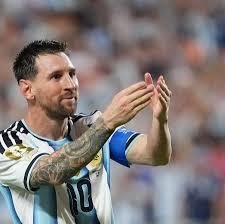
That is the thing about Messi’s last FIFA World Cup journey that is almost impossible to explain rationally. It should not feel new. We have had twenty years of Messi at this tournament — twenty years of brilliance, of near-misses, of heartbreak and eventual triumph. And yet, watching him in 2026 carries a weight that none of those earlier tournaments quite had. Because this one is the last. Everyone knows it. Messi knows it. Argentina knows it.
He played his final competitive match in Argentina itself back in September 2025 — an emotional evening that the country turned into a celebration of everything he has meant to them. He turned 39 during this very tournament. And still he came back. Still he qualified. Still he is, by every measurable standard, the best player Argentina have.
What he has done in the first two games of this World Cup is beyond anything a reasonable person could have scripted. Five goals. The all-time World Cup scoring record broken before the group stage is over. Argentina sitting top of Group J and already through to the knockout rounds. And one more group game to go.
This is the full story of Argentina Messi’s last FIFA World Cup journey — where it started, what has happened, and what still lies ahead.
The Road That Led Here – Six Tournaments, One Remarkable Thread
To understand what 2026 means, you have to understand what came before it. Messi’s World Cup story did not begin with triumph. It began with promise and early exits and the slow, grinding frustration of a nation that desperately wanted their greatest player to have the greatest possible stage.
2006 – Germany: He was 18 years old and came off the bench against Serbia and Montenegro with Argentina already comfortable. He scored. He also assisted. The world got its first proper glimpse of what was coming. Argentina went out to Germany in the quarter-finals on penalties. Messi did not even take one — José Pékerman left him on the bench. It was the first of several moments where the tournament and its politics around him felt unfair.
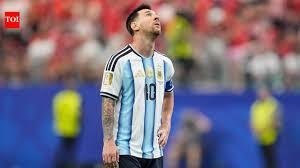
2010 – South Africa: The tournament that did not happen for him statistically — zero goals across five games — but that told a more nuanced story. He created and carried and dragged Argentina through matches on force of will, but the finishing from those around him was poor. Diego Maradona was the manager. Argentina lost 4-0 to Germany in the quarter-finals. Messi was brilliant and goalless. The criticism that followed was predictable and, if you watched the games, largely unjust.
2014 – Brazil: This was the one that felt closest before 2022 arrived to rewrite everything. Four goals. The Golden Ball as the tournament’s best player. Argentina reaching the final for the first time since 1990. And then Mario Götze’s extra-time winner for Germany, and Messi standing on the pitch at the Maracanã with a runners-up medal and an expression that said everything about what that moment cost him.
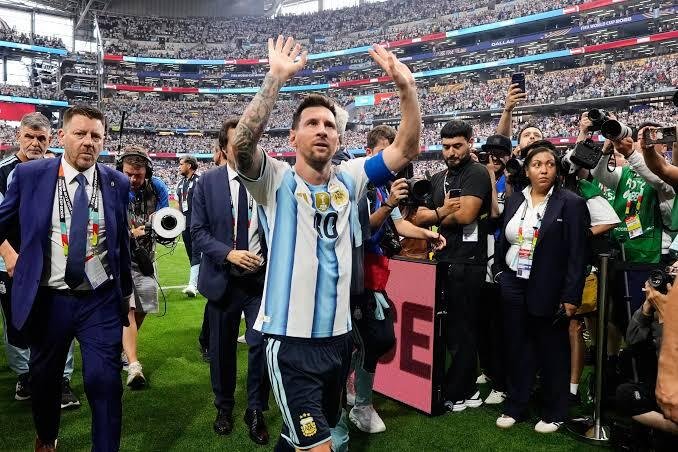
The Golden Ball in a losing final bothered people. The debate about whether he deserved it — whether it was right to give the best player award to a player from the losing side — ran for years. Messi himself has said he would trade every individual award for team trophies. In 2014, he had the award and not the trophy, and it showed on his face.
2018 – Russia: The lowest point. Argentina were disorganised, tactically incoherent, and leaning on Messi in a way that suffocated rather than liberated him. He scored once — a stunning strike against Nigeria that revived their group stage campaign — but they lost to France in the Round of 16. Mbappé announced himself to the world in that game. Argentina went home early. Messi briefly retired from international football, then came back.
That decision to return from international retirement is possibly the most important moment in the entire story. Without it, there is no 2022. Without it, there is no 2026.
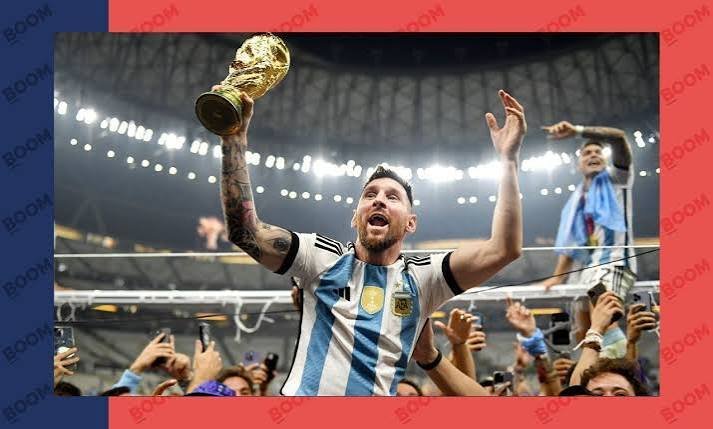
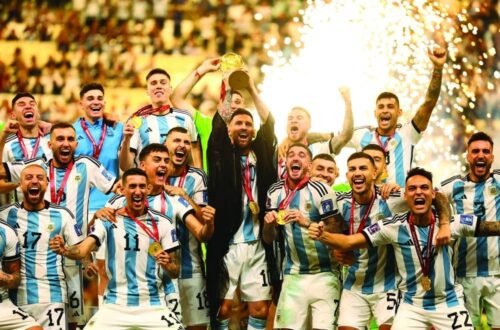
2022 – Qatar: The redemption that became a legend. Seven goals. Three assists. Argentina beating France in one of the greatest World Cup finals ever played — 3-3 after extra time, won on penalties. Messi scoring twice in the final. Lifting the trophy at the Lusail Stadium. The image of him in the bisht — the traditional Arab cloak placed over his shoulders by Qatari officials as he received the trophy — became one of the most reproduced photographs in the history of sport.
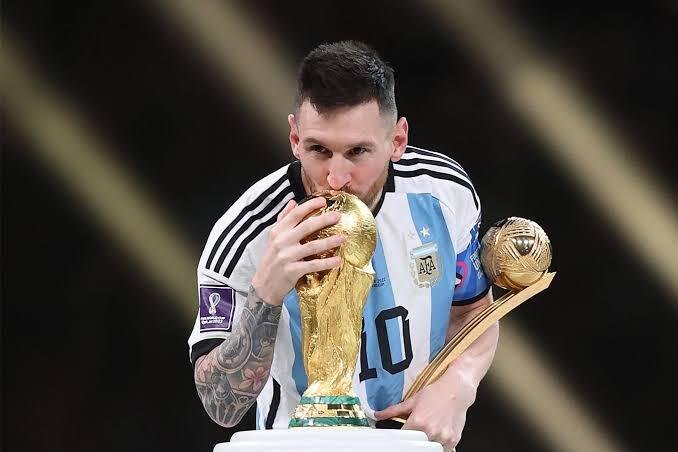
He became the first player to score in every round of a single World Cup. He won the Golden Ball for the second time. Argentina ended their 36-year wait for a world title. And Messi, finally, had the one thing that had been missing.
At that point, any reasonable person — including Messi himself — would have understood walking away. Mission accomplished. Legacy complete. Nothing left to prove.
Instead, he turned up in Kansas City on June 16, 2026. Shirt number 10. Six World Cups. And everything still to play for.
Game 1 – Argentina 3-0 Algeria: The Hat-Trick Nobody Saw Coming
June 16, 2026. Kansas City Stadium. Argentina’s opening game of the 2026 FIFA World Cup.
This was also Messi’s 200th international appearance for Argentina — the first South American man to reach that milestone. The number itself would have been a sufficient story for the evening. It was not close to the biggest thing that happened.
In the 17th minute, Messi scored his 15th career World Cup goal — equalling Mbappé, who had scored his 14th just hours earlier in France’s win over Senegal, and then added one more to move to 15. Then Messi scored his 16th. Then, before the evening was over, his first-ever World Cup hat-trick — three goals in one game, something he had never managed in his previous 25 appearances at the tournament across five editions.
Let that settle. Five World Cups. Twenty-five matches. Not once had he scored a hat-trick. He waited until he was 38 years old and the favourite to retire after this tournament to do it for the first time.
The records that fell in those 90 minutes in Kansas City were almost too many to catalogue in real time. He became the oldest player to score a World Cup hat-trick, breaking a record that had previously belonged to Cristiano Ronaldo. He became the only player to score in five consecutive World Cup matches. He became only the second man — alongside Ronaldo — to score at five different World Cups. He scored against his 11th different opponent at the World Cup, more than any other player in history.
And then, quietly extraordinary among all of those numbers, this one: he scored his first three goals of the 2026 World Cup on June 16 — exactly 20 years to the day of his World Cup debut on June 16, 2006. Twenty years. Three goals. His first hat-trick. An anniversary that felt like it had been written by someone who arranges football history from a distance.
Argentina won 3-0. They were already the team everyone else in Group J did not want to face.
Game 2 – Argentina 2-0 Austria: The All-Time Record Falls in Dallas
June 22, 2026. AT&T Stadium, Arlington, Texas — the venue they call Jerry’s World. The most appropriate possible setting for something historic.
Messi went into the game needing two more goals to break Miroslav Klose’s all-time record of 16 World Cup goals — a record the German had held since the 2014 tournament when he overtook Ronaldo Nazário.
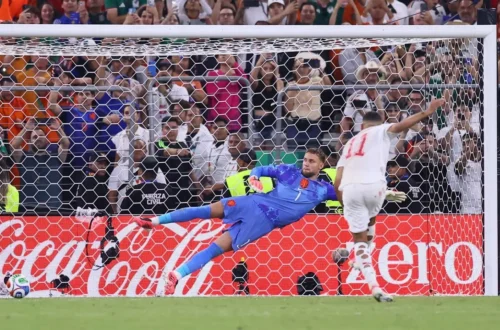
Early in the game, Messi missed a penalty. The goalkeeper saved it. For a brief moment — and only a moment, because the internet has a short attention span — there was a narrative building about the record delayed, about age, about a rare vulnerability. It was not a narrative that lasted long.
He scored his 17th World Cup goal in the 30th minute, latching onto a Thiago Almada cutback and finishing first time. He was level with Klose. Joint record holder. Then, in stoppage time at the end of the match — a rebound fell to him after his initial effort was blocked — he tucked it into the right corner of the net.
18 World Cup goals. The all-time record, his alone.
Argentina confirmed their place in the knockout stage with the 2-0 win, with Messi’s brace making him the World Cup’s all-time leading goalscorer, going past Germany’s Miroslav Klose who had held the record with 16 goals. Sky Sports
He did not roar. He did not sprint to the corner flag. He pumped his fist, looked at the sky for a moment, and then jogged back toward the centre circle. This was not the reaction of a man who needed to perform his joy for the cameras. This was the reaction of someone who understood exactly what the moment meant and carried it quietly, the way people carry things that are too large for noise.
Argentina sits atop Group J with a plus-five goal differential, having clinched a spot in the knockout stage of the World Cup with one match still to play in the group stage against Jordan. England Football
The Numbers – What Messi Has Done Across Six World Cups
Career World Cup Appearances: 28 (through 2 games of 2026)
Career World Cup Goals: 18 (all-time record — men’s and women’s combined)
Career World Cup Assists: 8
Total Goal Contributions: 26
Tournaments: 6 (2006, 2010, 2014, 2018, 2022, 2026)
Goals by tournament:
2006 — 1 goal
2010 — 0 goals
2014 — 4 goals
2018 — 1 goal
2022 — 7 goals
2026 — 5 goals (ongoing)
He has scored or assisted in each of his last 12 World Cup matches. He has scored against 11 different nations — more than any other player in World Cup history. He has won two Golden Ball awards. He has appeared in more World Cup matches than any other outfield player.
And he is still playing. The group stage is not finished.
The Argentina Squad Around Him – This Is Not a One-Man Team
One of the things that sometimes gets lost in the Messi narrative — understandably, given what he produces — is that the Argentina squad Lionel Scaloni has built around him is genuinely excellent in its own right.
Julián Álvarez, who scored four goals at the 2022 World Cup and was extraordinary in the final, operates as a perfect foil to Messi. His movement, his pressing, his ability to score from tight angles in big moments — he is a different kind of threat and one that keeps defences from being able to dedicate everything to stopping Messi.
Enzo Fernández in midfield has grown into one of the most complete central midfielders in world football since his 2022 World Cup breakthrough. Rodrigo De Paul provides the engine, the press, the tireless running that gives Messi the freedom to drop into space and receive. Alexis Mac Allister adds quality from Liverpool form.
Lautaro Martínez — averaging almost a goal per game for Argentina internationally — brings another dimension as a starter or impact substitute. The defensive structure has the experience of two Copa Américas and a World Cup in its bones.
This is not 2018, where Argentina were chaotic and leaning on Messi in desperation. This is an organised, dangerous, deep squad that knows how to win tournaments. The 2022 World Cup proved that. The 2026 group stage has reinforced it.
What Still Lies Ahead – Can Argentina Win Back-to-Back?
Argentina will move on to Miami next Friday, July 3, against the runner-up from Group H — which contains Spain, Uruguay, Cape Verde, and Saudi Arabia. youtube
After their final group game against Jordan on June 27 — which is expected to see Messi rest or play limited minutes given Argentina are already through — the real tournament begins. The Round of 32. Then the Round of 16. Quarterfinals. Semifinals. And potentially the final at MetLife Stadium in New Jersey on July 19.
The path matters enormously. If Argentina emerge from Group J as winners — which looks overwhelmingly likely — they face the Group H runner-up in the Round of 32. That could be Uruguay, Cape Verde, or potentially even Saudi Arabia. All manageable for a team of Argentina’s quality.
The rounds beyond that are where the heavyweights collide. France, Spain, England — any one of them could cross Argentina’s path from the quarterfinals onwards. Those are the games that will define this tournament and define whether Messi’s last journey ends in a second consecutive triumph or in the bittersweet reality of a great campaign that fell just short.
The psychological edge Argentina carry as defending champions is real and significant. They know what it takes to win a World Cup penalty shootout. They know what it takes to come back from a deficit in a final. They have that in their bones now, permanently installed by Lusail Stadium on December 18, 2022.
Whether that is enough — in a tournament with more teams, a longer bracket, and players like Mbappé and Yamal and Bellingham all hunting the same prize — is the central dramatic question of FIFA World Cup 2026.
The Emotional Weight of a Final Tournament
There is something genuinely unusual about watching an athlete navigate what everyone understands to be their last major championship. The farewell tour dynamic can sometimes work against a player — the sentimentality, the circus, the weight of expectation around every touch. It has undone some great careers in their final chapters.
It has not undone Messi. If anything, the opposite is true.
Having played an emotional final competitive match in Argentina in September 2025, Lionel Messi can finish an astonishing international career by leading his country to back-to-back World Cup titles at the 2026 finals in the US, Canada and Mexico. World Cup Pass
He is playing with a freedom that comes from having nothing left to prove and everything left to enjoy. The hat-trick against Algeria had a looseness to it, a joy in the movement and the finishing that reminded you of why he started playing football in the first place. The record-breaking goal against Austria was taken with the clinical certainty of a man who has scored in every conceivable situation, in every conceivable stadium, under every conceivable pressure.
There is a 100-year-old Argentinian woman who was featured in a documentary segment by ESPN during this tournament — a fan who has followed the national team since before Messi was born, who wept watching the 2022 final, and who said in an interview before 2026 that she had one wish left: to watch Messi lift a second World Cup.
You cannot know whether that happens. Football does not work that way. The bracket is long and the opposition is world-class and anything can happen from a quarter-final onwards.
What you can say with complete certainty is this: whatever happens in July, Lionel Messi’s last FIFA World Cup journey is already one of the most remarkable sporting stories in living memory. Five goals before the group stage is over. The all-time scoring record at 38 years old. A hat-trick twenty years to the day after his debut. Argentina through to the knockouts, top of their group, looking dangerous and organised and ready.
The final chapter is still being written. And the writer has shown no signs of putting down the pen.
Official FIFA Link – Argentina Fixtures, Stats & Full Schedule
For the complete Argentina match schedule, live Group J standings, Messi’s official stats page, and every result from the 2026 FIFA World Cup updated in real time:
FIFA World Cup 2026 Official Schedule and Results:
https://www.fifa.com/en/tournaments/mens/worldcup/canadamexicousa2026/articles/match-schedule-fixtures-results-teams-stadiums
FAQ
Is 2026 Messi’s last FIFA World Cup?
Yes. Messi himself and the Argentine football federation have confirmed that the 2026 FIFA World Cup is his sixth and final tournament. He played his last competitive match on home soil in Argentina in September 2025.
How many goals has Messi scored at the 2026 World Cup?
Five goals through two group stage matches — a hat-trick against Algeria (June 16) and a brace against Austria (June 22).
Did Messi break the all-time World Cup scoring record?
Yes. On June 22, 2026, Messi scored his 17th and 18th career World Cup goals against Austria, surpassing Germany’s Miroslav Klose (16) to become the all-time leading scorer in FIFA World Cup history.
How many World Cup goals does Messi have in total?
18 goals across six tournaments — 2006, 2010, 2014, 2018, 2022, and 2026.
Can Argentina win back-to-back World Cups with Messi?
They are among the favourites. Argentina topped Group J and are into the Round of 32. The path beyond that includes potentially France, Spain, or England — all major challenges. Their 2022 winning experience gives them a significant psychological edge.
What is Messi’s next game at World Cup 2026?
Argentina’s final group game is against Jordan on June 27 at AT&T Stadium, Arlington, Texas. Messi is expected to see limited minutes given Argentina are already through. Their Round of 32 match follows on July 3 in Miami.


2 Comments on “Argentina Messi Last FIFA World Cup Journey – The Final Chapter of Football’s Greatest Story”