






The 2026 FIFA World Cup is not just the biggest football tournament in history — it is the most structurally different. Since 1998, the World Cup has been played with 32 teams. That format lasted four tournaments and produced some of the most celebrated moments in modern football: France lifting the trophy at home, Zidane’s headbutt, Spain’s golden era, Germany’s 7-1, Mbappé’s hat-trick in a losing final. Decades of drama inside a framework that the whole world had come to understand.
That framework has now changed. Completely.
For 2026, FIFA expanded the tournament to 48 teams — a jump of 16 from 2022. New groups. A brand new knockout round nobody had before. A tiebreaker system that was rewritten from scratch. And a path to the final that now requires teams to win five matches rather than four. If you are trying to follow this tournament and you are still thinking about how the World Cup used to work, you are following the wrong map.
This guide explains everything: how the new format works from the first group game to the final whistle in New Jersey on July 19, what the rules are at every stage, what changed from previous editions, and the specific details that matter for understanding everything happening on the pitch right now.
The Big Picture — 48 Teams, 104 Games, Three Countries
Start with the scale, because it is genuinely unprecedented.
The 2026 FIFA World Cup features 48 nations competing across three host countries — the United States, Canada, and Mexico — in 16 different cities. The tournament runs from June 11 to July 19, a period of 39 days. There are 104 total matches, up from 64 in 2022. The opening game was Mexico versus South Africa in Mexico City on June 11. The final will be played at MetLife Stadium in East Rutherford, New Jersey on July 19.
The expansion from 32 to 48 teams is the most significant structural change to the World Cup since 1998, when the tournament grew from 24 to 32 teams. It means more countries competing, more matches at every stage, and a format that is more complex to navigate and understand than anything the World Cup has done before.
But the complexity serves a purpose: more football. More moments. More countries getting the chance to experience the tournament. And a level of unpredictability in the bracket that keeps fans engaged right up until the final.
For the official tournament overview, format details, and live match schedule, visit the FIFA official website: https://www.fifa.com/en/tournaments/mens/worldcup/canadamexicousa2026
Stage One — The Group Stage (12 Groups of Four)
The first stage of the 2026 World Cup is the group stage, which runs from June 11 to June 28. The 48 qualified nations are divided into 12 groups of four teams each. Every team plays the other three nations in their group once, giving each team exactly three group stage matches.
The points system is the same one football has used for decades. A win is worth three points. A draw earns one point for each team. A loss earns nothing. After three matches, the teams in each group are ranked by their points total, and the standings determine who advances to the knockout stage.

What has changed from previous editions is not the points system — it is how many teams advance, and which tiebreakers are used when teams finish level. Both of these changes are significant, and both require careful understanding.
A total of 72 group-stage matches are played in this format, compared to 48 in the previous 32-team World Cup. That jump in group-stage matches alone reflects the scale of the expansion and why the tournament takes longer than any previous edition.
Who Qualifies From the Group Stage?
This is where the 2026 format becomes genuinely different from every World Cup that came before it.
In the previous 32-team format, only the top two teams from each of eight groups advanced — 16 teams in total. Simple, clean, easy to follow.
In 2026, the qualification structure works differently on two levels.
The top two teams from each of the 12 groups qualify automatically for the knockout stage. That produces 24 qualified teams from group winners and runners-up. Then, the eight best third-placed teams from across the 12 groups also qualify, bringing the total to 32 teams advancing to the knockout rounds.
So: automatic qualification goes to the top two in every group. The third-placed teams compete against each other for the eight remaining spots, ranked by points, then goal difference, then goals scored, then fair play record, with lots drawn only if teams are still level after all those criteria have been applied.
This means that finishing third in a group is no longer an automatic elimination. It means more teams stay alive going into the final round of group matches. It means the drama of the last group stage games is greater than in any previous tournament, because more nations have a genuine stake in the outcome.
What it also means is that a team can technically advance to the Round of 32 with just one win, one draw, and one loss — if their third-place record is better than the other third-placed teams. That has never been possible at a World Cup before 2026, and it has already produced several fascinating qualification scenarios in the ongoing group stage.
The Tiebreaker System — The Biggest Rule Change
Perhaps the most technically significant change in the 2026 format — and the one that has already had a direct impact on group standings at this tournament — is the tiebreaker system. This is genuinely new, and getting it wrong means misunderstanding how groups are being decided right now.
For decades, the World Cup tiebreaker worked like this: if teams were level on points, goal difference came first. Then goals scored. Then head-to-head record. That was the order everyone had memorized.
FIFA changed it for 2026. Head-to-head record now comes first.
When two or more teams in the same group finish level on points, the first tiebreaker is now the result of the direct match between those teams — how many points each team earned against the other. If that is still equal, the next tiebreaker is goal difference in head-to-head matches. Then goals scored in head-to-head matches.
Only if those three head-to-head criteria have been exhausted does the overall goal difference come into play, followed by overall goals scored, then fair play record (yellow and red cards), and finally FIFA World Rankings.
The practical effect of this change is significant. A team can have a dramatically superior overall goal difference compared to a rival but still finish below them in the group because of a head-to-head defeat. This encourages teams to prioritize direct matchups rather than simply trying to run up the score against weaker opponents — a change that most football analysts consider positive for the quality of football produced at the group stage.
It is worth noting that this head-to-head system applies only within groups. When ranking the eight best third-placed teams against each other — since they come from different groups — head-to-head records cannot be used. In those cross-group comparisons, overall points, goal difference, goals scored, and fair play record are used in that order.
The Brand New Round of 32
The most structurally novel element of the 2026 World Cup format is one that simply did not exist in any previous edition of the tournament: the Round of 32.
In previous World Cups, teams qualified from the group stage directly to the Round of 16 — the last sixteen. In 2026, there is an additional knockout round between the group stage and the Round of 16. The 32 teams that advance from the group stage face each other in the Round of 32, producing 16 winners who then continue into the Round of 16.
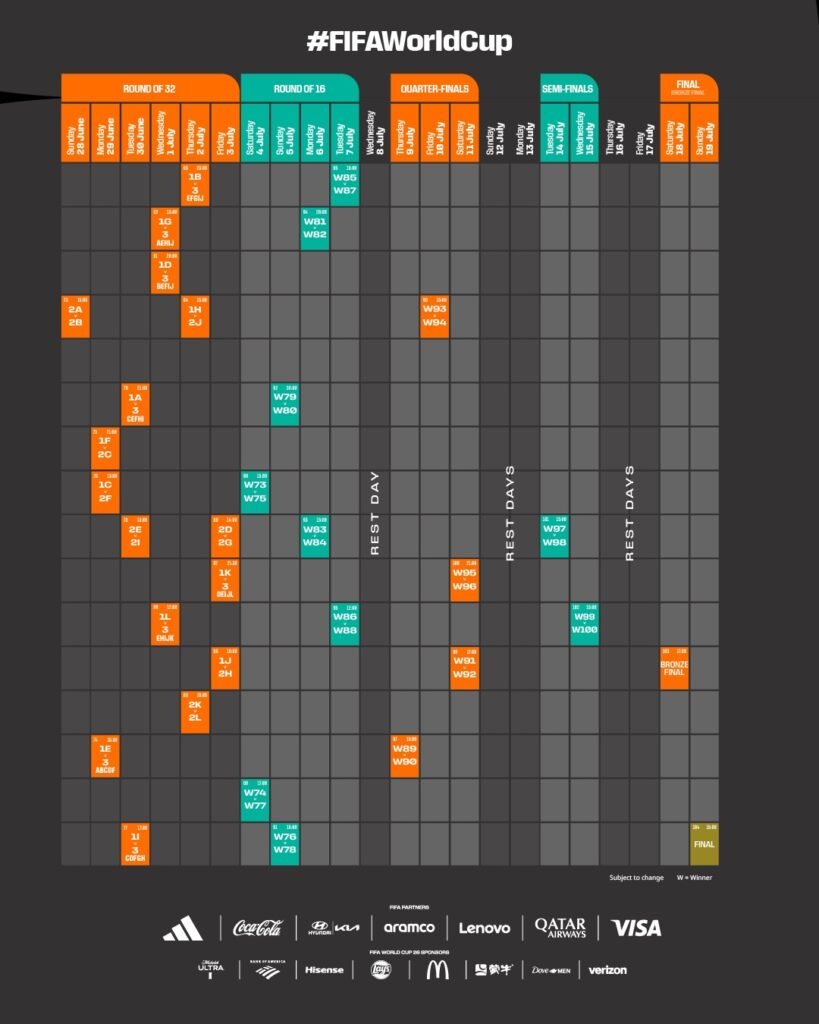
The Round of 32 begins on June 28 and runs through July 2, 2026. The matchups in the Round of 32 are determined by a specific seeding structure based on group finishing position. Group winners and runners-up face each other in combinations that were determined before the tournament began, meaning the bracket path for each team was known in advance, subject only to which position they finished in their group.
This structure means that the incentive to finish first rather than second in a group is real and significant — group winners receive a more favorable Round of 32 opponent in most cases, and potentially a softer path through the early knockout rounds. Teams that finish as runners-up may face tougher opposition earlier in the knockout stage.
For teams and fans, this extra round adds another layer of tension and planning to what was already the most complicated World Cup format in the tournament’s history.
The Knockout Stage — From Round of 32 to the Final
Once the Round of 32 begins, the format becomes the single-elimination knockout football that the world has watched and loved for generations. Win and you go through. Lose and your tournament is over. No second chances.
The full knockout stage structure runs as follows:
The Round of 32 reduces 32 teams to 16. The Round of 16 reduces 16 to 8. The quarterfinals reduce 8 to 4. The semi-finals reduce 4 to 2 finalists. Then a third-place playoff matches the two semi-final losers, and the final determines the champion.
The 2026 knockout stage includes 32 total matches, including the third-place playoff. The semi-finals are scheduled for July 14 and 15, with the third-place playoff on July 18 and the final on July 19 at MetLife Stadium.
For the first time in World Cup history, the teams that reach the final will have played eight matches — one more than in any previous edition. That single additional game has real consequences for squads and coaching staff: the physical load across eight matches in approximately five weeks is enormous, injuries and suspensions are more likely to affect final stages, and the depth of a 26-man squad becomes more important than it has ever been at a World Cup.
The eight-match final path is one reason that squad depth — rather than just starting-eleven quality — has been analyzed so closely by analysts going into this tournament. Teams like France and Spain, with genuine world-class quality throughout their 26-man squads, have a structural advantage in an eight-game format that they would not have had in a seven-game one.
What Happens When Knockout Matches Are Tied?
The group stage can end in a draw. Knockout matches cannot. One team must advance, one must be eliminated. The rules for what happens when scores are level at the end of 90 minutes follow a clear and established sequence.
First, extra time is played. Extra time consists of two 15-minute periods, meaning an additional 30 minutes of football. Teams can still score during extra time, and if one team takes the lead during the extra time periods and holds it, that team advances. The golden goal rule — where the first goal in extra time ended the match immediately — was abolished by FIFA in 2004 and does not apply at this tournament.
If the score remains level after 30 minutes of extra time, the match goes to a penalty shootout. Each team selects five penalty takers who shoot in alternating order against the opposing goalkeeper. The team that scores more of their five penalties advances. If the score is still level after five penalties each, the shootout continues in a sudden-death format — one penalty per team in alternating turns — until one team scores and the other misses.
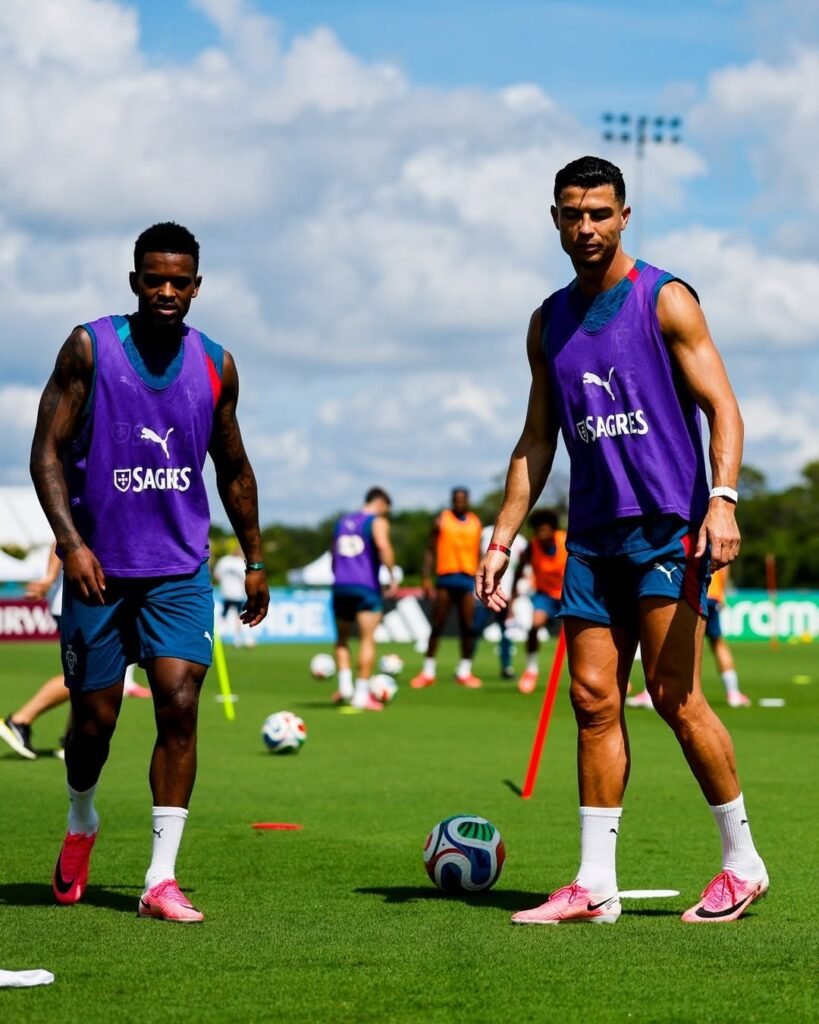
Penalty shootouts are one of the most dramatic moments in football, and they have decided some of the most iconic World Cup matches in history. They reward preparation, composure, and goalkeeping quality in ways that 90 minutes of play sometimes cannot.
There is one notable addition for the 2026 tournament regarding extra time and penalties: the semi-automated offside technology that was used at the 2022 World Cup has been further developed and is now more accurate and faster in its decisions. This means that offside calls in tight moments — including during extra time — will be determined with greater precision than at any previous tournament.
VAR — Video Assistant Referee at the 2026 World Cup
The Video Assistant Referee system — universally known as VAR — has been a fixture at the World Cup since Russia 2018, and it returns in 2026 with expanded use and improved technology.
VAR is used to review four categories of decision: goals and the actions leading up to them, penalty decisions, direct red card incidents, and cases of mistaken identity when a referee shows a card to the wrong player. The VAR team watches the match from a dedicated room and can alert the on-field referee to a potential error in these four specific categories.
What VAR does not do is review every decision. Judgment calls like yellow cards, indirect free-kicks, and general foul assessments remain the sole responsibility of the on-field referee. The system is designed to correct clear and obvious errors in the four review categories, not to second-guess every refereeing decision.
At the 2026 World Cup, the VAR system has been supplemented by semi-automated offside technology that was further developed following its introduction at Qatar 2022. This technology uses tracking data from multiple cameras to produce three-dimensional models of player positions in real time, allowing offside decisions to be made faster and with greater accuracy than the traditional video review process allowed. Marginal offside calls that previously took minutes to verify and generated significant controversy are now resolved much more quickly.
Former FIFA referee Mark Clattenburg, who has worked as a rules expert for FOX Sports’ World Cup coverage, has been direct about the complexity VAR introduces: “The World Cup brings together six confederations with different interpretations of the laws. VAR helps ensure consistency across all those different refereeing traditions and backgrounds.”
The cooling break system is another new addition at this tournament that deserves specific mention. Regardless of weather conditions, there is one break per half in every match — timed around the 22-minute mark in the first half and the 67-minute mark in the second. Each break lasts approximately three minutes and is scheduled during a natural stoppage of play. This is a welfare measure designed to help players manage the physical demands of playing in summer conditions across multiple venues in different climates, from the cooler stadiums of Canada to the high-humidity environments of some US venues.
Squad Rules — Who Can Play and When?
Each nation selects a squad of 26 players for the 2026 World Cup, an increase of two from the 23-player squads that were standard until the 2022 edition. The larger squad size was introduced partly in response to the COVID-19 disruptions of the previous cycle and has been retained because it provides better coverage against injuries across a tournament that now runs to eight possible matches.
Within the 26-player squad, teams must include at least one goalkeeper and can configure the remaining positions as they choose. The starting lineup for each match is made up of 11 players from the squad. Substitutions are allowed at any point during the match, with a maximum of five substitutions per team per game — a rule that was introduced during the pandemic period and has remained in place across all major competitions since.
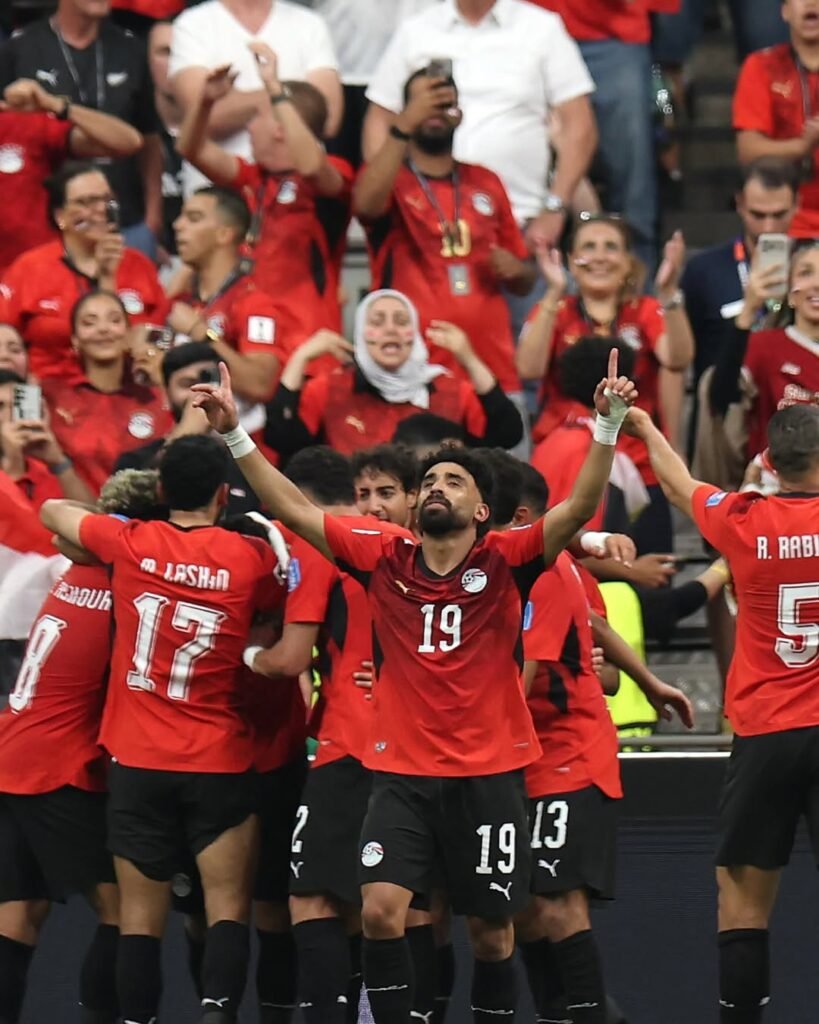
If a player is injured before their team’s first match and cannot be replaced by a player from outside the squad, FIFA has provisions for emergency replacements in specific circumstances. However, once the tournament has begun, squad changes are only permitted in exceptional cases and require FIFA medical approval.
Player suspensions carry over from match to match. A player who receives two yellow cards across any two matches of the tournament is suspended for the following game. A player who receives a direct red card is suspended for at least one match, with potentially longer bans depending on the severity of the incident and any subsequent disciplinary panel review.
The Third Place Match — Does It Matter?
The third-place playoff is one of the more debated elements of any World Cup format. Two semi-final losers, whose primary ambition has just been eliminated, play each other for the bronze medal position in a match that neither team particularly wanted to be in.
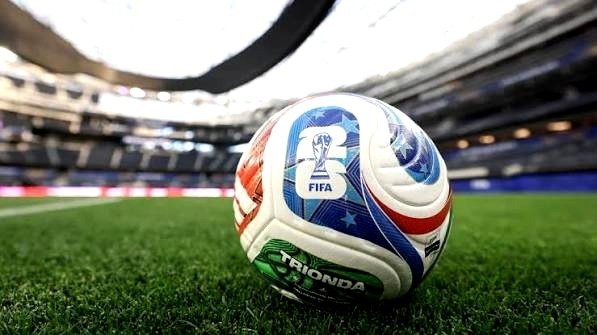
And yet, in practice, the third-place playoff almost always produces an entertaining, open match. Teams that have been eliminated with significant tournament experience tend to express themselves more freely without the pressure of a final — goals come more easily, risks are taken more readily, and the match often has a celebratory quality that the final itself, with all its tension, sometimes lacks.
The 2026 third-place playoff takes place on July 18, one day before the final, at a stadium to be confirmed based on the semi-final venues.
Key Dates — The Full 2026 World Cup Timeline
The complete timeline of the 2026 FIFA World Cup, from first kick to final whistle:
Group Stage runs from June 11 to June 26, covering all 72 group matches across the 12 groups. The Round of 32 then follows from June 28 to July 2, reducing the 32 qualified teams to 16. The Round of 16 takes place from July 4 to July 8. The quarterfinals are scheduled for July 10 and 11. The semi-finals follow on July 14 and 15, with the venues being Dallas and Atlanta respectively. The third-place playoff takes place on July 18. And the final — the match that ends this entire extraordinary journey — takes place on July 19, 2026 at MetLife Stadium in East Rutherford, New Jersey.
Why This Format Works — And Why It Changes Everything
The expanded 48-team format has generated debate ever since FIFA announced it. Critics argued that the group stage would produce too many meaningless matches, that the quality gap between the strongest and weakest teams would be too large, and that the new Round of 32 would add unnecessary bulk to an already long tournament.
What has actually happened in the opening two weeks of this World Cup is something closer to the opposite. The expanded format has produced several of the most surprising group stage results in World Cup history — upsets, dramatic late qualifications, and moments that would not have been possible in a smaller, less diverse field. The presence of nations like Cape Verde, South Africa, and Bosnia and Herzegovina has given the tournament an energy and an unpredictability that a smaller field would have lacked.
The Round of 32 is genuinely new territory, and the first knockout matches beginning on June 28 will tell us whether it adds to the tournament’s drama or dilutes it. Most analysts who have watched the group stage carefully believe it adds to it — more teams with real ambition, more matches where the outcome is genuinely uncertain, and a knockout stage where the range of possible results is wider than any previous edition.
Whether your team is France or Cape Verde, Messi’s Argentina or South Africa making their first ever knockout appearance — the 2026 FIFA World Cup format gives every nation more football, more chances, and more moments that the game will remember.
For the full official rules, format guide, match schedule, and live results, visit the FIFA official website: https://www.fifa.com/en/tournaments/mens/worldcup/canadamexicousa2026


2 Comments on “FIFA World Cup 2026 Rules and Format — Everything You Need to Know”