







It happened again. Four years after Morocco became the first African nation to reach a FIFA World Cup semi-final by dismantling some of the best teams in European football one by one — Spain on penalties, Portugal 1-0 in the quarterfinals — the Atlas Lions have returned to the knockout stages of the world’s biggest tournament and delivered another result that the footballing world genuinely did not see coming.
On Monday June 29, 2026, at Estadio BBVA in Monterrey, Mexico, Morocco eliminated the Netherlands from the FIFA World Cup 2026 in a penalty shootout that was so chaotic, so nerve-shredding, and so improbable in its sequence of misses, saves, and eventual conclusions that even the most composed football observer would have struggled to predict the final outcome after the opening three spot kicks had been taken.
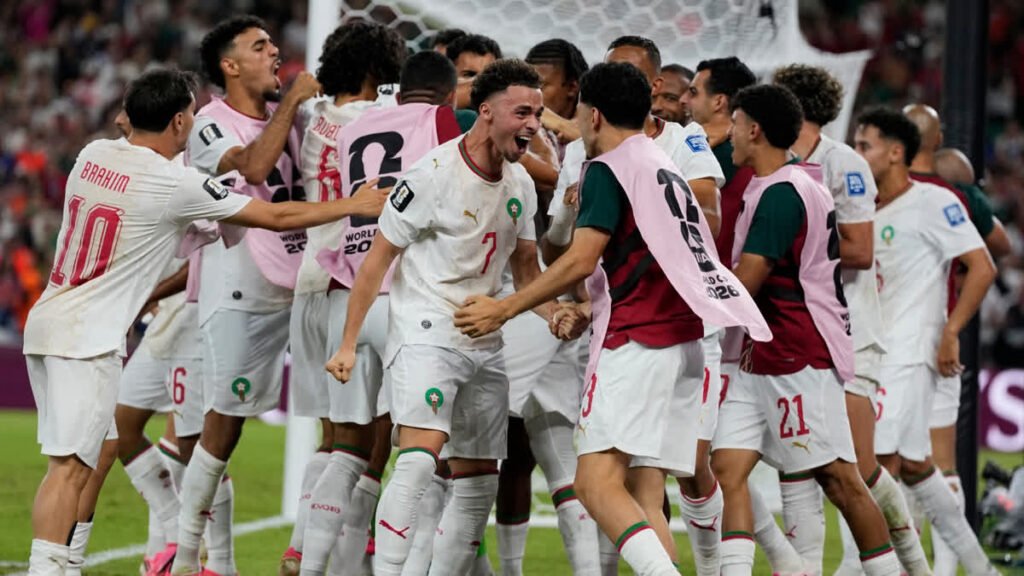
The final result: Netherlands 1-1 Morocco after 120 minutes. Morocco advance 3-2 on penalties.
This was not just a football result. This was a statement. Morocco, the Atlas Lions, African football’s most celebrated story of the modern era, are in the Round of 16 of the 2026 FIFA World Cup, facing Canada in Houston on July 4. And somewhere in the Netherlands, a football nation that has reached three World Cup finals and been heartbroken so many times in the sport’s history of near-misses, there is a silence that feels very familiar and very painful.
Here is every detail of how this extraordinary night unfolded.
The Build-Up — Two Teams With Everything to Prove
This match had been circled on the calendar since the Round of 32 draw was confirmed. The Netherlands had topped Group F with conviction — three wins across the group stage, including a dominant 5-1 over Sweden and an impressive 4-0 demolition of Japan alongside a 2-2 opener. Under Ronald Koeman, who has rebuilt Dutch football around a high-pressing, technically precise system, they arrived at this match as one of the tournament’s better-organized European sides.
Cody Gakpo, the Liverpool forward, had been their standout performer. Two goals in the group stage, playing with the combination of technical quality and physical directness that makes him so difficult to defend. Virgil van Dijk’s authority in central defence. Xavi Simons creating from deep in midfield. The Netherlands had genuine quality across their squad and were considered moderate favourites by most markets heading into the evening in Monterrey.
Morocco, meanwhile, had qualified from Group C as runners-up behind Brazil, their campaign defined by a 1-1 draw with the South Americans in the opener, a 1-0 win over Scotland, and a dominant 4-2 finish against Haiti. Coach Mohamed Ouahbi — the successor to Walid Regragui, who had masterminded the Qatar 2022 miracle run — had maintained the defensive identity and counter-attacking structure that Morocco have made their own in recent years, while adding a layer of attacking ambition that was not always present in 2022.
Achraf Hakimi, Morocco’s captain, was the most anticipated individual in the contest. At PSG, Hakimi has developed into one of the most complete right-backs in world football — contributing offensively with his overlapping runs and set-piece delivery while maintaining the recovery pace that makes him effective defensively despite his tendency to commit forward. Against a Netherlands left side that wanted to run at defenders, his defensive reading was going to be tested. Against a Netherlands defence that had shown gaps on the counter, his attacking impact could be decisive.
What nobody had fully accounted for was the specific sequence of events that would unfold across 120 minutes and a penalty shootout that produced more drama per kick than almost any shootout in recent World Cup memory.
First Half — Tight, Physical, and Full of Warning Signs for the Dutch
The match began with a caution from both sides that quickly gave way to something more interesting. Morocco grew into the contest within the first twenty minutes and created the clearest early chances, establishing an attacking rhythm that the Netherlands struggled to disrupt through their usual pressing structure.
The first genuine moment of the evening came in the 18th minute. Hakimi’s corner delivery from the right found Nael El Aynaoui in the penalty area, and his powerful header drew a brilliant reflex save from Netherlands goalkeeper Bart Verbruggen — the kind of stop that, in the moment, seemed routine but that would take on greater significance as the evening wore on.
Almost immediately, the ball fell to Hakimi on the edge of the area. He struck a fierce, low shot that Verbruggen pushed away with difficulty — a second excellent save in the space of thirty seconds. The message from Morocco was clear: they had come to win, not to defend and hope for the best.
The Netherlands, meanwhile, were struggling to impose their normal pattern. Their last clear shot in the first half came before the half-hour mark. Through 45 minutes, the Dutch were being outplayed by a team ranked lower in the FIFA standings, and the Monterrey crowd — heavily pro-Morocco with the enormous North African diaspora present across Mexico — was growing louder with every Moroccan advance.
Neither team scored in the first half. The physical intensity was significant. Brazilian referee Wilton Sampaio tested the patience of players from both sides on multiple occasions, with tackles flying in and players from both teams going to the ground with a frequency that suggested the match was operating close to the edge of what was permissible. The atmosphere, though, was magnificent.
Second Half — Gakpo’s Emotional Goal and Morocco’s Refusal to Accept Defeat
The second half was defined, for a period, by one of the most emotionally resonant individual moments of the entire 2026 FIFA World Cup.
In the 72nd minute, a Netherlands goal-kick found substitute Wout Weghorst in the centre of the pitch. Weghorst’s flick header was precise and immediate, releasing Crysencio Summerville down the left channel. Summerville drove at the last Moroccan defender, then slipped the ball inside to Cody Gakpo, who was arriving at pace and finished with the composure of a player who has spent years delivering in exactly these moments for Liverpool in the Premier League.
What made this goal unique was the context that surrounded it. Two days before this match, Gakpo and his partner Noa van der Bij had publicly announced the loss of their unborn son. The goal he had just scored — his third of the tournament, his sixth in his World Cup career, one shy of tying Johnny Rep’s Dutch all-time record — had been scored while carrying a grief that most professional footballers would have taken as a reason to withdraw from football entirely. He celebrated quietly, embraced by teammates who knew exactly what he had been through in the previous forty-eight hours.
For fifteen minutes after Gakpo’s goal, the Netherlands managed the game with discipline. Morocco pressed forward but created little of genuine quality. Verbruggen was barely tested. The Dutch looked capable of holding on.
Then came the 90th minute.
The 90th Minute — Issa Diop Writes His Name in History
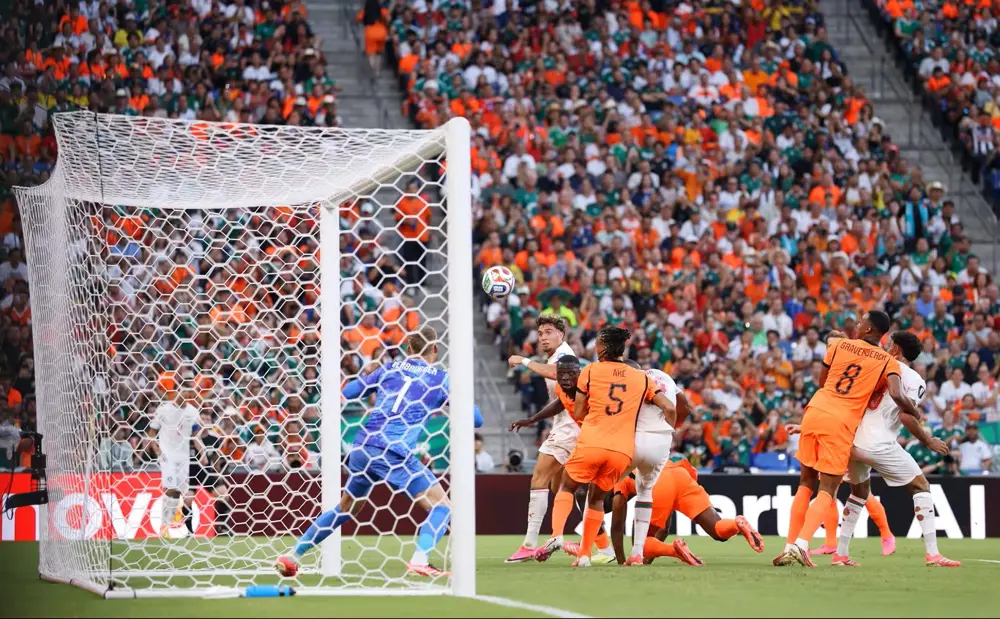
Substitute Chemsdine Talbi, who had come on in the second half to give Morocco an additional attacking dimension, picked up the ball on the left wing in the first minute of stoppage time. His cross was precise, finding the run of Issa Diop — a central defender who had pushed forward as Morocco threw everything at avoiding elimination. Diop, unmarked at the far post, glanced the ball into the net with his head for his first ever international goal and the most important header of his career.
The Morocco bench erupted. The Moroccan supporters in Monterrey — who had been experiencing exactly the same emotional journey as their team, from optimism to despair to desperate hope — released months of anticipation in a single, wild moment of celebration.
Morocco had equalized in the first minute of stoppage time, forcing extra time. The match that appeared to be over was not over.
<cite index=”11-1″>Verbruggen had been pressed into action moments earlier, producing a jaw-dropping save from Soufiane Rahimi, who went through on goal in the 96th minute and appeared to have found the winner, only to be denied by the Dutch goalkeeper’s outstretched hand.</cite> That save, in the moment, seemed to have saved the Netherlands. Ninety seconds later, Diop’s header undid all of it.
Extra Time — 30 Minutes of Tension Without a Winner
The additional thirty minutes produced very little in terms of chances, and a great deal in terms of atmosphere and exhaustion.
Morocco had 82% possession in the first fifteen minutes of extra time — an extraordinary statistic that tells you both how much they wanted to win and how deep the Netherlands had retreated in their attempts to protect what they hoped would be a penalty shootout advantage. The second fifteen minutes of extra time brought fewer clear chances as fatigue began to affect both teams visibly.
Neither side scored. After 120 minutes, the match was level at 1-1 and the decision would go to penalties.
The Netherlands, incredibly, have not lost a World Cup match in regulation since the 2010 final. Every loss in the knockout stages since then has come in extra time or on penalties. This pattern, which has now extended to five consecutive exits without a regulation defeat in the knockout stage, is simultaneously a tribute to Dutch resilience and a damning indictment of their ability to close matches out before they reach the most unpredictable conclusion football offers.
The Penalty Shootout — Chaos, Drama, and Bounou’s Greatness
The shootout that followed was, by any measure, one of the most dramatic in World Cup history. What it lacked in straightforward clean execution, it more than made up for in tension and narrative.
Morocco’s first taker, Neil El Aynaoui, hit the crossbar. Morocco were immediately behind in the shootout and the Netherlands had not even kicked yet. Disaster. The momentum appeared to swing decisively toward the Dutch.
Then Justin Kluivert stepped up for the Netherlands — and hit the post. El Aynaoui’s miss was immediately answered by a Dutch miss of equal proportions. The shootout was level in terms of successful kicks before either team had scored.
Soufiane Rahimi scored for Morocco. Wout Weghorst scored for the Netherlands. Chemseddine Talbi scored for Morocco. Quinten Timber missed for the Netherlands — sending his kick wide of the goal with the composure of a player who had not quite found his nerve under the pressure of the moment. Achraf Hakimi stepped up for Morocco’s fourth kick — and struck the post, Morocco’s second post or crossbar of the shootout.
Three of the first eight penalties in this shootout had missed the target entirely — two hitting woodwork, one going wide. The shootout was balanced on an impossible knife edge.
Then came Crysencio Summerville, the man whose assist had set up Gakpo’s opener. He needed to score to keep the Netherlands alive.
<cite index=”11-1″>Yassine Bounou stood tall when it mattered most, saving from Summerville before Saibari converted the final kick to complete a famous victory.</cite>
Bounou — who had been the hero of Morocco’s 2022 penalty shootout win over Spain, saving two kicks to send Morocco through in one of that tournament’s defining moments — saved again at exactly the right moment. Summerville went to his right. Bounou went to his right. The save was made. The Netherlands were out.
Ismael Saibari stepped forward as Morocco’s fifth taker. He placed the ball on the spot, took his run-up with the composed professionalism of a player who had scored penalties in high-pressure club situations across his career at PSV Eindhoven, and finished low to the left as Bart Verbruggen dived the wrong way.
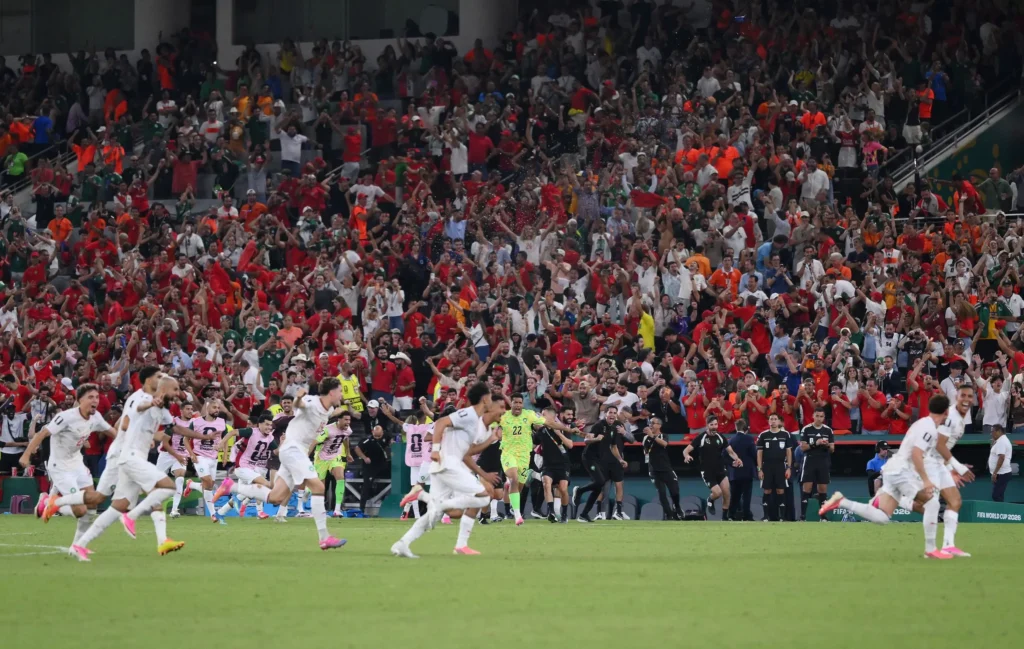
Morocco had won 3-2 on penalties. The Atlas Lions were in the Round of 16.
The Moments That Decided Everything
Looking at the specific sequence of events, two individual contributions stand above everything else in explaining why Morocco advanced.
The first was Issa Diop’s header. A central defender, forward in the final seconds of stoppage time, glancing in a cross that Morocco had no right to expect to be delivered at that exact moment. His first international goal. The most important goal he will ever score. Without that header, there is no extra time, no shootout, and Morocco go home.
The second was Yassine Bounou. The goalkeeper who saved two penalties against Spain in 2022 has now saved the decisive penalty against the Netherlands in 2026. Two World Cup shootouts. Two wins. The Atlas Lions have the most psychologically dominant penalty-shootout goalkeeper in international football right now, and the Netherlands paid the price for not accounting for that reputation when Summerville chose his corner.
The Dutch shootout record at this World Cup now reads: lost to Argentina 2014, lost to Argentina 2022, lost to Morocco 2026. Three consecutive exits on penalties, all against the same opponent or with the same result. Whether that pattern reflects a structural problem in Dutch penalty preparation or simply the randomness of shoot-outs is a question that will be debated in Amsterdam for years.
What This Means for Morocco — History Being Made
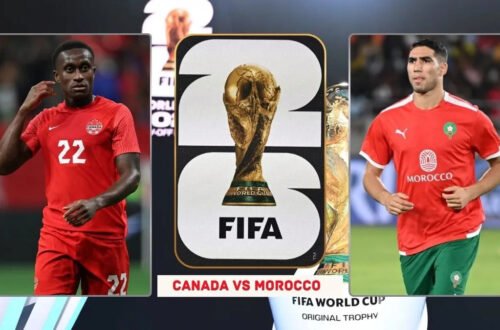
<cite index=”8-1″>The victory sends Morocco into a last-16 clash with Canada in Houston on Saturday.</cite> Canada, who beat South Africa 1-0 in the Round of 32 through a goal that the entire nation celebrated as one of the most significant in their football history, provides Morocco with a theoretically winnable path to the quarterfinals.
But the broader significance of this moment goes beyond the next match. Morocco became the first African nation to reach the World Cup semi-finals in Qatar in 2022. They have now reached the Round of 16 in consecutive World Cups for the first time in their football history. They have beaten a top-eight European team in the knockout stage in both tournaments.
Under Mohamed Ouahbi, who inherited what many considered an impossible task following Walid Regragui’s legendary Qatar campaign, Morocco have maintained the specific identity — compact defending, fierce pressing, organized set-pieces, and the goalkeeping brilliance of Bounou — that makes them consistently dangerous regardless of the quality of the opposition.
Achraf Hakimi, despite missing his penalty in the shootout, remains the most complete attacking full-back in this World Cup. His crossing, his set-piece delivery, and his defensive recovery pace have been constants throughout Morocco’s campaign. The four goals contributed against Haiti in the group stage told you what this team is capable of when they cut loose offensively. The Netherlands result told you what they are capable of when they need to defend for their lives.
What This Means for the Netherlands — The Painful End
<cite index=”8-1″>Cody Gakpo sank to the turf and appeared overcome with emotion as his teammates surrounded him in a prolonged group embrace.</cite> The image of Gakpo on the pitch after the final penalty encapsulates something specific about Dutch football’s modern relationship with the World Cup — always talented enough to reach the knockout stages, never quite finding the combination of fortune and timing that takes them to the final.
This was the second consecutive World Cup in which the Netherlands topped their group and went out in the Round of 32 or Round of 16 on penalty kicks. Virgil van Dijk, approaching 35, may not appear at another World Cup. Memphis Depay’s international career appears to be winding down. The squad will need significant renewal for 2030.
Incredibly, the Netherlands have not lost a World Cup match in regulation since 2010, with 10 wins and five draws entering this match. Yet when the Dutch have lost, it has always happened late.That pattern — resilient enough never to be beaten in regular time, unable to convert that resilience into tournament progression — is Dutch football’s defining paradox of the modern era.
Final Thought — Morocco’s Story Is Not Finished
The night of June 29, 2026, in Monterrey will be remembered in both countries with entirely different emotions. In Morocco, it joins the Qatar 2022 nights as evidence that African football has finally found its footing on the world stage and that the Atlas Lions are not a one-tournament story. In the Netherlands, it joins a long list of World Cup heartbreaks that Dutch football has been accumulating since reaching the final in 2010.
Canada await in Houston on July 4. It is, on paper, the most winnable Round of 16 match Morocco could have hoped for. But Morocco are not a team that approaches any knockout match as if the result is predetermined.
They showed that in 2022. They showed it again in Monterrey. And on July 4, they will show it again.
For the official Morocco vs Canada Round of 16 match details, fixtures, and all live results from FIFA World Cup 2026, visit the FIFA official website: https://www.fifa.com/en/tournaments/mens/worldcup/canadamexicousa2026


One comment on “Morocco Beats Netherlands on Penalties at FIFA World Cup 2026 — The Full Story”