






There is a photograph taken in Qatar in December 2022 that tells a story no words can fully capture. Cristiano Ronaldo, walking down the tunnel after Portugal’s quarterfinal defeat to Morocco, tears running down his face, his World Cup dream shattered once again. It was supposed to be the ending. The curtain falling on the greatest goalscorer in international football history at the tournament that had always, somehow, refused to be kind to him.
Use up and down arrow keys to resize the meta box pane.
But Ronaldo did not stop.
He kept playing. Kept scoring for Al Nassr in Saudi Arabia. Kept answering the call of the Portugal national team. And now, at 41 years old — a number that feels almost impossible to write next to the word “World Cup” — he is back. Playing in North America. Making history just by being here. And carrying, once again, the weight of a legacy that the World Cup has never fully rewarded.
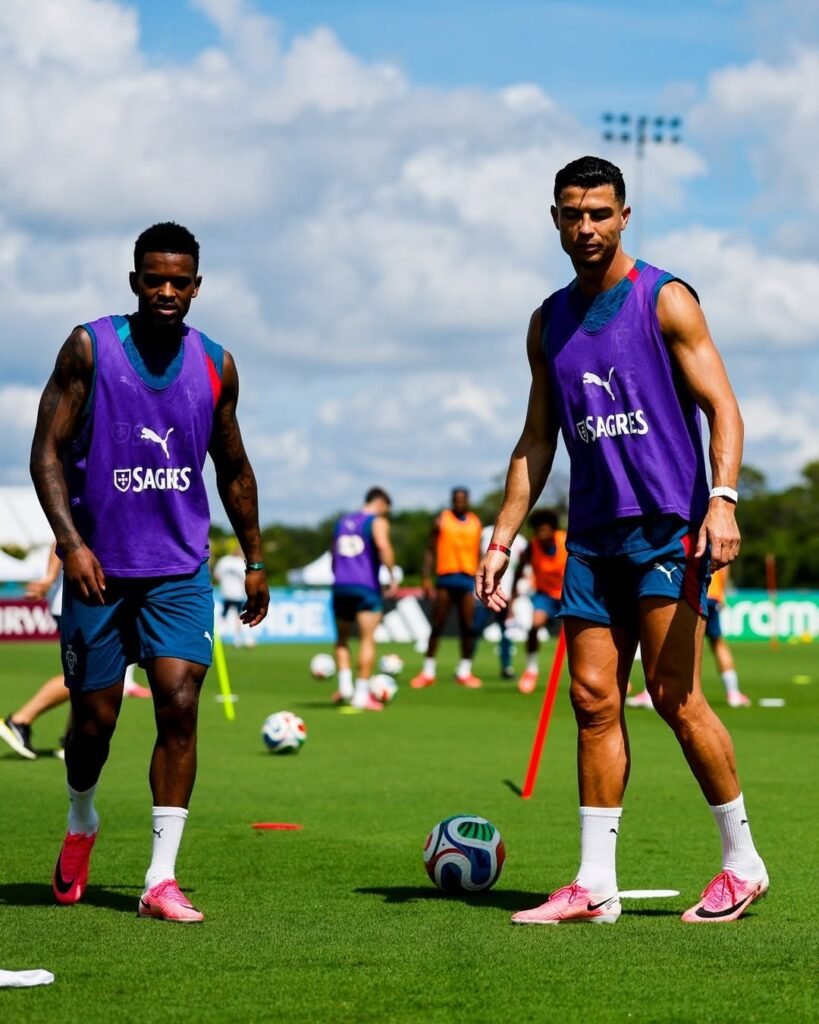
This is the final chapter. The last dance. The story of Cristiano Ronaldo’s sixth and final FIFA World Cup, and everything it means.
The Record That No One Can Take Away
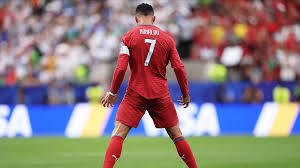
Before we talk about the controversy, the criticism, and the questions surrounding his place in this Portugal squad, we need to start with the number that defines this moment: six.
Six FIFA World Cups. No man in the history of the tournament had achieved that milestone before Lionel Messi did it earlier in this very tournament, and now Ronaldo has matched him. The two greatest players of their generation, separated by everything that makes sport beautiful — style, temperament, the teams they led, the trophies they won — but united by this single extraordinary achievement.
Ronaldo first appeared at a World Cup in Germany in 2006, when he was 21 years old and the world was just beginning to understand what he would become. That was twenty years ago. Twenty years of elite football, of maintaining the physical standards required to compete at the highest level of international sport, of answering every question about longevity with another goal, another record, another tournament.
He has made 229 appearances for Portugal, scoring 143 goals — both men’s world records. He has won five Ballon d’Or awards. He is the all-time leading scorer in club football history. And yet the World Cup — this specific competition, the one that matters most to the sport globally — has remained the one major honour that has eluded him across his entire career.
That gap in the trophy cabinet is not for lack of trying. It is not for lack of ambition. It is simply the way football works sometimes. The greatest player of his era meets the one tournament that never quite went his way.
Twenty Years of World Cup Heartbreak — Tournament by Tournament
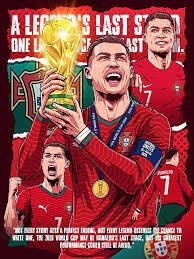
To understand what 2026 means to Ronaldo, you have to understand what the previous five World Cups meant — and what they cost him.
Germany 2006 was the beginning, and in many ways, it remains his best tournament. Portugal reached the semi-finals, their best result since 1966. Ronaldo scored his first World Cup goal — a penalty against Iran — and became the youngest Portuguese player to score at the tournament at 21 years and 132 days. The future felt limitless. When Portugal were eliminated in the semi-final, the general feeling was that this was just the start of something that would eventually lead to a World Cup winners’ medal.
South Africa 2010 was a disappointment. Portugal had a squad that contained multiple world-class players, but they were eliminated in the last sixteen by eventual champions Spain. Ronaldo scored just once, in a 7-0 demolition of North Korea, and the tournament came and went without the defining moment he was searching for.
Brazil 2014 was painful in a different way. It was supposed to be the tournament where the newly crowned world’s best player — Ronaldo had won his second Ballon d’Or that year — finally delivered on football’s biggest stage. Instead, Germany humiliated Portugal 4-0 in the group stage, Ronaldo scored once across all games, and Portugal went home early. He was carrying a knee injury throughout. It was an exercise in frustration from start to finish.
Russia 2018 was the tournament where Ronaldo finally looked like the player his club performances suggested he was at World Cup level. Four goals, including a stunning hat-trick against Spain — one of the great individual performances in World Cup history — and moments that reminded the world of his unique ability to deliver under pressure. Portugal were eliminated by Uruguay in the round of sixteen, but Ronaldo had shown he could be extraordinary on this stage.
Qatar 2022 was meant to be his last chance. At 37, his minutes were reduced after the group stage, and when Portugal were beaten by Morocco in the quarterfinal — the extraordinary Moroccan team that became Africa’s finest ever World Cup story — Ronaldo walked off the pitch in tears. His last act in that tournament was penalty against Ghana in the group stage. One goal from a penalty spot. After that, he watched from the bench as Portugal’s form improved without him and ultimately crumbled when it mattered most.
And now, 2026. One more chance. The final one.
The Uncomfortable Truth About 2026
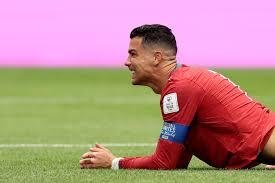
It would be dishonest to write about Ronaldo’s final World Cup without addressing what has actually happened on the pitch in the opening week of this tournament.
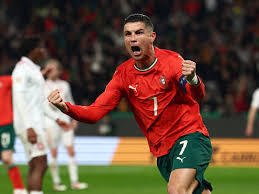
Portugal’s first group game was against DR Congo in Houston on June 17. In the first game of his sixth World Cup, Ronaldo played all 90 minutes and delivered a performance that generated the kind of debate that has surrounded him at international level for several years now.
The statistics were blunt. He had just 25 touches — the fewest of any Portugal starter and 10 fewer than Congo DR’s striker who scored the equaliser. He had three shots, none of them on target. He created zero chances. He made two progressive carries and two progressive passes. He completed 17 of 22 attempted passes, and the majority of them went backwards.
Portugal led 1-0 through João Neves’ early header before conceding the equalizer. They drew 1-1. It was the fourth time in five World Cups that Portugal failed to win their opening match.
The reaction was fierce. Former Arsenal and France striker Thierry Henry, watching as a studio pundit, was direct: “The team needs to score, not you need to score” — a comment directed at moments when Ronaldo chose to shoot rather than pass to better-positioned teammates. Paul Scholes was even more cutting: “I think there’s only one position a 41-year-old player should start on the pitch. And that’s the goalkeeper.” Former Ghana midfielder Kevin Prince Boateng said Portugal would be better served by Ronaldo coming off the bench for the final 15-20 minutes rather than starting.
Perhaps the most telling comment came from DR Congo midfielder Ngalayel Mukau, who was asked whether his team had a specific plan to stop Ronaldo. His answer was one of the most honest assessments of where Ronaldo is in his career: “Not really. We know he’s no longer the same player as before and that he’s older now. At his age, he can no longer put in the same effort as before, but I have tremendous respect for him.”
The contrast with Lionel Messi, playing the very next day, was impossible to ignore. Messi — two years younger than Ronaldo, also playing what is almost certainly his final World Cup — scored a hat-trick against Algeria, pulling level with Ronaldo’s record of 143 international goals and becoming the outright all-time leading scorer in World Cup history. In one afternoon, Messi did what Ronaldo could not do in an entire match, and the global reaction was immediate.
The Numbers That Tell the Real Story
One of the most significant statistics hovering over Ronaldo’s participation in this tournament is a streak that tells its own story: He has not scored in a major tournament from open play since June 19, 2021 — five years ago, against Germany at Euro 2020.
His only goal in the 2022 World Cup came from a penalty against Ghana. He was goalless at Euro 2024. At this World Cup, through the DR Congo game, he has now gone 10 consecutive games in major tournaments without scoring. That is tied for the longest such drought of his entire international career.
Portugal’s numbers when Ronaldo starts paint a picture that Portugal’s coaching staff are almost certainly aware of. In the two years before this World Cup, Portugal averaged 1.9 goals per game when Ronaldo started and 2.8 when he did not. The one statistical outlier is a 9-1 win over Armenia that inflates the non-Ronaldo average, but even accounting for that, the direction of the numbers is clear.
And yet — and this is where the Ronaldo story becomes genuinely complicated — when he does score at a World Cup, Portugal’s record is remarkable. Since his debut in 2006, Portugal is 5-1-0 in games where Ronaldo finds the net. When he does not score, they are 5-5-7. The team that needs him to be decisive is the same team that struggles when he starts but cannot score.
The version of Ronaldo who scored four goals at Russia 2018, who delivered a hat-trick against Spain, who sent the football world into a frenzy with the power and precision of his free-kick equalizer — that version of Ronaldo, when he appears, remains capable of winning Portugal a World Cup match on his own. The question in 2026 is whether that version can still show up consistently across six or seven games.
The Manager’s Dilemma — Roberto Martinez and the Ronaldo Question
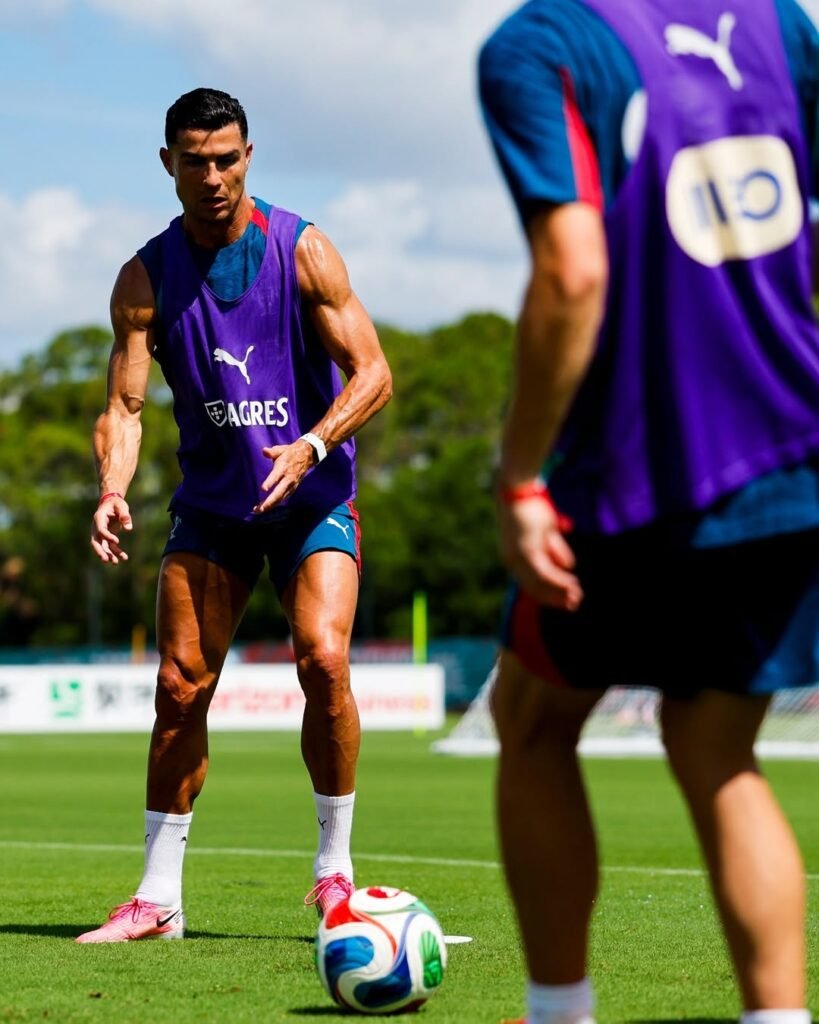
Portugal coach Roberto Martinez has faced the same dilemma his predecessor Fernando Santos faced in Qatar four years ago. Santos eventually dropped Ronaldo after the group stage. Benchmark wins over Switzerland and the run to the quarterfinals followed. When Portugal were knocked out by Morocco, the debate about whether Santos made the right call — and made it too late — still runs through Portuguese football.
Martinez, a Spanish coach known for his intelligence and his ability to manage complex squad dynamics, has so far chosen to stick with Ronaldo as a starter. His justification after the Congo DR draw was revealing: “It makes no sense to get the best goalscorer in world football out in a game that you need goals.” He also defended his decision not to substitute Ronaldo during the match: “The experience of Cristiano in the box is important.”
The logic is defensible — up to a point. Ronaldo’s presence in the box, even when he is not scoring, forces defenders to account for him, which creates space for players like Bruno Fernandes, Bernardo Silva, and Rafael Leão. There is a tactical argument for keeping a striker with his goalscoring history on the pitch.
But there is also a counter-argument that is becoming harder to dismiss: Portugal’s midfield — which contains some of the most creative players in world football — is arguably the best in this entire tournament. Bruno Fernandes, Bernardo Silva, Vitinha, Nuno Mendes, João Neves — these players can unlock any defense in the world. The question is whether a 41-year-old striker, whose main contribution requires service into specific areas of the box, is the most efficient way to use that creative quality.
Portugal face Uzbekistan next in Houston. Then Colombia to close out the group stage. Whether Ronaldo produces something remarkable in those games — a goal, a moment, something that silences the debate — will determine how this final chapter reads.
What This World Cup Means Beyond Football
Here is the thing about Cristiano Ronaldo’s final World Cup that gets lost in the noise of the tactical debate and the comparison with Messi: the sheer improbability of him being here at all.
He is 41 years old. He is playing international football at the highest level in the most demanding tournament on earth. The nearest comparison for an outfield player at a World Cup is Roger Milla, who came off the bench for Cameroon in 1994 at 42 — and scored. No outfield player had started a World Cup match at 41 before Ronaldo did against Congo DR.
The physical preparation required to be in this position — to be selected for a national squad, to be considered good enough to start, to be playing 90 minutes in the summer heat of Houston — is itself a kind of achievement. Whatever you think about whether he should be starting, whether he is helping or hurting Portugal’s chances, the fact of his presence here is extraordinary.
He has 143 international goals. 229 caps. Five World Cups of experience before this one. A Champions League winner. A Premier League winner. A Serie A winner. He led Portugal to their first ever major international trophy at Euro 2016. He won UEFA Nations League titles in 2019 and 2025. He has scored more goals in competitive professional football than any player in history.
The World Cup has not given him a winner’s medal. It has given him tears, heartbreak, moments of individual brilliance surrounded by collective disappointment. And he has come back, again and again, because the dream never died.
The Final Verdict — A Story Still Being Written
When people look back at Cristiano Ronaldo’s career — and they will look back at it for a very long time — the World Cup will be the complicated chapter. The one that did not go the way his talent deserved. The one that made football feel unfair in the specific way that only the World Cup can make even the greatest careers feel unfair.
But it will not be the only chapter. And it will not define him.
What might define him, in the end, is this: He chose to come back. At 41, after the tears in Qatar, after the questions about whether his time had passed, after four years that provided every reason to walk away — he came back. He put on the Portuguese shirt for a sixth World Cup because he still believed something was possible.
Whether Portugal win this tournament, whether Ronaldo scores the goal that changes everything, whether the final chapter ends with triumph or with another painful exit — the story of his last World Cup is already unlike anything football has seen before.
And it is not finished yet.
For official Portugal squad details, fixtures, and real-time match updates, visit the FIFA official website: https://www.fifa.com/en/tournaments/mens/worldcup/canadamexicousa2026


4 Comments on “Ronaldo’s Last FIFA World Cup Story — The Final Chapter of a Legend”