







Two stories that football could not have scripted. Morocco, the team that made the world believe African football had permanently joined the conversation for the sport’s biggest prizes — semi-finalists in Qatar 2022, now through to the Round of 16 again after a penalty shootout that reduced the Netherlands to silence in Monterrey. And Canada, a co-host nation playing its first ever World Cup on home soil, celebrating a Round of 32 win over South Africa with the kind of national joy that only football can produce when a country finally experiences it for the first time.
They meet on July 4 — American Independence Day, which creates a backdrop that is equal parts dramatic and somewhat surreal — at NRG Stadium in Houston, Texas. The stakes are simple: a quarterfinal place in the FIFA World Cup 2026. The history is compelling: Morocco have never lost to Canada in senior men’s football, winning three of their four previous meetings. The stories around the match are even better than that.
This is the full preview.

The Context — Two Nations Who Rewrote Their Own History to Get Here
Before the tactics, the statistics, and the prediction, it is worth pausing on what it means for both of these teams to be standing in a Round of 16 at the 2026 FIFA World Cup.
Canada’s journey to this point has involved a specific combination of qualification agony, home tournament pressure, injury disruption, and the kind of individual moments that only the best players in any generation can produce. They qualified for the 2022 World Cup in Qatar — their first appearance since 1986, a 36-year absence from the sport’s biggest stage. They did not win a single match in Qatar, but the experience and the momentum it generated fed directly into the preparation for 2026.
As co-hosts, Canada entered this tournament without the usual qualification requirements. They had the home advantage, the passionate crowds, and the expectation of a football-awakening nation that has spent the past decade falling in love with a sport it used to treat as an afterthought. They also had significant injury problems — Alphonso Davies, arguably their most recognizable player and one of the most dynamic full-backs in world football at Bayern Munich, missed most of the group stage with a knock and has only played 15 minutes of this tournament so far. Ismaël Koné, their most creative central midfielder, was stretchered off against Qatar with a broken leg and will not feature again.
Despite all of that, Canada finished second in Group B, beat South Africa 1-0 in the Round of 32 through a 92nd-minute Stephen Eustaquio winner, and now find themselves in the Round of 16 for the first time in their history. If they beat Morocco today, they face either France or Paraguay in the quarterfinals. The journey, improbably, is still going.

Morocco’s story is the one that needs less introduction, because the football world has been telling it for four years. The Qatar 2022 semi-final run — the first ever by an African nation — was supposed to be a once-in-a-generation moment. Instead, it appears to have been the beginning of something. Under Mohamed Ouahbi, who took over from Walid Regragui in March 2026 with just two matches before the tournament began, Morocco arrived at this World Cup on a 33-game unbeaten run. They drew with Brazil in the opener — having 12 shots in the first half and arguably deserving to win. They beat Scotland 1-0 and Haiti 4-2 in subsequent group games. And then they eliminated the Netherlands in Monterrey in a penalty shootout that produced more missed kicks, stunning saves, and dramatic narrative turns per spot kick than almost any shootout in recent World Cup memory.
Morocco have become the first African nation to win a knockout stage match in two separate World Cups. They are written in football history already. A quarterfinal would write them deeper.
The Tactical Picture — How Both Teams Will Set Up
Understanding this match requires understanding the specific tactical identity each team brings to Houston, because they are genuinely different and the contrast creates the central tension of the contest.
Morocco under Ouahbi have moved away from the defensive, counter-attacking structure that Regragui used to devastating effect in 2022 and toward a possession-based approach built around a 4-2-3-1 system. Against the Netherlands, Morocco completed a staggering 801 passes — a remarkable total for a team that many people still associate with parking the bus and hitting on the break. Only Spain, the most technically accomplished passing team in this tournament, have completed more than 800 passes in a single World Cup game since data collection began.
The high press that Ouahbi has emphasized throughout his short tenure as head coach will be Morocco’s primary weapon against Canada. In the first twenty minutes of this match, Morocco will press Canada’s defenders and goalkeeper with intensity and purpose, looking to win the ball high up the pitch and create quick attacking opportunities before Canada can establish their defensive shape. How Canada’s center-backs — Moisés Bombito and Derek Cornelius — handle that pressure will tell us a great deal about the outcome of the match.
Canada, under Jesse Marsch, set up in a structured mid-block that prioritizes defensive organization before looking to exploit transitions. The key is the speed of their forward line on the counter — Jonathan David’s intelligent movement, Tajon Buchanan’s directness from wide areas, and the pace that Alphonso Davies would add if he is fit enough to start. Canada made more than 100 final-third pressures in the first half against South Africa in the Round of 32 — the most of any team in a World Cup half since 2010 — which shows that Marsch’s team is not passive. They press energetically, they run, and they create the kinds of situations where individual quality can be decisive.
The central tactical contest of this match is Morocco’s high press against Canada’s ability to play out from the back under pressure. If Morocco win the ball consistently in Canada’s defensive third, they will create enough chances to win comfortably. If Canada can resist the press, transition quickly, and get the ball to Jonathan David in dangerous positions against Morocco’s defensive line, they have a realistic path to scoring.
Key Player Duel No. 1 — Achraf Hakimi vs Tajon Buchanan
Every tactical preview for this match identifies the same individual battle as the most important on the pitch: Achraf Hakimi, Morocco’s captain and right-back, against Canada’s Tajon Buchanan, who operates on the left wing.
Hakimi is one of the most complete attacking full-backs in world football. At PSG, he has spent years developing the combination of pace, crossing ability, and defensive recovery that makes him so difficult to account for. In this tournament, his corner delivery has been a consistent source of danger — creating the chance that El Aynaoui nearly converted against the Netherlands, and setting up multiple goal-scoring opportunities throughout the group stage. Against South Africa, he was equally involved in Morocco’s attack. He will push forward down Canada’s left side repeatedly, looking to get behind Buchanan or deliver early crosses that Morocco’s forwards can attack.
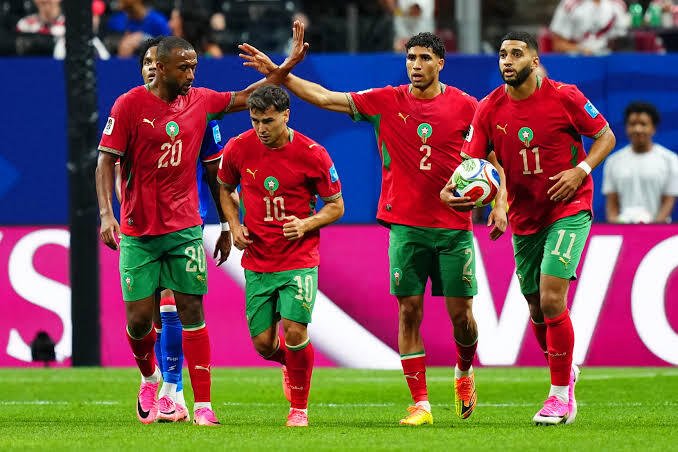
Buchanan, who plays his club football at Villarreal, brings pace and directness from the left that can match Hakimi’s attacking intensity. He has been one of Canada’s more consistent creative threats through this tournament and his ability to track back and defend when Hakimi overlaps is going to be tested throughout this match.
This duel will define the right side of the pitch. If Hakimi dominates it, Morocco score first. If Buchanan can hold his defensive line and threaten on the break, Canada stay in the match.
Key Player Duel No. 2 — Jonathan David vs Morocco’s Central Defence
Jonathan David is Canada’s most reliable goal threat and the player Morocco will have prepared for most carefully in the days before this match. His hat-trick against Qatar in the group stage is the most discussed individual performance of Canada’s tournament, but his contribution has been more consistent than that single game suggests — six consecutive games in which Canada have scored, with David involved in the majority of those goals through his movement, his hold-up play, and his direct running in behind defensive lines.
Morocco’s central defensive unit — anchored by Romain Saiss and Nayef Aguerd at the base, with Chadi Riad and the supporting cast providing cover — is experienced, physical, and specifically organized to deal with the type of striker that David represents. Riad suffered a knock against the Netherlands in the 75th minute and was forced off, but has made a rapid return to training and is expected to be available for selection.
The question for David is whether he can find the specific type of space and service that makes him lethal. Against South Africa’s deep defensive block, Canada struggled to create clear-cut openings — they had more shots on target than any other team at this tournament at that point, but South Africa’s organized defense and goalkeeper Ronwen Williams kept them out until Eustaquio’s 92nd-minute moment. Morocco will defend with greater quality than South Africa, but also with a higher defensive line — which creates the exact type of space in behind that David’s runs are designed to exploit.
The Alphonso Davies Question
No Canada preview for this match can avoid the most important selection question Jesse Marsch faces: does Alphonso Davies start?
The Bayern Munich left-back, one of the fastest footballers on the planet and Canada’s most globally recognized player, missed most of the group stage with injury and came on for only 15 minutes against South Africa in the Round of 32. His influence on Canada when fit is transformative — he provides an attacking dimension from left-back that forces opposition teams to allocate defensive resources to a position that most teams treat as straightforward, and his pace on the counter is the most dangerous individual weapon Canada possesses.
Marsch has not ruled out a starting role for Davies, but the competing argument is that Richie Laryea, who has been excellent defensively throughout the tournament, provides the defensive security that knockout football at this stage requires. Morocco’s right side — Hakimi pushing forward constantly — means that whoever plays Canada’s left-back needs to be reliable defensively as well as dangerous going forward.
The compromise solution — starting Laryea at left-back and moving Davies into a more advanced position — has been discussed in Canada’s camp and would represent the kind of tactical flexibility that could surprise Morocco in the opening stages. A fully fit Davies in attack, freed from defensive responsibilities, would be the most dangerous individual on the pitch. But a Davies who is not at full fitness and is exposed defensively by Hakimi’s relentless overlapping runs would create problems that Canada cannot afford.
The 33-Game Unbeaten Run — Morocco’s Remarkable Statistic
One number defines Morocco’s current form better than any other: 33. That is the number of consecutive matches Morocco have gone without defeat — a run that stretches back more than two years and encompasses the entire qualifying campaign and this World Cup up to this point.
The run includes their draw with Brazil in the World Cup opener — a match that most teams would have lost, and that Morocco arguably deserved to win based on the first-half chances they created. It includes the penalty shootout win over the Netherlands, which extended the sequence in the most dramatic possible circumstances.
Canada, by contrast, have won just three of their last eight matches — a record that reflects both the quality of opponents they have faced in recent months and the specific disruptions caused by injury to key players. Their record against Morocco in senior men’s football is even more relevant: Canada have never beaten Morocco, losing three of their four previous encounters, including a 2-1 defeat in the group stage of the 2022 World Cup.
Those head-to-head statistics do not guarantee the outcome on July 4. Football is not played on paper. But they provide important context for why Morocco are the justified favourites for this match and why Canada, despite their remarkable journey to this point, begin the day as significant underdogs.
The Live Odds — What the Market Says
As of July 3, 2026, the current odds for this match across major sportsbooks:
Morocco to win: -125 to -130 Draw after 90 minutes: +250 to +265 Canada to win: +390 to +400 Under 2.5 goals: -160
The market has settled on Morocco as moderate favourites — not dominant ones, but clear ones. The -125 to -130 moneyline for Morocco reflects roughly a 55% implied probability of a Morocco win in 90 minutes, and higher overall probability of Morocco advancing when extra time and penalties are included. Canada at +390 suggests the market gives them approximately a 20% chance of winning in regulation.

The Under 2.5 goals market at -160 is the most confident line — nearly every analyst covering this match expects a tight, low-scoring contest where defensive organisation on both sides limits clear-cut opportunities. Morocco’s tournament record supports that: they have conceded sparingly throughout, and their defensive shape under Ouahbi has been one of the most organized in this World Cup.
For the scoreline market, multiple preview sites are backing a 1-0 Morocco win as the most likely single result — a figure consistent with Morocco’s recent form, their defensive solidity, and the specific difficulty Canada will have in scoring against an Atlas Lions defensive unit that is deeper and more technically reliable than anything they have faced so far in this tournament.
The Predicted Lineups
Morocco (4-2-3-1, predicted): Yassine Bounou; Achraf Hakimi, Chadi Riad, Nayef Aguerd, Romain Saiss; Sofyan Amrabat, Azzedine Ounahi; Brahim Diaz, Ismael Saibari, Bilal El Khannouss; Soufiane Rahimi
Chadi Riad is listed as questionable following his forced substitution against the Netherlands, with Redouane Halhal on standby if he is ruled out after the final training session. Ouahbi is expected to make minimal changes to the squad that eliminated the Dutch, reflecting confidence in the structure and personnel that produced one of the tournament’s most dramatic results.
Canada (4-4-2, predicted): Maxime Crépeau; Alistair Johnston, Moisés Bombito, Derek Cornelius, Richie Laryea; Tajon Buchanan, Stephen Eustaquio, Nathan Saliba, Liam Millar; Jonathan David, Cyle Larin
Marsch faces the critical decision on Davies and the three-way forward competition between Cyle Larin, Tani Oluwaseyi, and Promise David for the second striking position alongside Jonathan David. Eustaquio, the scorer of the 92nd-minute winner against South Africa who plays for Porto in club football, is certain to start.
The Verdict — Prediction and Final Analysis
Here is the honest assessment, built from the live data, the tactical analysis, and the form of both teams heading into this match.
Morocco are the better team. Their 33-game unbeaten run is not a statistical accident — it reflects genuine sustained quality across a defensive structure that Ouahbi has successfully transitioned toward a more possession-based identity without losing its defensive foundations. Achraf Hakimi at right-back gives them the best individual player in this specific match. Ismael Saibari, the hero of the Netherlands penalty shootout with his winning kick, has three goals from the group stage and carries the specific momentum of a player who is performing at the very peak of his abilities.
Canada’s path to an upset runs through one specific scenario: Jonathan David scores early, Canada manage the defensive line against Hakimi’s overlapping runs, and the home crowd in Houston — which will be significantly behind Canada given their co-host status — generates the kind of energy that lifts teams beyond their expected ceiling.
That scenario is possible. It is not probable.
The most likely outcome is a match that stays tight through the first hour — Morocco controlling possession, Canada pressing energetically but not creating clear-cut opportunities — before Morocco’s quality tells in the final twenty to thirty minutes. Ismael Saibari, who has been the tournament’s most productive Moroccan forward, is the player most likely to find the decisive moment.
Prediction: Morocco win 1-0. Ismael Saibari scores the only goal of the match, Canada push forward in the final fifteen minutes without creating the clear-cut opening they need, and Morocco advance to the quarterfinals for the second consecutive World Cup.
If Canada score first — which Eustaquio’s quality from midfield and David’s movement make possible — the match becomes significantly more open and the result is genuinely uncertain. But the weight of evidence, the head-to-head record, the current form, and the specific quality gap between these two squads all point in the same direction.
Morocco march on. Canada’s remarkable World Cup journey ends in Houston, but with a legacy that every Canadian football supporter will carry forward with enormous pride.
For the official Morocco vs Canada kick-off time, confirmed lineups, live match updates, and full Round of 16 schedule at FIFA World Cup 2026, visit the FIFA official website: https://www.fifa.com/en/tournaments/mens/worldcup/canadamexicousa2026





2 Comments on “Morocco vs Canada — FIFA World Cup 2026 Round of 16 Preview & Prediction”