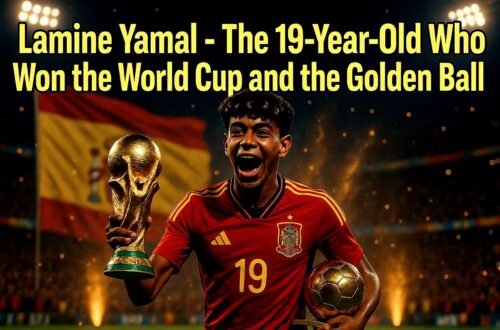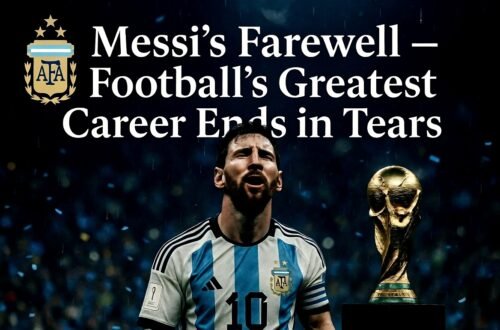








Spain 1-0 Argentina after extra time. Ferran Torres scored in the 106th minute. Enzo Fernandez sent off. Messi cried. Spain are world champions for the second time. Full match report inside.
The Final Score That Nobody Expected – And Yet Felt Completely Right
Spain 1-0 Argentina. After extra time. Ferran Torres. 106th minute.
That is the sentence that will be printed on the front page of every sports newspaper in the world tomorrow morning. That is the result that ends Argentina’s reign as world champions. That is the goal that gives Spain their second World Cup title, sixteen years after their first in South Africa. And that is the moment that brought Lionel Messi — standing on the MetLife Stadium pitch in New Jersey, tears running down his face, looking around a stadium that had just watched what is almost certainly his last competitive match — to his knees.
Nobody expected this specific result. A 1-0 win for Spain after extra time, decided by a substitute who had been on the pitch for less than thirty minutes when he fired the ball into the roof of the net from a Lamine Yamal cross. Ferran Torres — a player who had barely featured in Spain’s tournament before this moment, a player whose name had not been in the pre-match conversation as a likely match-winner — stepped off the bench and changed the history of the sport.
Spain are world champions. For the second time. And the story of how they got there — across 120 minutes of the most tense, technical, and emotionally loaded football the 2026 World Cup produced — deserves telling properly.
Before the Match – The Weight of What Was Coming
The closing ceremony at MetLife Stadium began at 1:30 PM ET and set a tone that was half carnival, half cathedral. Post Malone performed. Tom Cruise arrived by zipline and delivered a speech that the internet immediately began discussing with the kind of energy normally reserved for controversial refereeing decisions. Jennifer Hudson performed the national anthem with a vocal performance that produced a genuine silence between phrases — the kind of silence that 82,000 people create when they are collectively holding their breath.
And then the teams walked out.
Messi emerged from the tunnel wearing the number 10 shirt and the noise that greeted him — from Argentina supporters, from Spanish supporters, from the neutral sections, from people who had not watched a football match since the last World Cup — was the kind of noise that a stadium makes when it understands it is watching history. Not predicting it. Not hoping for it. Understanding it, in real time, with absolute certainty.
The greatest footballer who ever lived. Walking onto a World Cup final pitch. For the last time.
US President Donald Trump was among the star-studded crowd at MetLife Stadium, where the closing ceremony was packed with so much American spectacle that kickoff was delayed by five minutes.
First Half – Emiliano Martínez Against the World
The first half of the FIFA World Cup 2026 final was the most one-sided goalless forty-five minutes in the history of the competition’s final match. Spain had the ball. Spain moved the ball. Spain created chances. Argentina defended. And Emiliano Martínez — the Argentina goalkeeper whose record in high-pressure matches is the best of any keeper in the modern tournament era — produced a performance that kept his country alive through every minute of it.
Lamine Yamal had a chance in the twelfth minute — a cut inside from the right, his trademark movement, a low shot that Martínez got down to quickly and turned around the post. Spain’s corner came to nothing. Rodri drove a shot from twenty-five yards in the nineteenth minute that Martínez pushed wide with two hands. Dani Olmo arrived late at a cross in the thirty-first minute and hit the ball on the half-volley — Martínez at full stretch, right hand, tipped over the crossbar.
Argentina’s attack produced precisely nothing in the first half. Two touches in the Spain penalty area across forty-five minutes — neither of them from Messi, both of them from defensive clearances that fell to Argentine feet accidentally. Spain had sixty-two percent possession. Spain had twelve shots. Argentina had none.
At halftime the scoreline read 0-0 and it felt like a scoreline that contained more tension than any 3-2 result in the tournament’s history. Martínez had been extraordinary. Spain had been dominant. Something had to give in the second half. The only question was when.
The Halftime Show – Twenty-Two Minutes That Changed the Rhythm
The first ever halftime show in World Cup final history arrived between the two halves and ran for twenty-two minutes. Shakira opened with Hips Don’t Lie. BTS performed three songs. Justin Bieber appeared. Madonna closed with Like a Prayer and 82,000 people sang the last chorus back to her.
Both sets of players watched from their dressing rooms. Both managers gave their team talks while Shakira performed above the pitch. It was the most unusual tactical conversation in the history of football — both coaches trying to find the key to a match that had locked itself shut, while a globally celebrated pop star performed fifty metres overhead.
The extended break — twenty-two minutes rather than the usual fifteen — changed the physical rhythm of the second half in ways that were visible from the first minutes after the restart. Both teams looked slightly stiff. Both teams took longer than usual to find the pressing intensity of the first half. The match opened up slightly. And that opening — briefly, dangerously — was where Spain found their best second-half opportunities.
Second Half – Ferran Torres’ Header and Martínez’s Record
Spain continued to apply pressure after the restart, including multiple corner kicks and shots to challenge Martínez. Ferran Torres — who had just come on as a substitute — had a great header after a cross from Yamal in the 66th minute, but Martínez was right there. Again.
By the time the ninetieth minute approached, Emiliano Martínez had broken the championship-game record of eight saves. He had faced twenty shots across ninety minutes and kept every single one of them out. His positioning, his reflexes, his reading of where the ball was going before it arrived — everything that makes him the best goalkeeper in world football in high-pressure situations was on display at MetLife Stadium in front of the largest audience of his career.
Argentina, meanwhile, had managed two shots across the entire match. Two. Spain’s expected goals total from their twenty attempts was 1.94 — meaning that by the mathematics of shot quality, Spain should have scored twice in normal time. They had not scored once.
And then, in the ninety-third minute of normal time, came the moment that changed everything.
Enzo Fernández — Argentina’s best player in the knockout rounds, the man who had scored the semifinal equaliser against England and created the crucial passages of play in every tight match — received his second yellow card for a foul on Pau Cubarsí. The challenge was ugly. The protest that followed it was uglier. Referee Slavko Vincic showed the red card without hesitation.
Argentina were reduced to ten men. Three minutes before the end of normal time. In a World Cup final.
Martínez parried a Nico Williams shot clear in those final three minutes. Argentina survived normal time at 0-0. But they were going to extra time with ten men, against a Spain side that had been the better team for ninety consecutive minutes without scoring. The mathematics of that situation told a very clear story about what was coming.
Extra Time – The 106th Minute That Ended It All
The first fifteen minutes of extra time produced the same pattern as the previous ninety. Spain pressed with ten Argentine outfield players dropping deeper, defending their penalty area with the desperation of a team that understood exactly what the scoreline meant.
Martínez saved again. And again. Spain hit the post once — Laporte from a corner, the ball bouncing away from the goalline with Martínez beaten.
And then — the 106th minute. Second half of extra time. Thirty-seven seconds after the restart from the interval.
Lamine Yamal received the ball on the right wing — his natural territory — and drove at Tagliafico, who had been defending on ten for fifteen minutes and whose legs had covered the ground that Fernández’s absence demanded. Yamal cut inside, looked up, and crossed — low, fast, arriving at the near post.
Ferran Torres — the substitute who had entered the pitch in the sixty-third minute and had been largely peripheral since — read the cross before it arrived. He took one touch to control. He hit the ball with his right foot, driving it hard and low. It hit the underside of the crossbar. It went in.
Spain 1-0 Argentina. 106th minute. Ferran Torres, arms spread, running toward the Spanish supporters in the corner of MetLife Stadium. Lamine Yamal chasing him. The entire Spain bench emptying onto the pitch in the way that benches empty when they know — absolutely, completely, without doubt — that the match is won.
There will be a minimum of five additional minutes at the end of this second half. Argentina are throwing everything at this to try and take this World Cup final to penalties.
They could not. Spain held. The final whistle blew.
Spain 1-0 Argentina. After extra time. World champions. For the second time.
The Final Whistle – What Happened Next
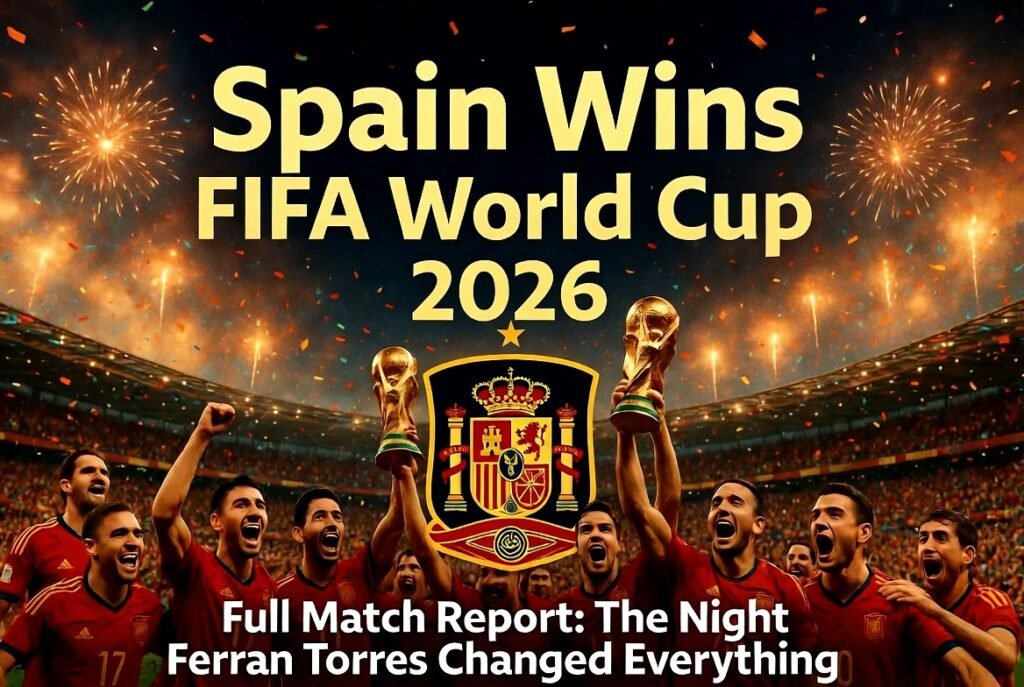
The moment the whistle blew, MetLife Stadium divided into two entirely different worlds.
In the Spanish sections — and in the neutral sections that had been gradually drawn toward Spain by the dominance of their performance — pure joy. Rodri on his knees on the pitch. Yamal with his face in his hands, shaking. Luis de la Fuente running onto the pitch and embracing his players. The Spanish bench a sea of red shirts and tears.
In the Argentine sections — silence, briefly, and then the kind of noise that football crowds make when they are proud of their team despite the result. Not celebration. Something more complicated and more respectful than celebration.
Argentina’s players were less composed. Tempers frared as the final whistle sparked Spanish celebrations. Nahuel Molina pushed Rodri as the midfielder ran onto the pitch to celebrate. Leandro Paredes clashed with Gavi near the tunnel. Lionel Scaloni was there trying to calm the situation — a manager who has won more than any other coach in Argentine football history, trying to hold the moment together for his players.
And Messi. Through all of it — through the altercations, through the celebration, through the noise and the chaos of a World Cup final ending — Messi walked slowly toward the trophy table to receive his runners-up medal.
Lionel Messi is openly crying on the pitch after receiving his medal, looking around the stadium in what very well could be his last time in the Argentina shirt as a player.
He looked around. He looked at the crowd. He looked at the sky. And then he cried — openly, visibly, without any attempt to hide it — in the way that people cry when something they have given everything to has ended and they know it will never come back in this form.
If this is it, thank you Leo.
Player Ratings
Spain:
Unai Simón — 7. Barely troubled but commanding when called upon. Pedro Porro — 8. Dynamic on the right, excellent tracking back. Pau Cubarsí — 9. The best central defensive performance in the final. Seventeen years old. Won the World Cup. Aymeric Laporte — 8. Hit the post in extra time. Dominant aerial presence throughout. Marc Cucurella — 7. Steady left back, limited Messi’s involvement effectively. Rodri — 8. Controlled tempo for ninety minutes. His best tournament performance in the final. Fabián Ruiz — 9. Spain’s best outfield player in the final. Box-to-box energy, key interceptions, one extraordinary long-range effort that Martínez turned over. Dani Olmo — 8. Created three clear chances in the first half. Unlucky not to score. Lamine Yamal — 9. One assist — the cross for Torres’ winner. Constant menace. The best teenager in a World Cup final since Pelé. Mikel Oyarzabal — 7. Hard working without being decisive. Nico Williams — 8. Came on as substitute and immediately created danger, shot saved brilliantly by Martínez in normal time. Ferran Torres — 10. Came off the bench and scored the goal that won the World Cup. The most important substitute in the history of Spain’s tournament football.
Argentina:
Emiliano Martínez — 10. Broke the World Cup final saves record. Made ten saves of the highest quality. Lost. Football is not always fair. Nahuel Molina — 7. Defended Yamal better than expected. Lost composure after full time. Cristian Romero — 8. Defended magnificently with ten men in extra time. Lisandro Martínez — 8. Heroic in the final exchanges. Threw himself in front of everything. Nicolás Tagliafico — 7. Could not prevent the Torres goal but was exhausted by that point. Rodrigo De Paul — 7. Covered enormous ground defensively. Attack was entirely absent. Leandro Paredes — 6. Quiet. Booked. Involved in post-match altercations. Alexis Mac Allister — 7. Worked hard in a thankless defensive task. Enzo Fernández — 4. Red card in the ninety-third minute of a World Cup final. Changed the entire course of the match. Will carry that for a long time. Lautaro Martínez — 6. Isolated. Zero shots. The game never reached him. Lionel Messi — 8. Eight goals in this tournament. The all-time World Cup scoring record. Gave everything he had. It was not enough. And it was still extraordinary.
Match Statistics
Spain: Possession 62% | Shots 20 | Shots on target 12 | Goals 1 | xG 1.94 Argentina: Possession 38% | Shots 2 | Shots on target 0 | Goals 0 | xG 0.2
Spain’s xG of 1.94 against Argentina’s 0.2 is the most one-sided expected goals figure in any World Cup final in the history of the competition. By every statistical measure, Spain were dominant to a degree that the 1-0 scoreline does not fully capture.
Emiliano Martínez: 10 saves — World Cup final record.
The Awards – What Spain’s Players Won
Golden Boot: Lionel Messi — 8 goals Golden Ball: Lamine Yamal — best player of the tournament Golden Glove: Emiliano Martínez — best goalkeeper Best Young Player: Pau Cubarsí — Spain Adidas Best Goal: Lamine Yamal vs Saudi Arabia, group stage
What Spain’s Win Means
Spain started their World Cup campaign with a draw against Cape Verde — tournament debutants ranked outside the top fifty in the world. It felt, in that moment, like a stumble. Like a side that was not quite ready for the occasion despite their quality.
What followed was eight consecutive victories. The best defensive record at the tournament. Zero minutes of being behind at any point across the entire competition. A 2-0 demolition of France in the semifinal. And a 1-0 win against the defending world champions in a World Cup final, decided by a substitute goal in the 106th minute.
La Roja ended Argentina’s incredible run as winners of three major tournaments in a row — an achievement Spain also managed with wins in Euro 2008, the 2010 World Cup and Euro 2012. Spain became only the second nation in history to win consecutive European Championships and then a World Cup. They become the first European Championship winners to win the subsequent World Cup since Spain themselves did it in 2008 and 2010.
Luis de la Fuente, the manager who was criticised when he was appointed for lacking the profile of a big-name coach, has now won a European Championship and a World Cup in consecutive major tournaments. He embraced Didier Deschamps — France’s manager, watching from the stands — after the final whistle. Then he embraced Lamine Yamal. Then he sat on the MetLife Stadium pitch and cried.
Messi’s Last Chapter
This is the part of the match report that no statistics can fully contain.
Lionel Messi played his last World Cup match today. He scored eight goals across seven appearances in this tournament. He won the Golden Boot. He produced the assists, the dribbles, the free kicks that kept Argentina alive through every knockout round. He was the difference in the semifinal against England, creating both goals in the final eleven minutes from the bench.
And in the final, against the best defensive team in the tournament, he produced two shots. Neither on target. The game did not reach him in the way the previous six matches had. Spain’s system — Rodri’s positioning, the defensive compactness — denied him the space that every other team in this World Cup had eventually surrendered.
He received his runners-up medal. He looked around MetLife Stadium. And he cried.
Football does not always give its greatest players the ending they deserve. It gave Messi the 2022 World Cup. It gave him eight goals and the all-time scoring record at 2026. It did not give him a second consecutive title. And the image of him crying on the pitch at MetLife Stadium — looking around the stadium one last time in an Argentina shirt — is the last image of the greatest World Cup career the sport has ever seen.
Thank you, Leo. There will never be another one like you.
Official FIFA Link – Full Match Stats, Awards & Tournament Records
For the official full match statistics, all tournament records, Golden Boot final standings and the complete FIFA World Cup 2026 review:
FIFA World Cup 2026 Official Website: https://www.fifa.com/en/tournaments/mens/worldcup/canadamexicousa2026/articles/match-schedule-fixtures-results-teams-stadiums
FAQ
Who won the FIFA World Cup 2026? Spain won the FIFA World Cup 2026, defeating Argentina 1-0 after extra time at MetLife Stadium in East Rutherford, New Jersey on July 19, 2026. It is Spain’s second World Cup title after their first in 2010.
Who scored the winning goal in the World Cup 2026 final? Ferran Torres scored the only goal of the match in the 106th minute of extra time, converting a cross from Lamine Yamal to fire the ball into the roof of the net past Emiliano Martínez.
What happened to Enzo Fernández in the World Cup final? Enzo Fernández received his second yellow card in the 90th minute of normal time for a foul on Pau Cubarsí, reducing Argentina to ten men for the entirety of extra time. Argentina could not hold Spain out with ten players and conceded the winning goal in the 106th minute.
How many saves did Emiliano Martínez make in the final? Emiliano Martínez made ten saves in the World Cup 2026 final — a new record for saves in a World Cup final match. Despite his extraordinary performance he could not prevent Ferran Torres’ extra-time winner.
Who won the Golden Boot at World Cup 2026? Lionel Messi won the Golden Boot with eight goals across seven appearances — the all-time record for goals in a single World Cup tournament by a player aged 35 or over.
Who won the Golden Ball at World Cup 2026? Lamine Yamal won the Golden Ball as the tournament’s best player — the youngest player to win the award in World Cup history at 19 years old.
Is this Messi’s last World Cup? Almost certainly yes. Messi was visibly emotional after the final, openly crying on the pitch after receiving his runners-up medal. While he has not officially confirmed retirement from international football, the 2026 World Cup is widely expected to be his last.
What is Spain’s unbeaten record now? With this victory Spain extended their unbeaten run to 38 consecutive matches — breaking the all-time record of 37 set by Italy between 2018 and 2021.