







Lionel Messi walked off the MetLife Stadium pitch in tears after Argentina lost the World Cup final. Eight goals. 21 career World Cup goals. Twenty years. This is how the greatest footballer who ever lived said goodbye.
The Moment That Stopped the World
It was not the goal. It was not the trophy lift or the celebration or the confetti falling from the MetLife Stadium roof. Those moments belonged to Spain.
What stopped the world — what made 82,500 people inside that stadium go quiet at exactly the same moment, what made hundreds of millions of people watching on television around the planet feel something simultaneously — was a single image. Lionel Messi. Walking slowly toward the Argentina supporters still in the stands. Runners-up medal around his neck. Tears running down his face. Looking up at the crowd the way a person looks at something they know they are seeing for the last time.
Football does not always give its greatest performers the ending they deserve. It gave Messi 2022 — the World Cup, the trophy, Qatar, the bisht, the perfect ending that turned out not to be the ending at all. And then it brought him back for 2026. And it gave him eight goals, and the all-time scoring record, and a tournament that exceeded every expectation anyone had for a 39-year-old playing his sixth World Cup. And then, in the final, in the 106th minute, it gave him Ferran Torres scoring from a Lamine Yamal cross and Spain celebrating and Argentina losing 1-0 after extra time.
He sat on the pitch after the loss, watching as Spain celebrated, taking it all in. And with that, it is almost certainly the last time Messi will take part in a World Cup as a player on the Argentina national team.
This is the story of how the greatest footballer who ever lived said goodbye. How twenty years ended in tears on a Sunday evening in New Jersey. And why, despite the result, despite the loss, despite the tears — what he gave to this sport will outlast every trophy and every record and every individual award the game has ever produced.
Twenty Years That Changed Football Forever
The first time Lionel Messi played for Argentina at a FIFA World Cup was June 16, 2006. He was eighteen years old. He came off the bench against Serbia and Montenegro in the final group stage match of a game Argentina were already winning comfortably. He scored. He assisted. The world had been told about this teenager from Rosario by way of Barcelona. That evening in Gelsenkirchen, Germany, the world saw for itself.
Twenty years later — almost to the day, since his 2026 World Cup hat-trick against Algeria came on June 16 — he walked off the MetLife Stadium pitch for the last time in an Argentina shirt.
Twenty years. Six World Cups. Eight World Cup tournaments counting both the senior competition and the youth tournaments that first brought him to global attention. More international appearances than any South American man in history. More World Cup goals than any player in the history of the competition, until Kylian Mbappé scored twice in Saturday’s third-place game to pass him at 22.
In those twenty years, the sport did not just watch Messi play. It organised itself around him. The debate about who was the greatest — Messi or Maradona, Messi or Pelé, Messi or Ronaldo — was not just a football conversation. It was a cultural conversation, a generational argument that people had at dinner tables and in school playgrounds and in the comments sections of YouTube videos at two in the morning. Entire careers were built on analysing him. Entire coaching philosophies were constructed around stopping him. Entire nations defined their football identity by their relationship to what he produced.
And through all of it — through the debates, through the awards, through the pressure of being the answer to every question the sport kept asking — he kept playing. He kept producing. He kept finding new ways to be extraordinary on the largest possible stage at an age when every previous version of extraordinary had long since retired.
The 2026 World Cup – The Tournament Nobody Expected
When Argentina qualified for the 2026 FIFA World Cup in October 2025, the conversation around Messi was already one of farewell. He would be 38 turning 39 during the tournament. He had already played his last competitive match in Argentina on home soil — a 3-0 win over Venezuela at the Estadio Monumental on September 4, 2025, where he scored twice and the entire stadium understood they were watching something that was ending.
Nobody expected what came next.
A hat-trick against Algeria in the group stage opener — his first ever World Cup hat-trick, scored in his 26th match at the tournament, at 38 years old, twenty years after his debut. Two goals against Austria that broke Miroslav Klose’s all-time World Cup scoring record of 16, making Messi the all-time leading scorer in the competition’s history. One goal against Jordan from the bench. One goal against Cape Verde in the Round of 32. The equaliser against Egypt in the Round of 16 — scored in the 79th minute when Argentina were 2-0 down with eleven minutes to play, the kind of moment that makes you readjust everything you thought you knew about the limits of what a human being can produce at 39. Two assists against England in the semifinal — both in the final eleven minutes, both decisive, both the kind of pass that arrives at an angle other players do not identify until the ball is already there.
Eight goals and four assists. A Golden Boot — though Mbappé overtook him with two goals in Saturday’s third-place match, finishing with 22 to Messi’s 21. Twenty-one career World Cup goals — the most by any man in the history of the competition until those final two Mbappé strikes. The first player to start three World Cup finals. An international goals total of 125, second only to Cristiano Ronaldo.
When you have Messi on the other side, well, you are nervous, Ferran Torres said after the final whistle. And that was the most honest summary of what Messi means to opponents — even at 39, even in his last tournament, even when Spain were the dominant team and Argentina managed two shots all match, the player who made Ferran Torres nervous when he was not even on the ball was Lionel Messi.
The Final – When the Magic Ran Out
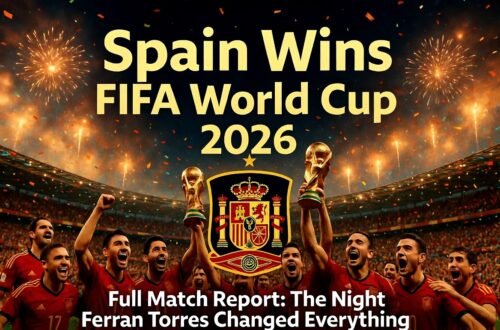
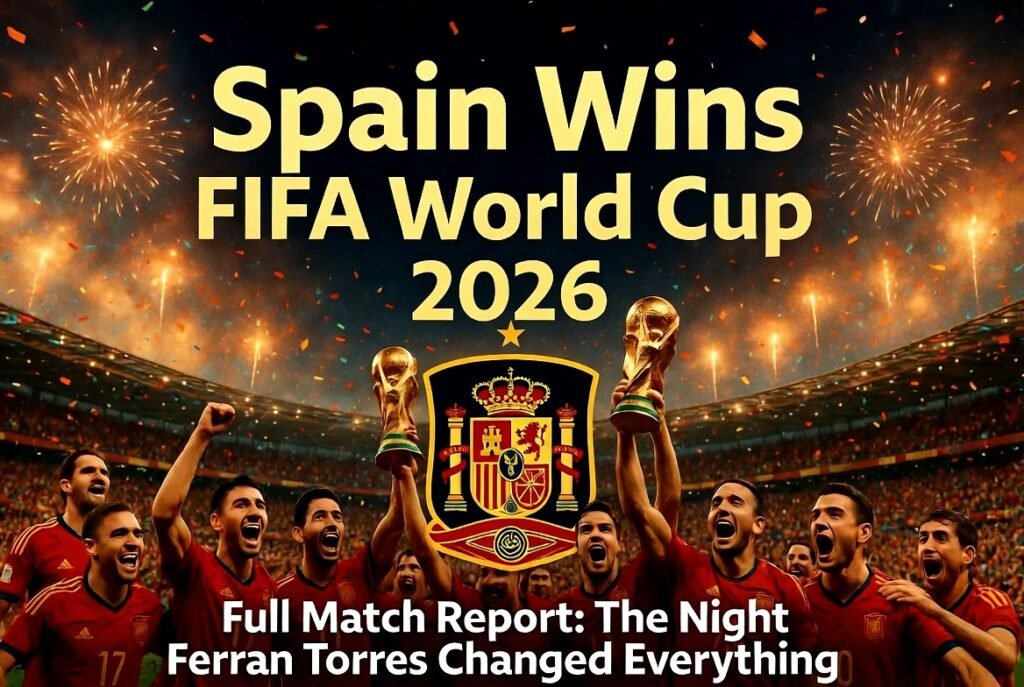
The 2026 World Cup final was the most one-sided match Messi has played in on this stage. Spain had twenty shots. Argentina had two. Spain’s expected goals total was 1.94. Argentina’s was 0.2. The match was decided by Ferran Torres in the 106th minute — a powerful low drive into the roof of the net from a Yamal cross — after Enzo Fernández had been sent off in the ninety-third minute with ten men unable to stop what Spain’s dominance was always building toward.
Messi himself was held scoreless in Sunday’s final after scoring eight goals in the first seven matches of the tournament. Argentina were held scoreless in a World Cup match for the first time since 2018.
It was not the ending the story deserved. But then, the 2014 final was not the ending the story deserved either — Argentina beaten by a Mario Götze extra-time goal, Messi with the runners-up medal and the Golden Ball and the hollow feeling of having been the best player at a tournament his team did not win. This felt similar and different simultaneously. Similar because the pain was real. Different because in 2014 there was still 2022 ahead. This time, there is nothing ahead. This was it.
The loss marked Messi’s second loss in a World Cup final. His first came against Germany at the 2014 FIFA World Cup in Brazil, which, like Sunday’s final, also ended with a substitute scoring the match-winning goal against Argentina. In 2014, it was Germany’s Mario Götze. In 2026 it was Spain’s Ferran Torres. The parallel is uncomfortable and exact.
The Trophy Ceremony – The Image That Will Last Forever
After the final whistle, Argentina’s players had to remain on the pitch for the award presentation. The losing team receives runners-up medals from the same stage where the winners lift the trophy. It is football’s most dignified and most painful ritual — standing there, watching Spain celebrate, receiving a medal that represents falling short.
Messi was the first person on his team to receive the medal on the stage. He walked off. He went toward the Argentina supporters still in the stands — the ones who had stayed, who had not moved, who were still singing despite the result.
That is where the tears came.
Messi let the tears fall after receiving his second-place medal. He sat on the field after the loss, watching as Spain celebrated, taking it all in.
The cameras found him and stayed with him. The image that circulated within minutes across every platform in the world — Messi, in his Argentina shirt, tears on his face, looking at the supporters who had travelled to New Jersey to watch him play — became the defining image of the 2026 FIFA World Cup within the hour. Not Torres celebrating. Not Spain lifting the trophy. Not Yamal with the Golden Ball. Messi in tears.
Because even in defeat, even in the last moment of the last match of the greatest international career the sport has ever produced, the world looked at Messi.
What the World Said
Football said goodbye to Messi the only way it knows how — with an outpouring of emotion from every corner of the sport simultaneously.
Lionel Messi in tears is such a sad sight. Contemplating the defeat? Contemplating the end of his international career? He has brought such joy to the world of football. Too many of his teammates were poor, too set on spoiling, but that cannot mask what Messi has done this World Cup. And previous tournaments. Legend, journalist Henry Winter said.
Lionel Messi crying. You have to think that is it for him with Argentina. An incredible 20-year career with the Argentina national team. The trophies won are there for all to see. Thank you for the memories, the moments, everything, journalist Roy Nemer added.
The best to ever do it. If this was Messi’s final FIFA World Cup, thank you for all the magic, FOX Sports said.
Honestly 2022 is what we asked for and Messi delivered. 2026 is when none of us had any expectations and Messi exceeded those expectations and made us believe. Leo Messi from the bottom of my heart thank you for this, one fan expressed.
I hope that everyone feels proud of him, of what he has achieved because he is the best football player ever to step foot on a pitch, Argentina coach Lionel Scaloni said in his post-match press conference. His voice broke when he said it.
Dear Messi. Thanks for giving us a childhood, a million highlights, and endless debates. Football was simply better because you were in it. Forever the GOAT, another fan wrote.
The Record That Will Outlast Everything
When the final numbers are written — when the 2026 World Cup becomes history and the analysts and the historians begin compiling what Messi produced across six tournaments — the scale of it is almost impossible to absorb in a single sitting.
Twenty-one World Cup goals before Mbappé passed him in the third-place match. The all-time record held for less than 24 hours — and still the greatest individual World Cup goal-scoring career any player has produced across multiple tournaments. Eight goals at a single World Cup at 39 years old. The first man to score in five different World Cup editions. The first man to appear in three World Cup finals. The most Player of the Match awards in World Cup history. Two Golden Balls. One Golden Boot from 2026. The highest assists total in the history of the competition.
And beyond the World Cup — nine Ballon d’Or awards. Twelve La Liga titles. Four Champions Leagues. One World Cup. Two Copa Américas. One Copa del Rey. One FIFA Club World Cup. One Finalissima. The most decorated footballer in the history of the sport by individual honours.
He raised his international goals total to 125, second only to Cristiano Ronaldo’s 146. He became the first player to start three World Cup finals. He became, by any measure that attempts to capture both achievement and impact and longevity, the greatest footballer who has ever lived.
The Question Nobody Wants to Answer – Is He Done?
Messi has not made any official announcement. Though Messi has not made any official announcement, the 39-year-old superstar hinted before the tournament that this would be his last World Cup. His international future is uncertain.
The mathematics suggest the World Cup is over for him. By the time the 2030 tournament — hosted across Spain, Portugal and Morocco, with matches in Argentina, Uruguay and Paraguay to mark the 100th anniversary of the first World Cup — reaches its group stage, Messi will be 42 years old. That is not impossible. It is not the world we live in.
Whether he continues to play for Inter Miami in MLS is a different question. He is contracted to the club through 2025 with an option — the club have made clear they want him as long as he wants to play. At 39, playing at MLS pace rather than World Cup intensity, Messi could conceivably play for two or three more years at club level. That career, whatever form it takes, will be watched and celebrated.
But the Argentina shirt. The blue and white stripes. The number 10. The World Cup. That — in all likelihood — is over. And the tears at MetLife Stadium on Sunday evening were the tears of a man who knew it.
What He Gave Us – The Parts That Cannot Be Measured
There are things about Messi’s career that statistics capture perfectly. The goals. The assists. The trophies. The awards. They are there in the record books, permanent and undeniable.
And then there are the things that statistics cannot capture at all. The feeling of watching him receive the ball with his back to goal and know — before he has moved, before the defender has committed, before anything has happened — that something is about to happen. The way he finds space that does not exist until he creates it. The passes that arrive at angles that other players do not identify until the ball is already there. The free kicks that bend away from the goalkeeper’s reach with the precision of something calculated rather than felt. The moments in finals, in semifinals, in the ninetieth minute of must-win matches, when the ball found him and the stadium held its breath because everyone in it understood that the outcome of the next three seconds was likely to determine everything.
Those things are what football supporters will carry with them from Messi’s career. Not the number of Ballon d’Or awards. Not the World Cup goal tally. The feeling of watching him play — which was, for twenty years at the highest level, unlike watching anyone else play the sport. Unique. Unrepeatable. Already missed, even now, even tonight, even while he is still technically playing club football in Florida.
Football was simply better because you were in it. That fan on the internet, writing in the immediate aftermath of the final, got it exactly right. And the extraordinary thing — the part that no summary of Messi’s career fully captures — is that football knew it was better while it was happening. It did not need the passage of time to understand the value of what it was watching. It understood, in real time, with every Messi touch on every important pitch in every important match across twenty years, that this was the best there had ever been.
One Final Image
After the trophy ceremony ended, after Spain had lifted the trophy and the MetLife Stadium crowd had begun to disperse, Messi remained on the pitch longer than any other player. His teammates had gone to the tunnel. The Spain players were still celebrating. The stadium was half-empty.
He stood at the centre circle. He looked at the pitch. He looked at the remaining crowd. He looked at the sky.
And then he walked toward the tunnel, slowly, for the last time.
The greatest footballer who ever lived. Leaving a World Cup pitch. In tears. Having given everything he had to a game that gave him everything it could — and then, in the end, not quite enough.
Thank you, Leo. There will never be another one like you. And we knew it the whole time. That is the rarest thing of all.
Official FIFA Link – Messi’s Career Stats and 2026 World Cup Records
For the official career statistics, full 2026 World Cup records, and every individual award from this tournament:
FIFA World Cup 2026 Official Website: https://www.fifa.com/en/tournaments/mens/worldcup/canadamexicousa2026/articles/match-schedule-fixtures-results-teams-stadiums
FAQ
Did Messi retire after the 2026 World Cup? Messi has not made an official retirement announcement as of July 19, 2026. However, he hinted before the tournament that this would be his last World Cup, and his emotional reaction after the final loss to Spain has led almost everyone in football to conclude that his international career with Argentina is over.
How many goals did Messi score at the 2026 World Cup? Messi scored eight goals and provided four assists across seven matches at the 2026 FIFA World Cup — his most productive individual World Cup tournament in terms of goals.
How many career World Cup goals does Messi have? Messi finished the 2026 World Cup with 21 career World Cup goals — the joint record alongside Kylian Mbappé, who scored twice in Saturday’s third-place match to draw level.
How many World Cups did Messi play in? Messi played in six FIFA World Cups — 2006, 2010, 2014, 2018, 2022 and 2026 — tying the men’s record alongside Cristiano Ronaldo and Guillermo Ochoa.
Did Messi win the 2026 World Cup? No. Argentina lost the 2026 World Cup final to Spain 1-0 after extra time, with Ferran Torres scoring the winner in the 106th minute. Messi was held scoreless in the final.
Who won the Golden Boot at World Cup 2026? Kylian Mbappé won the Golden Boot at the 2026 FIFA World Cup with 10 goals — passing Messi’s total of eight with two goals in the third-place match against England on Saturday.
Who won the Golden Ball at World Cup 2026? Rodri of Spain won the Golden Ball as the best player of the 2026 FIFA World Cup — the second consecutive major tournament individual award for the Manchester City and Spain midfielder after his 2024 Ballon d’Or.
What records did Messi break at World Cup 2026? At the 2026 World Cup, Messi became the first player to score in five different World Cup editions, the first man to start three World Cup finals, and temporarily broke Miroslav Klose’s all-time career World Cup scoring record before Mbappé passed him in the third-place match.