







The complete history of football — from ancient ball games in China and Greece to the formation of FIFA and the birth of the World Cup. How the beautiful game was born, evolved and conquered the world. Full story inside.
The Game That Conquered the Planet
There are approximately 270 sports played competitively around the world. Thousands more are played informally, regionally, seasonally. Of all of them — every single one — only one has genuinely conquered the entire planet. Only one is played on every continent, in every country, in every culture, by people of every income level and every background. Only one stops entire nations simultaneously and makes strangers in a stadium feel like family.
That sport is football. And understanding how it got here — how a game played with a pig’s bladder on a medieval English street became the most watched, most played, most emotionally significant sport in human history — is one of the most interesting stories you can tell.
This is that story. From the earliest ball games played thousands of years ago to the formation of the Football Association in a London pub in 1863, from the founding of FIFA in 1904 to the first World Cup in Uruguay in 1930, from the black-and-white television broadcast of the 1966 final to Messi lifting the trophy in Qatar in 2022 — this is the complete history of football and how the beautiful game was born.
Part 1 – Ancient Ball Games: The Roots Go Back Further Than You Think
Most people assume football was invented in England in the nineteenth century. The truth is considerably more complicated and considerably more interesting.
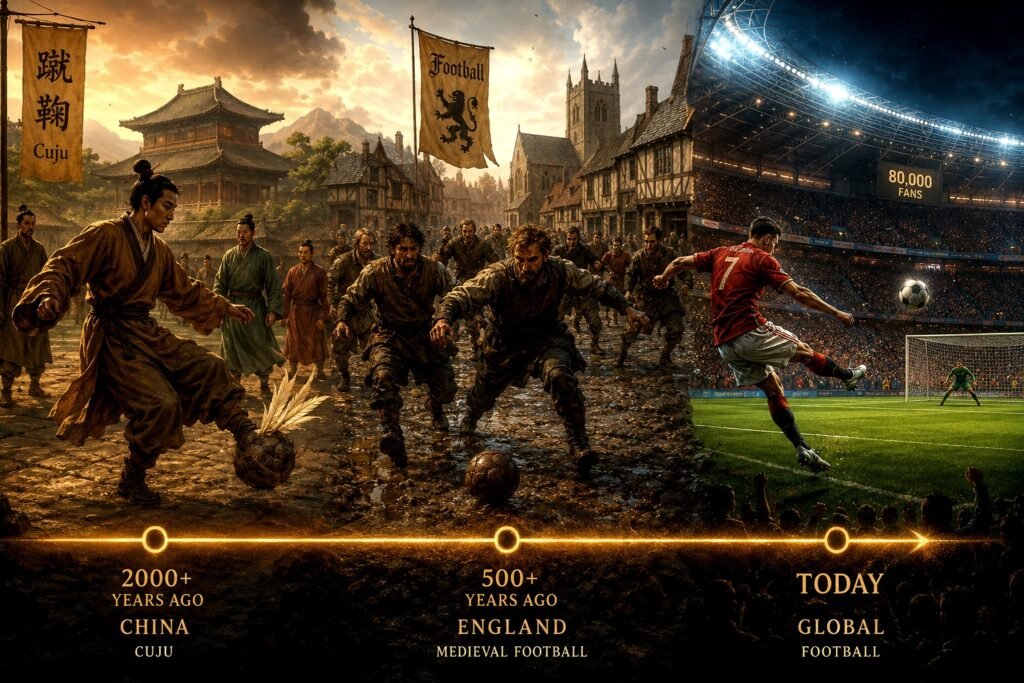
Human beings have been kicking balls around for thousands of years. The earliest recorded evidence of a ball game involving the feet comes from China — specifically from a military training manual dating to approximately 300 BCE. The game was called Cuju, which translates roughly as “kick ball.” Players competed to kick a leather ball — stuffed with feathers and hair rather than inflated — through a small opening in a silk net hung between two poles. Teams competed against each other. Rules governed play. Officials watched and judged. By any reasonable definition, Cuju was a form of football.
The Chinese played Cuju for centuries. It became a recreational activity for soldiers, a competitive sport for the upper classes, and an organised game with recognised rules during the Han Dynasty around 200 BCE. Some accounts suggest women played it as well. The Emperor Taizong of Tang is said to have been a passionate Cuju player. The sport was codified, standardised, and popular in ways that would be familiar to a modern football fan.
Meanwhile, on the other side of the world, other cultures were developing their own versions of kicking games. The ancient Greeks played a game called Episkyros — a team ball game involving hands and feet. The Romans adapted it into something called Harpastum, a rougher and more physical game played on rectangular pitches. Roman soldiers brought Harpastum with them as they expanded across Europe — including, eventually, to the British Isles.
In Mesoamerica, the Maya and Aztec civilisations played ball games that are among the oldest known organised sports in human history. Their games used rubber balls — the first in recorded history — and were played in specially constructed stone courts. The significance of these games went far beyond recreation: they carried ritual and religious meaning that made them central to the culture of their societies.
None of these ancient games are football in the form we recognise today. But they are the deep roots of the impulse that eventually produced football — the human desire to compete with a ball, to organise that competition into rules and teams, and to find meaning and community in the outcome.
Part 2 – Medieval Football: Chaos on the Streets of England
If ancient ball games are the distant roots of football, medieval England is where the trunk of the tree began to grow — even if it was a pretty chaotic and unrecognisable tree for several centuries.
From around the eighth century onwards, ball games involving kicking were being played across England. By the twelfth century, these games had become a regular feature of public life — particularly on Shrove Tuesday, the day before Lent began, when communities across the country would organise large-scale ball games in the streets.
And large-scale is an understatement. These games involved entire towns. Hundreds of players on each side. No fixed pitch — the game could roam across streets, fields, rivers and courtyards. No time limit. Goals were often landmarks at opposite ends of town — a church door here, a mill gate there. The object was simple: get the ball to your goal using any means necessary. Kicking, carrying, wrestling — all of it was part of the game.
These medieval street football games were extraordinarily popular and extraordinarily violent. Records from the period describe broken bones, injuries, property damage, and occasional deaths. The authorities were not fans. King Edward II banned football in London in 1314, describing it as a game involving “hustling over large balls from which many evils arise.” Edward III banned it in 1331. Richard II banned it in 1389. Henry IV banned it twice. None of the bans worked, which tells you something about how deeply the game had embedded itself in English popular culture.
Despite — or perhaps because of — its roughness, football continued to grow. By the sixteenth century, it was being played in schools and universities as well as streets. And in those more educated environments, people began to think seriously about what the rules should be.
Part 3 – The Formation of the Football Association: October 26, 1863
The moment that changed everything happened in a pub in London. Specifically, at the Freemasons’ Tavern on Great Queen Street, on the evening of October 26, 1863.
Representatives of eleven London football clubs gathered that evening with a single purpose: to establish a unified set of rules for the game of football. For decades, different schools and clubs had played by different rules — some allowed handling the ball, some did not; some allowed tripping and hacking, some did not. The confusion made it nearly impossible for teams from different areas to play each other with any consistency.
The meeting at the Freemasons’ Tavern established the Football Association — the FA — and over the following weeks, the delegates argued their way through the rules question. The critical division was between those who wanted to allow handling and hacking — the more physical game that would eventually become rugby — and those who wanted a kicking-only game that required skill over brute force.
The handling faction eventually split off to form their own code — rugby football — while the FA settled on a set of laws that prohibited handling the ball except by the goalkeeper, prohibited tripping and hacking, and defined a rectangular pitch with goals at each end.
On December 8, 1863, the Football Association Laws of the Game were published. Modern football had been born. The date is now regarded as the founding moment of association football — the game we know today.
The FA’s laws did not immediately spread across the world. But they gave the game a structure, a legitimacy, and a clarity that allowed it to be exported — first through the British Empire, then through trade routes, then through the sheer irresistible appeal of a game that anyone could play anywhere with almost nothing.
Part 4 – The Spread of Football Around the World
Once codified and organised, football spread with remarkable speed. British sailors, merchants, soldiers, students, and railway workers carried the game to every corner of the globe in the latter half of the nineteenth century.
The first football clubs outside Britain were established in the 1860s and 1870s. Lausanne Football and Cricket Club in Switzerland — founded in 1860. Club de Gimnasia y Esgrima La Plata in Argentina — founded in 1887. São Paulo Athletic Club in Brazil — 1888. Genoa Cricket and Football Club in Italy — 1893. Real Club de Fútbol Barcelona — 1899. Each of these clubs was founded partly or entirely through British influence — British workers, British students, British expatriates who brought the game with them and taught it to their neighbours.
In South America especially, football took root with an enthusiasm that eventually surpassed even England’s passion for the game. Argentina, Uruguay, and Brazil all developed strong football cultures in the late nineteenth century, and all three nations would go on to become among the most successful footballing countries in World Cup history.
In Europe, the game spread through schools, universities, and industrial towns. Germany, France, Spain, Italy, the Netherlands — all established football associations and organised competitions before the turn of the twentieth century. By 1900, football was already a genuinely international sport, even if the word “international” had a more limited meaning than it does today.
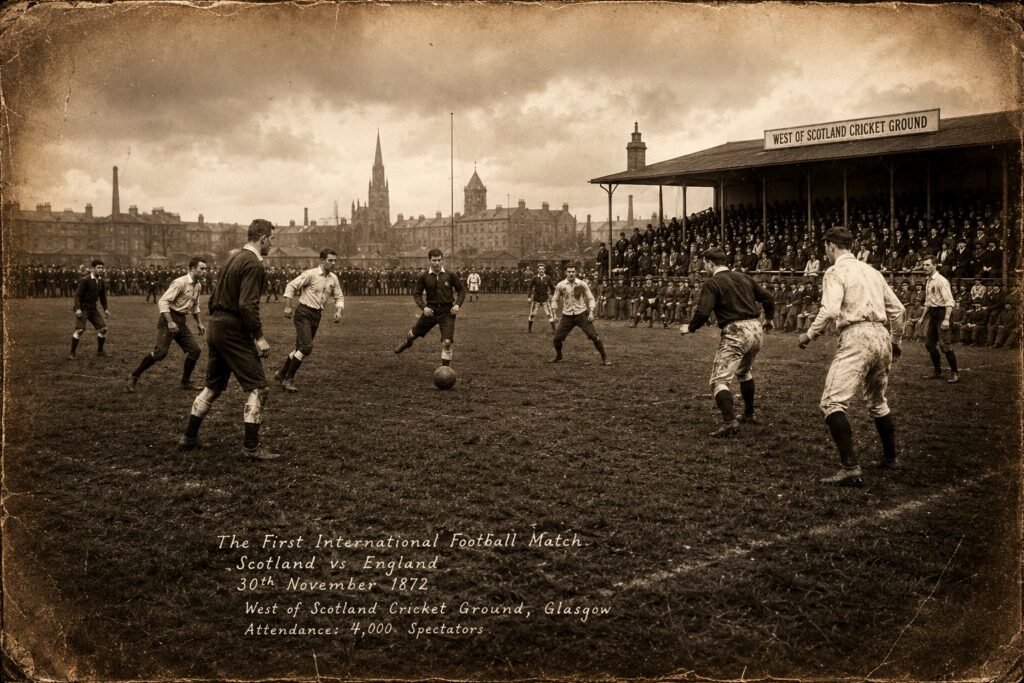
The first international football match was played on November 30, 1872, between Scotland and England at Hamilton Crescent cricket ground in Glasgow. The result was 0-0. Fewer than 4,000 people watched. It was, by modern standards, an utterly unremarkable match. But it was the first time two national teams had met in an officially recognised football contest — the moment that established the concept of international football that the World Cup would eventually build upon.
Part 5 – The Founding of FIFA: 1904
By the early twentieth century, football had spread across Europe and South America to the point where international organisation was clearly necessary. Different national associations used slightly different rules. There was no body to sanction international matches or tournaments. The sport was growing faster than any single national federation could manage.
On May 21, 1904, representatives of seven football associations — France, Belgium, Denmark, the Netherlands, Spain, Sweden, and Switzerland — gathered in Paris and founded the Fédération Internationale de Football Association. FIFA.
England, Scotland, Wales and Ireland — the nations that had invented and codified the game — were not present at the founding meeting. The British associations initially refused to join, dismissing FIFA as an unnecessary European organisation. They eventually joined in 1905, left in 1920, rejoined in 1924, left again in 1928, and finally rejoined permanently in 1946. The complicated relationship between England and FIFA is one of football’s longest-running administrative soap operas.
FIFA’s founding purpose was to oversee international football, establish unified rules, and eventually organise a world championship. That world championship took twenty-six years to actually happen — but when it did, it transformed the sport forever.
Part 6 – The First World Cup: Uruguay, 1930
The idea of a football world championship had been discussed within FIFA almost since its founding. The Olympic Games had included football since 1900, but the Olympics were an amateur competition — professional players were excluded. Football needed its own global tournament.
FIFA president Jules Rimet pushed the idea forward throughout the 1920s, and in 1928 FIFA announced that the first World Cup would be held in 1930. Uruguay was chosen as the host nation — they had won the Olympic football tournament in both 1924 and 1928, their infrastructure was adequate, and they offered to cover all travel and accommodation costs for participating teams.
The 1930 World Cup was not the massive global event the modern tournament has become. Thirteen teams participated — nine from South America and four from Europe, with many European nations declining to make the long sea voyage to Uruguay. The United States also participated, representing North America.
But what the 1930 World Cup lacked in scale, it delivered in drama. Uruguay met Argentina in the final at the Estadio Centenario in Montevideo on July 30, 1930. Uruguay won 4-2. The winning goal, scored by Héctor Castro — who played despite having lost his right hand and forearm in a childhood accident — sent the host nation into celebrations that lasted for days. The following day was declared a national holiday.
Lucien Laurent of France scored the very first goal in World Cup history — a volley against Mexico on July 13, 1930. That goal is remembered with a plaque in Villefrance-sur-Saône, Laurent’s hometown. He lived to be 97 years old and attended the 1998 World Cup final in Paris.
The tournament that Jules Rimet had championed was an immediate success. Despite the modest participation and the primitive conditions, the 1930 World Cup established a template — host nation, group stage, knockout rounds, a final, a champion — that has remained essentially unchanged for 96 years.
Part 7 – Football Through the Twentieth Century
The decades that followed the first World Cup saw football grow into something that no other sport has managed to replicate — a genuinely universal language.
Italy won the second and third World Cups in 1934 and 1938, with Benito Mussolini using both tournaments for political propaganda in ways that cast a shadow over the competitions. The Second World War interrupted the tournament for twelve years — no World Cups were held in 1942 or 1946.
When the competition resumed in Brazil in 1950, football reasserted itself as the world’s sport. The 1950 World Cup produced one of its most famous results — the United States’ 1-0 defeat of England in the group stage, a result so shocking that many British newspapers initially assumed it was a misprint. England had entered their first ever World Cup as heavy favourites. They went home in the group stage.
The 1950 final was not actually a final in the traditional sense — a round-robin final group stage was used instead. Uruguay needed only to draw against Brazil in the last match at the Maracanã in Rio de Janeiro to win the tournament. The stadium held 200,000 people. Brazil needed only to draw against Uruguay to win. Brazil went ahead 1-0. Then Uruguay scored twice. The result — 2-1 to Uruguay — produced what Brazilians call the Maracanazo, a moment of national grief so profound that the yellow shirts Brazil had worn that day were immediately abandoned and replaced with the blue they still wear as their away kit today.
The 1958 World Cup introduced the world to Pelé — a seventeen-year-old from Brazil who scored six goals in the tournament including two in the final against Sweden. Brazil won 5-2. The golden era of Brazilian football had begun.
The 1966 World Cup, hosted in England, was the one moment in history where the game’s birthplace lifted the trophy. Bobby Moore’s England defeated West Germany 4-2 in the final at Wembley, with Geoff Hurst completing a hat-trick — the only hat-trick ever scored in a World Cup final. Whether his second goal actually crossed the line remains the most debated refereeing decision in football history.
The 1970 World Cup in Mexico is widely regarded as the greatest tournament ever played. Brazil’s squad — Pelé, Jairzinho, Rivelino, Tostão, Carlos Alberto — produced football of a quality and beauty that has never quite been matched. Their 4-1 defeat of Italy in the final remains the benchmark against which all subsequent World Cup performances are measured. Carlos Alberto’s goal — the fourth, scored from a position forty yards from goal after a flowing team move — is the most celebrated in the history of the competition.
The game grew. Television brought it into living rooms. The 1970 World Cup was the first broadcast in colour globally. Suddenly, billions of people who had never attended a football match could watch Pelé control a ball with his chest, turn in a single movement, and shoot — and feel the same electricity as the crowd in the stadium.
Part 8 – The Modern Era: From Maradona to Messi
The second half of the twentieth century produced the rivalries, the legends, and the moments that gave football its emotional depth and its permanent hold on global culture.
Diego Maradona’s 1986 World Cup in Mexico was a one-man tournament in a way that no World Cup before or since has quite replicated. His two goals against England in the quarter-final — the infamous Hand of God and the Goal of the Century, scored four minutes apart — captured everything contradictory and extraordinary about the sport. The Hand of God was cheating. The Goal of the Century was genius. Both happened in the same match. Argentina won. The world kept watching.
Germany and Brazil dominated the 1990s — Germany winning in 1990 with a ruthlessly organised side, Brazil returning to glory in 1994 with Ronaldo Nazário emerging as the next great striker, then producing the flowing attacking football of their 2002 triumph where Ronaldo scored eight goals including two in the final to complete one of sport’s great comeback stories after his seizure on the eve of the 1998 final.
France hosted and won in 1998. Spain dominated an era with three consecutive major tournament titles from 2008 to 2012. And then came the Messi era — the argument, the longing, the six World Cups and finally the trophy in Qatar in 2022. And now 2026, where Messi has broken the all-time scoring record and Argentina are defending champions at the age of 38.
Part 9 – How Football Works Today: The Global Structure
The game that began in a London pub in 1863 is now administered by one of the most complex organisational structures in world sport.
FIFA, headquartered in Zurich, Switzerland, currently has 211 member associations — more members than the United Nations. It organises the FIFA World Cup every four years, the Women’s World Cup every four years, age-group tournaments, and the Club World Cup.
Beneath FIFA sit six continental confederations:
UEFA covers Europe — 55 member associations and the home of the Champions League, the most prestigious club competition in world football.
CONMEBOL covers South America — ten member associations including the Copa Libertadores and Copa América.
CONCACAF covers North and Central America and the Caribbean.
CAF covers Africa — 54 member associations and the Africa Cup of Nations.
AFC covers Asia — 47 member associations.
OFC covers Oceania.
Domestically, each member association runs its own league system. The Premier League in England, La Liga in Spain, Bundesliga in Germany, Serie A in Italy, Ligue 1 in France — these are the competitions that produce the clubs and the players who eventually represent their nations at World Cups.
The financial scale of modern football is extraordinary. The Premier League alone generates over £10 billion in revenue annually. The top clubs — Real Madrid, Barcelona, Manchester City, Paris Saint-Germain — are global brands with fan bases and commercial operations that rival the largest corporations in the world.
Part 10 – Why Football Matters
After more than 150 years of organised history and thousands more years of human beings kicking balls around, it is worth asking why. Why does football matter so much? Why does it generate more passion, more collective emotion, more shared experience than any other cultural activity in human history?
The answer is probably simpler than you might expect.
Football is accessible in a way that almost nothing else in human culture is. You do not need expensive equipment. You do not need a perfectly maintained pitch. You do not need a team of officials or a governing body or a television deal. You need a ball — or something that approximates one — and a couple of people willing to play.
And yet from that simplest possible starting point, the game scales all the way up to 90,000 people in a stadium on a Tuesday night in Dallas watching France take on Spain for the right to play in a World Cup final. The same game. The same basic rules. The same ball, the same goals, the same duration. Whether it is played on a beach in Senegal or on the pitch at the Estadio Azteca, the game is recognisably, fundamentally the same.
That continuity — from the street games of medieval England to the 2026 World Cup semifinal — is what makes football’s history so remarkable. The game born in chaos and codified in a London pub 163 years ago has become the shared language of humanity. And it shows absolutely no sign of losing that status anytime soon.
Official FIFA Link
For the current FIFA World Cup 2026 schedule, results, and tournament information — the game’s ongoing history being written today:
FIFA World Cup 2026 Official Website: https://www.fifa.com/en/tournaments/mens/worldcup/canadamexicousa2026/articles/match-schedule-fixtures-results-teams-stadiums
FAQ
When was football invented? The modern game of association football was officially codified on December 8, 1863, when the Football Association published the Laws of the Game in London. However, humans have been playing ball games involving the feet for thousands of years — the earliest recorded evidence comes from ancient China around 300 BCE.
Where was football invented? Association football as we know it today was organised and codified in England. The Football Association was founded in London on October 26, 1863, at the Freemasons’ Tavern on Great Queen Street.
What is the oldest football club in the world? Sheffield FC, founded in 1857 in Sheffield, England, is widely recognised as the world’s oldest association football club. Notts County, founded in 1862, is the oldest current member of the English Football League.
When was FIFA founded? FIFA was founded on May 21, 1904, in Paris, by representatives of seven national football associations — France, Belgium, Denmark, the Netherlands, Spain, Sweden, and Switzerland.
When was the first World Cup played? The first FIFA World Cup was held in Uruguay in 1930. Uruguay won the tournament, beating Argentina 4-2 in the final on July 30, 1930.
Who scored the first goal in World Cup history? Lucien Laurent of France scored the very first FIFA World Cup goal, netting against Mexico on July 13, 1930.
How many countries play football? FIFA currently has 211 member associations — more than the number of countries in the United Nations. Football is played competitively in every country on Earth.