







There is a version of Saudi Arabia’s World Cup story that is easy to tell. It goes like this: they showed up in 1994, made a stunning impression, went quiet for three decades, then produced one of the greatest upsets in tournament history in 2022, and have been trying to build on that ever since.
But that version leaves out too much. It leaves out the goalkeeper who played in four World Cups and became one of Asia’s most celebrated players. It leaves out the striker who scored at three different tournaments twelve years apart. It leaves out the difficult tournaments, the heavy defeats, the long absences, and the quiet determination of a football programme that has been on a slow, persistent upward trajectory for three decades — and that now carries the extraordinary knowledge that they will host the FIFA World Cup themselves in 2034.
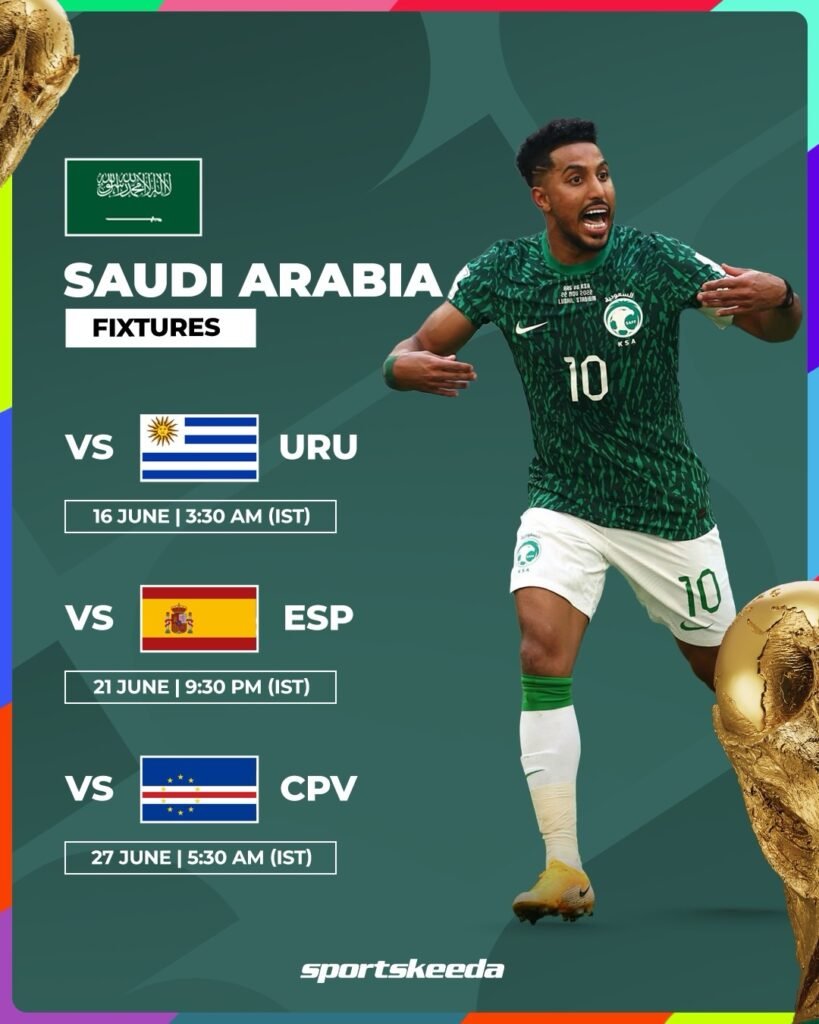
Saudi Arabia are in Group H at the 2026 FIFA World Cup, alongside Spain, Uruguay, and Cape Verde. Their campaign so far — one draw, one heavy loss, one game remaining — captures the Saudi World Cup story perfectly. Moments of genuine quality. Moments that leave you wondering what could be. And one more match that could change everything.
Here is the complete picture of Saudi Arabia’s FIFA World Cup performance — tournament by tournament, milestone by milestone, with everything you need to understand where the Green Falcons stand today.
Saudi Arabia at the FIFA World Cup – The Numbers
Before we go through the story, here are the career numbers heading into the 2026 campaign:
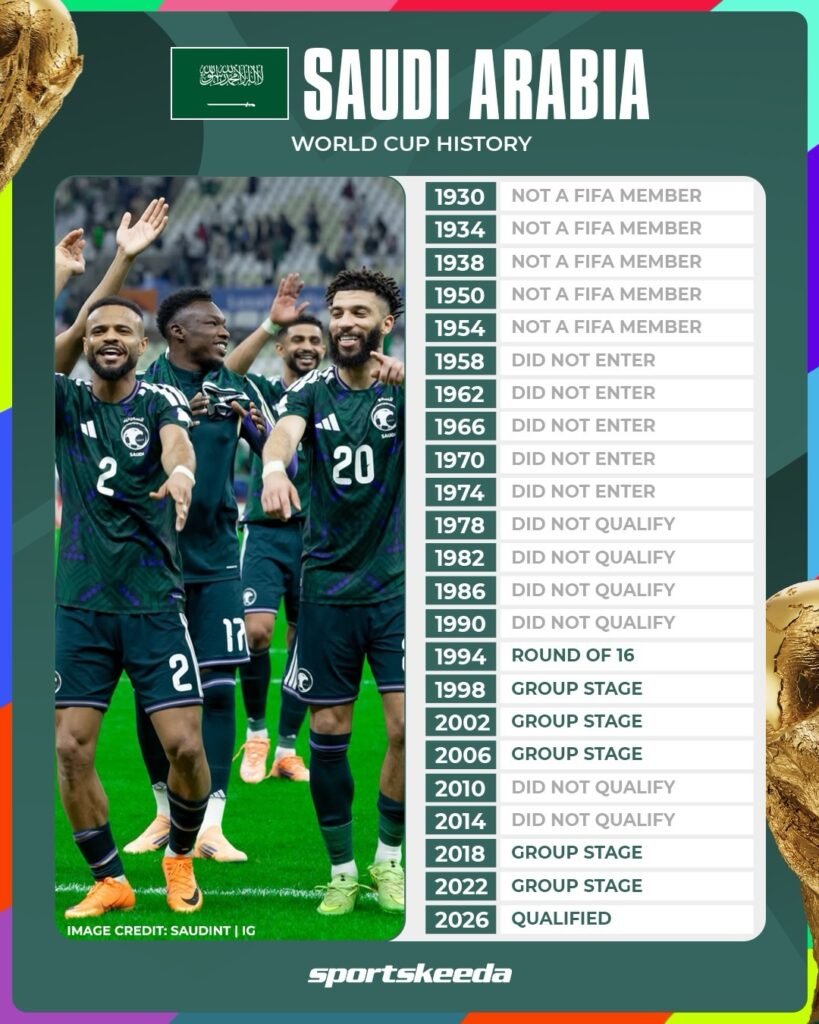
World Cup Appearances: 7 (1994, 1998, 2002, 2006, 2018, 2022, 2026)
Total Matches Played: 21 (including 2026 games so far)
Wins: 5 | Draws: 3 | Losses: 13
Goals Scored: 15 | Goals Conceded: 52
Best Result: Round of 16 (1994)
Worst Defeat: 8-0 vs Germany (2002)
Most Caps at World Cup: Sami Al-Jaber (11 matches, 4 tournaments)
All-time Top World Cup Scorer: Sami Al-Jaber (4 goals)
Most Famous Goal: Saeed Al-Owairan vs Belgium (1994)
Most Famous Result: Saudi Arabia 2-1 Argentina (2022)
1994 – USA: The Greatest Debut in Asian World Cup History

The year is 1994. Saudi Arabia have never played at a World Cup in their lives. They qualify under Argentine manager Jorge Solari, arrive in the United States as complete unknowns, and proceed to produce the best debut any Asian nation had ever managed at that point.
Group F placed them alongside the Netherlands, Belgium, and Morocco. On paper, a difficult draw. In practice, Saudi Arabia played like a team that had been planning this moment for years.
Their first match against the Netherlands ended in a 2-1 defeat — not a disgrace, but a reminder of the quality they were dealing with. Fuad Anwar scored Saudi Arabia’s first-ever World Cup goal that day, and a tradition was established.
Then came Belgium. And the goal that changed everything.
In the 5th minute, Saeed Al-Owairan received the ball inside his own half. What happened next became one of the most replayed sequences in World Cup history. He ran. For roughly 70 yards. He beat one defender, then another, then another. Belgian defenders fell away like he had planned every touch in advance. He drove into the penalty area and finished low past the goalkeeper. Saudi Arabia won 1-0. The goal was later cited alongside Maradona’s 1986 run and Roberto Baggio’s 1990 masterpiece as one of the all-time great World Cup goals.
They beat Morocco 2-1 in their final group game to advance to the Round of 16 — the first Arab nation to reach the knockout stages in their debut World Cup. They faced Sweden there and fought hard, eventually losing 3-1, but not before substitute Fahad Al-Ghesheyan scored a brilliant goal that briefly made the comeback feel possible.
Saudi Arabia went home as the revelation of USA 1994. The best debut by any Asian nation at a World Cup. And a standard they have been trying to live up to ever since.
1998 – France: The Crash After the High
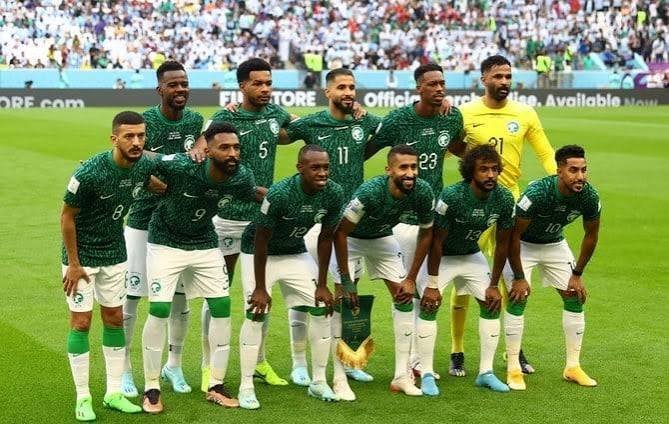
France 1998 was brutal by comparison. A new coach, Brazilian Carlos Alberto Parreira, could not replicate Solari’s setup. Saudi Arabia were placed in a group with Denmark, France, and South Africa — and they lost their first two games badly.
A 1-0 defeat to Denmark. Then a 4-0 loss to France. Parreira was dismissed during the tournament itself — a dramatic and deeply unusual decision — and Saudi coach Mohammed Al-Kharashy took over for the final group game against South Africa, which ended 2-2.
They went home having scored twice, conceded six, and produced nothing close to what 1994 had promised. The gap between their debut and their second tournament told you something about how difficult it is to sustain that level of World Cup performance as an emerging football nation.
2002 – Korea/Japan: The Worst Day in Saudi Football History
If 1998 was bad, 2002 was catastrophic.
Saudi Arabia were placed alongside Germany, Cameroon, and Ireland. Germany were one of the favourites that year. But what happened on June 1, 2002, in Sapporo, was not just a heavy defeat — it was a historical embarrassment.
Germany 8-0 Saudi Arabia.
Eight goals. It remains to this day Saudi Arabia’s worst defeat at any FIFA World Cup. Miroslav Klose scored a hat-trick. Oliver Neuville added two. Saudi Arabia could not cope with the pace and power of the German attack on that day and they were dismantled completely.
They lost to Ireland and drew with Cameroon to go home without a win. It was as low as Saudi Arabia have gone at a World Cup.
2006 – Germany: Signs of Stability, But Still No Progress
Saudi Arabia returned to the World Cup in Germany 2006, placed in Group H alongside Spain, Ukraine, and Tunisia. They drew 2-2 with Tunisia in their opener — a decent result — but defeats to Ukraine (4-0) and Spain (1-0) sent them home in the group stage again.
Sami Al-Jaber, then 35 years old, scored against Tunisia in what became his fourth and final World Cup tournament goal. No other Saudi player has scored at three different World Cups. His legacy as Saudi Arabia’s greatest World Cup player was cemented in Germany.
They qualified for the next World Cup twelve years later. The gap between 2006 and 2018 was the longest absence Saudi Arabia had experienced since their debut.
2018 – Russia: The Return, and One Win
Russia 2018 was about getting back on track after a 12-year absence. Saudi Arabia opened the tournament on the very first day — in the very first game — as Russia played Saudi Arabia in Moscow to officially open the tournament.
It did not go well. Russia won 5-0 in front of their home crowd, their biggest ever World Cup win at that point. Saudi Arabia were exposed by the pace and precision of the Russian counter-attack, and the 5-0 scoreline made headlines for all the wrong reasons.
They lost 1-0 to Uruguay next. Then, in their final game against Egypt with nothing to play for in terms of advancement, Salem Al-Dawsari and Salman Al-Faraj scored in a 2-1 win. It was Saudi Arabia’s first World Cup victory in 24 years. Small comfort, but significant — and Al-Dawsari’s performance that day pointed toward what was coming four years later.
2022 – Qatar: The Upset That Stunned the Planet
You know about this. Everyone knows about this.
November 22, 2022. Lusail Stadium, Qatar. Lionel Messi and Argentina — one of the clear tournament favourites and who would go on to win the whole thing — versus Saudi Arabia, 51st in the FIFA World Rankings at the time.
Messi scored a penalty in the 10th minute. VAR disallowed three Argentine goals for offside. At half-time it was 1-0 and the outcome felt inevitable.
What happened in the second half was one of the great stories in World Cup history.
Within six minutes of the restart, Saleh Al-Shehri equalised. Then, five minutes after that, Salem Al-Dawsari received the ball 25 yards from goal, took a touch, and curled a right-foot shot into the far top corner. Saudi Arabia 2-1 Argentina. The Lusail Stadium — full of Saudi and Arab supporters — erupted.
Saudi Arabia held on. Hervé Renard, the French coach, had set up his team with a high defensive line specifically designed to catch Argentina offside when they played through balls. The plan worked to a degree beyond anything even he could have anticipated.
The final whistle confirmed it. Saudi Arabia had beaten the defending South American champions and eventual 2022 world champions. It was described by many — including FIFA themselves — as one of the biggest upsets in World Cup history.
They could not build on it. Defeats to Poland (2-0) and Mexico (1-0) sent them out in the group stage. But that single result against Argentina placed Saudi Arabia permanently in World Cup folklore.
2026 – USA/Canada/Mexico: Group H and the Current Campaign
Saudi Arabia qualified for the 2026 FIFA World Cup in October 2025 — their seventh appearance overall — and were drawn into Group H alongside Spain, Uruguay, and Cape Verde. Manager Georgios Donis took charge in April 2026, replacing Hervé Renard in the lead-up to the tournament.
Their tactical setup in 2026 has largely followed a 4-3-3, with Salem Al-Dawsari — the hero of 2022 — still carrying the creative burden, and Firas Al-Buraikan leading the attack. Mohammed Al-Owais remains the undisputed first-choice goalkeeper.
Game 1: Saudi Arabia 1-1 Uruguay — June 15, 2026 | Hard Rock Stadium, Miami
The opening match gave Saudi Arabia genuine reason for optimism. In the 41st minute, a Hassan Al-Tambakti header from a corner was parried by the Uruguayan goalkeeper, and Abdulelah Al-Amri reacted first to finish the rebound. Saudi Arabia led 1-0.
They held it. They defended with organisation and compact lines. With ten minutes remaining, Maximiliano Araújo equalised for Uruguay. The final score was 1-1.
For Saudi Arabia, a point against Uruguay — a side featuring experienced South American quality and managed by Marcelo Bielsa — was a legitimate result. The dressing room knew what they had done. The group was alive.
Game 2: Spain 4-0 Saudi Arabia — June 21, 2026 | Mercedes-Benz Stadium, Atlanta
And then came Spain.
The reigning European champions, stung from their 0-0 draw against Cape Verde in their opener and desperately needing to respond, found their best form against Saudi Arabia. Spain controlled 73% of possession. Their pressing game, particularly in the first 30 minutes, gave Saudi Arabia’s midfield no time to breathe.
The final score — 4-0 — did not flatter Spain. Saudi Arabia were outclassed by a team operating at a level they simply could not match. The difference in technical quality was stark. The score left them with 1 point, a goal difference of -3, and a must-not-lose final group game if they want to stay alive for one of the eight third-place qualification spots.
Game 3: Saudi Arabia vs Cape Verde — June 26, 2026 | NRG Stadium, Houston
The final group game is the one that matters. Saudi Arabia need to beat Cape Verde — the Cinderella story of Group H, who have drawn 0-0 with Spain and 2-2 with Uruguay — to have any realistic chance of advancing as one of the eight best third-place teams.
This is not straightforward. Cape Verde are disciplined, organised, and play with a low-block counter-attacking system that has frustrated better sides in this tournament. Saudi Arabia need to break them down and win. History says they are capable of rising to that challenge. The 2022 Argentina result proved that. The Uruguay draw in game one reinforced it.
Whether they can produce that performance again on June 26 in Houston is the next chapter in Saudi Arabia’s World Cup story.
The Key Players – Then and Now
Saeed Al-Owairan (1994) — The man behind the goal that made the world notice Saudi Arabia. A 70-yard solo run against Belgium that belongs on any list of the greatest World Cup goals ever scored. Earned 75 caps with 24 goals.
Mohamed Al-Deayea (1994–2002) — Saudi Arabia’s legendary goalkeeper, with over 178 international appearances. Played in four consecutive World Cups and was named Asian Footballer of the Year in 1996.
Sami Al-Jaber (1994–2006) — Saudi Arabia’s greatest ever World Cup player by caps (11 appearances across four tournaments) and goals (4). He scored in 1994, 1998, and 2006 — the only Saudi to net at three different World Cups.
Salem Al-Dawsari (2018–2026) — The modern heir. His goal against Argentina in 2022 was one of the tournament’s defining moments. Still the creative heartbeat of the current team at 32 years old.
Firas Al-Buraikan (2026) — Saudi Arabia’s 2026 top scorer in qualification with five goals. The 25-year-old striker is the focal point of Donis’s attack and the player most likely to produce something decisive against Cape Verde on June 26.
Mohammed Al-Owais (2022–2026) — The current first-choice goalkeeper, undisputed in that role and one of the most reliable keepers across the AFC qualification campaign.
Saudi Arabia and the Future – 2034 Is Coming
Beyond the immediate 2026 campaign, Saudi Arabia’s football story has a very significant chapter ahead. They are confirmed as hosts of the 2034 FIFA World Cup — only their second time hosting a major international tournament after they hosted the predecessor to the Confederations Cup back in 1992.
Hosting a World Cup changes everything for a football programme. Infrastructure investment, youth development, increased grassroots participation, and the national visibility that comes with staging the biggest sporting event on the planet. Saudi Arabia has seen what happened to Qatar following 2022. They have watched how the sport grew in that country before, during, and after the tournament.
The 2034 World Cup gives Saudi football a target that focuses everything. Every qualifying campaign, every investment in the national team setup, every young player coming through the system — it all points toward a home World Cup in eight years’ time.
Saudi Arabia World Cup Performance – Tournament by Tournament Summary
1994 USA: Round of 16 | 3 matches | 2W 0D 1L | Goals: 4 scored, 3 conceded
1998 France: Group Stage | 3 matches | 0W 1D 2L | Goals: 2 scored, 5 conceded
2002 Korea/Japan: Group Stage | 3 matches | 0W 0D 3L | Goals: 0 scored, 12 conceded
2006 Germany: Group Stage | 3 matches | 0W 1D 2L | Goals: 2 scored, 5 conceded
2018 Russia: Group Stage | 3 matches | 1W 0D 2L | Goals: 2 scored, 7 conceded
2022 Qatar: Group Stage | 3 matches | 1W 0D 2L | Goals: 3 scored, 5 conceded
2026 USA/Canada/Mexico: Ongoing | 2 matches | 0W 1D 1L | Goals: 1 scored, 4 conceded
Career Total (through 2 games of 2026): 21 matches | 4W 3D 14L | 14 goals | 41 conceded
Official FIFA Link
For the full Saudi Arabia squad page, live Group H standings, all match reports, and Saudi Arabia’s complete fixture list at the 2026 FIFA World Cup:
FIFA World Cup 2026 Full Schedule and Results:
https://www.fifa.com/en/tournaments/mens/worldcup/canadamexicousa2026/articles/match-schedule-fixtures-results-teams-stadiums
FAQ
What is Saudi Arabia’s best FIFA World Cup performance?
Their best result was reaching the Round of 16 at the 1994 FIFA World Cup in the United States, where they were eventually beaten 3-1 by Sweden.
How many times has Saudi Arabia played at the FIFA World Cup?
Seven times — 1994, 1998, 2002, 2006, 2018, 2022, and 2026.
Who is Saudi Arabia’s all-time top scorer at the World Cup?
Sami Al-Jaber, with four World Cup goals across four tournaments between 1994 and 2006.
Did Saudi Arabia beat Argentina at the 2022 World Cup?
Yes. On November 22, 2022, Saudi Arabia beat Argentina 2-1 in one of the biggest upsets in World Cup history. Goals from Saleh Al-Shehri and Salem Al-Dawsari overturned a Messi penalty in a result that stunned world football.
What group is Saudi Arabia in at the 2026 FIFA World Cup?
Group H, alongside Spain, Uruguay, and Cape Verde.
Who is Saudi Arabia’s manager at World Cup 2026?
Georgios Donis, who replaced Hervé Renard in April 2026 ahead of the tournament.
Will Saudi Arabia host a FIFA World Cup?
Yes — Saudi Arabia are confirmed as hosts of the 2034 FIFA World Cup.



3 Comments on “Saudi Arabia FIFA World Cup Performance – The Complete Story of the Green Falcons”