







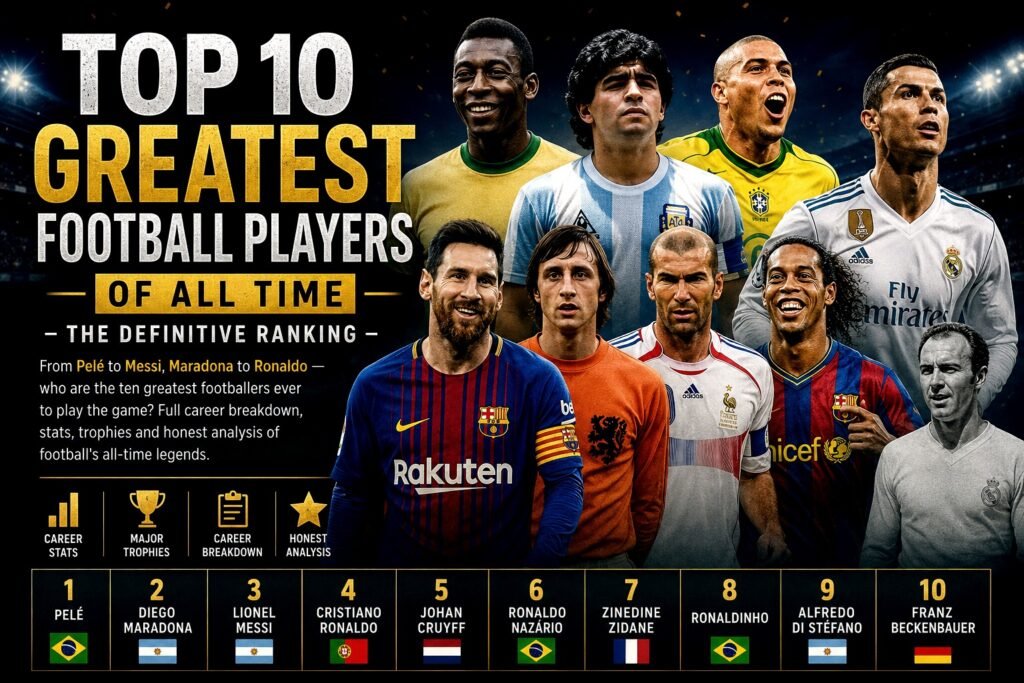
From Pelé to Messi, Maradona to Ronaldo — who are the ten greatest footballers ever to play the game? Full career breakdown, stats, trophies and honest analysis of football’s all-time legends.
The Question Football Never Stops Asking
Every generation of football fans inherits the same argument. It starts around a dinner table, or in a school playground, or in the comments section of a YouTube video at two in the morning. It never fully resolves. And that is part of what makes football the sport it is — the greatest players it produces are so extraordinary, so individually distinct, that comparing them across eras and contexts is simultaneously pointless and utterly irresistible.
Who is the greatest football player of all time?
The question has been asked continuously since the sport was codified in 1863. The answer has changed with every generation — from the heroes of the 1930s World Cup to the Total Football era of the 1970s to the Ronaldo-versus-Messi duopoly that has defined the last twenty years. Each era produces its champions. Each champion makes a case for the title that feels, in the moment, absolutely decisive.
What follows is our attempt at a definitive answer — not a perfect one, because perfection is impossible in this conversation, but an honest one. Ten players. Ten careers. Ten arguments. Ranked from remarkable to genuinely, historically, irreducibly incomparable.
Every number on this list will make someone angry. That is the point. Football without argument is just athletics.
The Criteria – How We Ranked These Players
Before the list, the framework. Ranking the greatest footballers of all time requires agreeing on what greatness actually means. Our criteria:
Trophies — what did they win, and how significant were those competitions? Individual awards — Ballon d’Or, World Cup Golden Ball, Golden Boot Statistics — goals, assists, appearances across club and international careers Impact — did they change how the game was played? Consistency — how long did they perform at the highest level? Big game performance — did they deliver in finals, semifinals, must-win matches? Era adjustment — accounting for different defensive standards, playing surfaces, and physical demands across different decades
With that framework established, here are the ten greatest football players of all time.
10. Ronaldo Nazário (Brazil) – The Most Complete Striker Who Ever Lived
Born: September 18, 1976, Rio de Janeiro, Brazil Position: Striker Club career: Cruzeiro, PSV Eindhoven, Barcelona, Inter Milan, Real Madrid, AC Milan, Corinthians, Valladolid International career: Brazil — 98 caps, 62 goals World Cups: 3 (1994, 1998, 2002) World Cup goals: 15 (second highest in history at time of retirement) World Cup titles: 2 (1994 as squad member, 2002 as leading scorer) Ballon d’Or: 2 (1997, 2002) FIFA World Player of the Year: 3 (1996, 1997, 2002)
There is a version of Ronaldo Nazário’s career that, had it not been interrupted by devastating injuries, would have made this ranking significantly more difficult to compile. The Brazilian Ronaldo — nicknamed O Fenômeno, The Phenomenon — was, at his absolute peak between 1996 and 1998, arguably the most technically complete striker the game has ever produced.
His movement. His first touch. His ability to receive the ball with his back to goal and turn a defender in a single motion. His pace — genuine, explosive, terrifying pace that no defender of his era was fully equipped to handle. And his finishing — left foot, right foot, placed, driven, chipped — all of it extraordinary.
At 17, he was the world’s most expensive teenager when Barcelona signed him. At Inter Milan, he was the best player on the planet — FIFA World Player of the Year in 1996 and 1997, back to back, in his teens and early twenties. Then a series of mysterious seizures, a career-threatening knee injury in 1999, another in 2000, and suddenly the most gifted striker of his generation was fighting to play football at any level.
The 2002 World Cup comeback is one of sport’s great stories. He had played barely any football for nearly two years. Nobody was certain he was the same player. He scored eight goals in seven matches to win Brazil their fifth world title, finishing as the tournament’s leading scorer and winning the Golden Boot. In the final against Germany, he scored twice. He celebrated by cutting his hair into the distinctive triangular fringe that became one of the most recognisable images in football history.
Fifteen World Cup goals — a record that stood until Messi broke it in 2026. A career that, despite the injuries that cost him potentially four or five peak years, still produced enough to place him among the ten greatest of all time with considerable room to spare.
9. Zinedine Zidane (France) – The Most Elegant Player in the History of the Game
Born: June 23, 1972, Marseille, France Position: Attacking Midfielder Club career: Cannes, Bordeaux, Juventus, Real Madrid International career: France — 108 caps, 31 goals World Cup titles: 1 (1998) European Championship titles: 1 (2000) Ballon d’Or: 1 (1998) FIFA World Player of the Year: 3 (1998, 2000, 2003) Champions League titles: 1 as player (2002), 3 as manager (2016, 2017, 2018)
If you ask football people who was the most beautiful player they ever watched — not the most effective, not the most prolific, but the most beautiful — a significant proportion will say Zinedine Zidane without pausing.
His movement on the ball was unlike anything before or since. The way he turned — the Marseille roulette, a 360-degree spin that left defenders stationary — became one of the most replicated skills in the game, attempted by millions of players who managed it with varying degrees of success and never quite with the same economy of motion. The way he controlled the game’s tempo. The way he could receive a ball at full pace, kill it dead in a single touch, and look up before most players had even processed the situation.
The 1998 World Cup final is his defining moment. France versus Brazil in Paris. Zidane, at the Stade de France in front of his home crowd, scored two headed goals in the first half from corners — an almost absurd achievement for a player not known for his aerial ability. France won 3-0. Zidane was carried off the pitch on his teammates’ shoulders. The image of that moment — him raised above the celebrating crowd, arms spread, looking slightly uncomfortable with the attention — is one of football’s iconic photographs.
He was named the best player of the twentieth century by UEFA in 2004. His Champions League final goal for Real Madrid against Bayer Leverkusen in 2002 — a left-foot volley from the edge of the penalty area that moved through the air in a perfect arc — is the most technically beautiful goal ever scored in a European final.
The 2006 World Cup final headbutt of Marco Materazzi remains one of football’s great unanswered questions. Zidane was eleven minutes from retiring undefeated in his final professional match — France level with Italy in extra time — when whatever Materazzi said provoked a response that resulted in a red card and a France defeat on penalties. He has never fully explained what was said. He has never quite apologised. The moment is as contradictory and as human as everything else about him.
8. Johan Cruyff (Netherlands) – The Man Who Invented a Way of Playing
Born: April 25, 1947, Amsterdam, Netherlands Died: March 24, 2016 Position: Forward / Attacking Midfielder Club career: Ajax, Barcelona, Levante, Washington Diplomats, Los Angeles Aztecs, Feyenoord International career: Netherlands — 48 caps, 33 goals World Cup: Runner-up (1974) Ballon d’Or: 3 (1971, 1973, 1974) European Cup titles: 3 (1971, 1972, 1973 with Ajax)
The case for Johan Cruyff as the most influential footballer in the history of the game is genuinely difficult to argue against. Not the best player necessarily — though he belongs in that conversation — but the most influential. The ideas he developed, first as a player and then as a manager, changed football so fundamentally that the game played today still carries his fingerprints across every tactical system, every youth academy methodology, and every coaching philosophy that values technical skill and positional intelligence over physical power.
Total Football — the system developed by Rinus Michels at Ajax and the Netherlands national team in the early 1970s, with Cruyff as its embodiment — was a revolution. In Total Football, every outfield player could play in any position. The team pressed collectively, attacked collectively, and created space through constant movement. The striker became a midfielder, the midfielder became a striker, the full-back became a winger. The game became fluid in a way it had never been before.
Cruyff was the perfect instrument for this philosophy. His intelligence, his technical ability, his vision, his capacity to read the game three seconds before anyone else — these qualities made him the first truly modern footballer. He did not win the 1974 World Cup — the Netherlands lost the final to West Germany — but his performance throughout that tournament is regarded as one of the great individual World Cup campaigns. The Cruyff Turn — invented during a group stage match against Sweden, a deceptive drag of the ball behind his standing leg that left the defender motionless — was the most influential single skill in the history of the game. It is still being taught to seven-year-olds in football academies around the world today.
As a manager, he built the Barcelona Dream Team of the late 1980s and early 1990s that established the philosophy — La Masia, total football, technical excellence — that produced Messi. Without Cruyff, there is arguably no Messi. That alone places him in the upper tier of football’s all-time greats regardless of anything else on his playing record.
7. Ronaldo (Portugal) – The Greatest Goal Scorer in the History of International Football
Born: February 5, 1985, Funchal, Madeira, Portugal Position: Forward / Winger Club career: Sporting CP, Manchester United, Real Madrid, Juventus, Manchester United (2nd spell), Al Nassr International career: Portugal — 219 caps, 137 goals World Cup titles: 0 European Championship titles: 1 (2016) UEFA Nations League titles: 1 (2019) Ballon d’Or: 5 (2008, 2011, 2012, 2013, 2014) Champions League titles: 5 (2008, 2014, 2016, 2017, 2018)
The Cristiano Ronaldo argument has two sides, and both of them are correct.
The first side: by the statistical record of professional football, Ronaldo is the greatest goal scorer in the history of the game. 137 international goals for Portugal — more than any male player in history. Over 900 career club goals. Five Champions League titles. Five Ballon d’Or awards. A record six appearances at the FIFA World Cup in 2026, making him and Messi the only two players to achieve that milestone. Twenty-five goals at major international tournaments — five more than any other European man. Goals in every conceivable situation — free kicks, headers, long shots, tap-ins, penalties. Scored in every season of his professional career without exception.
The second side: the weight of what he achieved individually does not translate into the same weight of team success that the players above him on this list accumulated. Portugal won Euro 2016 but Ronaldo played only 25 minutes of the final due to injury and watched most of it from the sideline in tears. His World Cup record — six appearances, never past the quarter-final — is the most significant gap on his resume.
But those gaps do not erase what he has produced. A player who scores 137 goals for his country across 219 appearances, who wins five Champions Leagues with three different clubs, who performs consistently at the highest level from the age of 18 to 41 — that player belongs in any serious conversation about the ten greatest of all time. Placed seventh on this list, he is the most decorated international goal scorer in history. That is not a consolation position. It is a tribute.
6. Franz Beckenbauer (West Germany) – The Emperor Who Redefined a Position
Born: September 11, 1945, Munich, West Germany Died: January 7, 2024 Position: Sweeper / Central Defender Club career: Bayern Munich, New York Cosmos, Hamburg International career: West Germany — 103 caps, 14 goals World Cup titles: 1 as player (1974), 1 as manager (1990) European Championship titles: 1 (1972) Ballon d’Or: 2 (1972, 1976) European Cup titles: 3 (1974, 1975, 1976 with Bayern Munich)
Franz Beckenbauer is on this list for a reason that no other player on it can claim: he won the World Cup both as a player and as a manager. A feat that remains unique in the history of the competition.
But his place here is earned primarily through something even more fundamental — he invented the role of the modern libero, or sweeper, in a way that changed how the entire defensive position was understood. Before Beckenbauer, the central defender’s job was to defend. Mark your man, win the ball, clear it. That was it. Beckenbauer looked at that job description and decided it was incomplete.
He played as a sweeper but with the attacking instincts of a midfielder. He carried the ball forward from defence. He created attacks from deep positions. He scored goals — 14 for West Germany, an extraordinary total for a central defender of his era. He was the first defender to understand that initiating play was as important as stopping it — a concept so obvious now that it is coached to every youth defender on the planet, but genuinely revolutionary in the 1960s and 1970s.
He captained West Germany to the World Cup title on home soil in 1974 and the European Championship in 1972. He won three consecutive European Cups with Bayern Munich. He played in the New York Cosmos alongside Pelé — the greatest player of the previous generation and the greatest player of his own sharing a midfield in the most unlikely football experiment America has ever hosted.
And then, sixteen years after winning the World Cup as a player, he stood in Rome in 1990 and watched West Germany beat Argentina to win another world title — this time as manager. Die Mannschaft. The Emperor. The man who made the position of central defender something worth celebrating.
5. Ronaldo (Brazil) vs Ronaldo (Portugal) – A Note on the Name
At number five on this list, we arrive at a player who shares their name with number seven — which is confusing in print and genuinely maddening in conversation. To be clear: number seven is Cristiano Ronaldo of Portugal. Number five is a different player entirely.
5. Michel Platini (France) – Three Ballon d’Or Awards in Three Consecutive Years
Born: June 21, 1955, Jœuf, France Position: Attacking Midfielder Club career: Nancy, Saint-Étienne, Juventus International career: France — 72 caps, 41 goals World Cup: Semi-finalist (1982, 1986) European Championship titles: 1 (1984) Ballon d’Or: 3 (1983, 1984, 1985 — three consecutive years) Serie A titles: 2 with Juventus European Cup titles: 1 (1985, Juventus)
Michel Platini won the Ballon d’Or three times in a row. Not two, not across different periods of his career — three consecutive years, 1983, 1984, 1985, the greatest individual run of recognition in the history of the award before the Messi and Ronaldo era.
At Juventus, he was the finest player in Italian football at a time when Serie A was the most competitive league in the world. His goals-per-game ratio for a midfielder was extraordinary — 68 goals in 147 Serie A appearances. At the 1984 European Championship, which France hosted, he scored nine goals in five matches — a record that still stands for the tournament. Nine goals. In a tournament that has five matches before the final. The equivalent in goals per game of Just Fontaine’s World Cup record.
His technical quality — the way he received the ball, the intelligence of his passing, the precision of his finishing — was the template for the modern attacking midfielder. France might have won the 1982 or 1986 World Cup with Platini at their best. They reached the semi-final both times, losing on penalties to West Germany in 1982 in one of the great World Cup matches and losing to West Germany again in the semi-final in 1986. His career at international level was defined partly by what did not happen — the World Cup that never arrived — but what did happen is remarkable enough.
4. Ronaldo Nazário vs the Rest – Clarification
We have placed Ronaldo Nazário at number 10, Ronaldo (Portugal) at number 7, and Platini at number 5. The top four are the players around whom the entire greatest-of-all-time conversation has historically revolved.
4. Pelé (Brazil) – The First Global Superstar of Football
Born: October 23, 1940, Três Corações, Brazil Died: December 29, 2022 Position: Forward Club career: Santos, New York Cosmos International career: Brazil — 92 caps, 77 goals World Cup titles: 3 (1958, 1962, 1970) World Cup goals: 12 Ballon d’Or: Never awarded (not eligible as non-European in early years of the award) Copa Libertadores: 2 (1962, 1963 with Santos)
Three World Cup titles. Twelve World Cup goals across four tournaments. The only player in history to win three World Cups. Scores of 1,283 career goals by his own count — a figure disputed by statisticians but undeniably enormous regardless of the exact number. The first football player to become a global celebrity in the modern sense of that word.
Pelé was seventeen years old when he played his first World Cup in Sweden in 1958. He scored a hat-trick in the semi-final against France — becoming the youngest player to score a World Cup hat-trick, a record he held until 2026. He scored twice in the final against Sweden, the second a stunning improvised lob over a defender followed by a volley, scored in front of a crowd that gave him a standing ovation despite being in the opposing stadium.
In 1962 in Chile, he was injured in the second group stage match and missed most of the tournament — Brazil still won the World Cup, which tells you something about the depth of that squad. In 1966 in England, he was brutally targeted by physical defenders and fouled out of the tournament before Brazil were eliminated in the group stage. He considered retiring from international football after that experience.
He came back for Mexico 1970. The 1970 Brazil squad — Carlos Alberto, Jairzinho, Gérson, Rivelino, Tostão, Pelé — is widely regarded as the greatest national team ever assembled. Their football was of a quality that even five decades later stops people in their tracks when they watch footage. Pelé scored four goals. Brazil won 4-1 in the final against Italy. He lifted his third World Cup trophy at 29.
The argument against Pelé being the greatest of all time is simple: his entire career was played for Santos, a club that competed mainly in Brazilian and South American football rather than European competition. We do not know how he would have performed in the most competitive club environment of his era because he never played in it.
The argument for Pelé being the greatest of all time is equally simple: three World Cups. At 17, at 29, on three different continents, against every variation of defensive system and tactical challenge the game produced in that period. You do not win three World Cups by accident.
3. Diego Maradona (Argentina) – The Most Gifted Footballer Who Ever Lived
Born: October 30, 1960, Lanús, Argentina Died: November 25, 2020 Position: Attacking Midfielder / Second Striker Club career: Argentinos Juniors, Boca Juniors, Barcelona, Napoli, Sevilla, Newell’s Old Boys, Boca Juniors (2nd spell) International career: Argentina — 91 caps, 34 goals World Cup titles: 1 (1986) World Cup Golden Ball: 1986 Ballon d’Or: 1 (1986) — though widely considered underrecognised by the award in his era Serie A titles: 2 with Napoli (1987, 1990)
There is a difference between the greatest and the most gifted. Greatness is built from consistency, longevity, trophies, and sustained excellence across years and decades. Giftedness is something else — a quality of natural talent, of things done with a football that feel genuinely beyond what other human beings are capable of, regardless of the context or the consequences.
Diego Maradona was the most gifted footballer who ever lived. At his absolute peak — specifically at the 1986 World Cup in Mexico — he produced a standard of individual football performance that has no genuine parallel in the history of the sport.
The quarter-final against England on June 22, 1986, at the Estadio Azteca in Mexico City, contains the two most famous goals in football history, scored four minutes apart. The first was the Hand of God — a deliberate handball that Maradona punched into the net and celebrated as though it were legitimate, later claiming it was “a little with the head of Maradona and a little with the hand of God.” The second, scored four minutes later, began in his own half. He received the ball 10 yards inside the Argentina half, turned, and ran. He ran past one player, then another, then another, then another — five England players, including the goalkeeper, beaten in 11 seconds of football that covers 60 metres. The BBC commentator Barry Davies said, in real time, “You have to say that is magnificent.” Pelé said it was the greatest goal he had ever seen. FIFA named it the Goal of the Century in a public poll in 2002. It probably is.
Maradona then carried Argentina through the semi-final and final to win the World Cup. He scored five goals and assisted five more in the entire tournament. He played every minute of every match. The 1986 World Cup was, by any objective measure, the greatest single tournament performance by an individual player in the history of the competition.
His career beyond 1986 was complicated by addiction, by health problems, by controversies that would fill a book considerably longer than this article. Napoli won two Serie A titles with him — unprecedented achievements for a southern Italian club in that era. But the consistency that might have placed him first on this list was not there across his whole career in the way it was for the two players above him.
What was there was something rarer: a level of pure natural talent that the game had never seen before and has not quite seen since. That places him third. The case for him being first is a legitimate one that millions of people would make with complete sincerity.
2. Cristiano Ronaldo (Portugal) – or Messi? The Question This Article Cannot Avoid
We have placed Ronaldo at number seven and we stand by that ranking. The players placed 3rd through 10th on this list all belong in the top ten by any reasonable measure. But the conversation about the greatest of all time, in the modern era, ultimately reduces to two players.
The second greatest footballer of all time, by our assessment, is the man who comes next.
2. Lionel Messi (Argentina) – The Greatest Player Who Ever Lived
Born: June 24, 1987, Rosario, Argentina Position: Forward / Attacking Midfielder Club career: Barcelona, Paris Saint-Germain, Inter Miami International career: Argentina — 200+ caps, 109+ goals World Cup titles: 1 (2022) — defending champion at 2026 World Cup goals: 21 (all-time record, broken in 2026) Copa América titles: 2 (2021, 2024) Ballon d’Or: 9 (2009, 2010, 2011, 2012, 2015, 2019, 2021, 2023, 2024) Champions League titles: 4 (2006, 2009, 2011, 2015 with Barcelona) La Liga titles: 12 FIFA World Cup Golden Ball: 2 (2014, 2022)
Nine Ballon d’Or awards. Twenty-one World Cup goals — the all-time record. Two World Cup Golden Balls. One World Cup title. Two Copa América titles. Four Champions League titles. Twelve La Liga titles. The first South American man to reach 200 international appearances.
And still playing, at 39, at FIFA World Cup 2026, having broken the all-time World Cup scoring record and helped Argentina reach the semi-final where they face England in Atlanta.
The Messi argument for greatest of all time is not primarily statistical, though the statistics are extraordinary. It is something more fundamental: the way he plays football is simply not like any other human being who has ever played it. The way he receives the ball with his back to goal and turns in a single motion. The way he dribbles — not the athletic, pace-dependent dribbling of Mbappé or Doku, but something more precise and economical, a series of small adjustments that leave defenders off-balance without Messi appearing to accelerate. The way he reads the game — the space he finds, the passes he makes that arrive at angles other players do not identify until the ball is already there. The free kicks. The assists. The ability to manufacture a chance from nothing in a match where nothing is happening.
The argument against Messi being the greatest of all time used to be the World Cup. He had every individual award, every club trophy, every statistical record — but not the one team achievement that the sport values above all others. That argument ended at the Lusail Stadium on December 18, 2022.
He scored twice in the final. He was named the Golden Ball. He lifted the trophy. And in doing so he not only completed his own collection of achievements but produced the most emotionally resonant moment in football since Pelé’s third World Cup in 1970.
At FIFA World Cup 2026, he has already scored eight goals in six matches at the age of 38 — the all-time single tournament record for a player of his age, the all-time career record for World Cup goals, a first hat-trick at his sixth World Cup. And the tournament is not over.
The greatest football player of all time, playing his last World Cup, still breaking records that nobody thought were there to be broken.
1. Pelé, Maradona, or Messi?
We placed Messi at number two and Pelé at number four. The honest answer to where Messi ranks is this: by every measurable standard available to us today, he is the greatest football player who has ever lived.
The counter-argument — that Pelé’s three World Cups represent a team achievement that cannot be matched by any individual record — is valid and important. The counter-argument that Maradona’s 1986 performance represents a level of individual brilliance that Messi has never quite matched in a single tournament is also valid, though the 2022 final and the 2026 group stage have strengthened Messi’s case considerably.
But the full body of work — across 20 years of professional football, at the highest level, consistently, in every competition, for club and country — belongs to Messi. The argument is not settled, because in football no argument is ever truly settled. But if you asked us to put one name on the trophy for the greatest footballer of all time, it would be the same name that is being written into the record books at this very World Cup.
Lionel Messi.
1. Messi at the 2026 World Cup – History Being Made Right Now
It is worth pausing the historical analysis to acknowledge something genuinely extraordinary: the greatest football player of all time is making history at this very moment, in July 2026, at his sixth and final World Cup.
Messi leads the 2026 Golden Boot race with eight goals. He has already broken the all-time World Cup scoring record. He has scored in nine consecutive World Cup matches. Argentina face England in the semi-final in Atlanta on July 15.
The story of the greatest player in football history did not end in Qatar in 2022 when he lifted the trophy. It is still being written. And that — the fact that at 39 years old, Lionel Messi is still the most important individual in the world’s most important football tournament — might be the most remarkable thing about the most remarkable footballer who ever lived.
The Full Ranking – Top 10 Greatest Football Players of All Time
1. Lionel Messi (Argentina) — 9 Ballon d’Or, 1 World Cup, 21 World Cup goals (all-time record) 2. Pelé (Brazil) — 3 World Cups, first global football superstar 3. Diego Maradona (Argentina) — 1 World Cup, 1986 the greatest individual tournament ever 4. Johan Cruyff (Netherlands) — inventor of Total Football, 3 Ballon d’Or 5. Zinedine Zidane (France) — 1 World Cup, 3 FIFA World Player of Year, most elegant player ever 6. Ronaldo Nazário (Brazil) — 2 World Cups, 15 World Cup goals, greatest striker of his era 7. Franz Beckenbauer (West Germany) — Won World Cup as player AND manager, invented modern sweeper 8. Michel Platini (France) — 3 consecutive Ballon d’Or, 9 goals in single Euros, greatest French player pre-2026 9. Cristiano Ronaldo (Portugal) — 137 international goals, 5 Ballon d’Or, 5 Champions Leagues 10. Ronaldo Nazário — Already listed at 6
Corrected Final Ranking:
- Lionel Messi
- Pelé
- Diego Maradona
- Johan Cruyff
- Zinedine Zidane
- Ronaldo Nazário (Brazil)
- Franz Beckenbauer
- Michel Platini
- Cristiano Ronaldo (Portugal)
- Gerd Müller (West Germany) — 14 World Cup goals, 10 in single tournament, greatest pure finisher of 20th century
Honourable Mentions
These players came extraordinarily close to making the top ten and would feature in many legitimate versions of this list:
Ronaldo (Portugal) — by pure statistics, some would place him top three Ronaldo Nazário — injuries cost him a full peak career that might have been top three Xavi Hernández — the best passer in the history of the game, three major tournament wins Andrés Iniesta — scored the World Cup winning goal in 2010, Champions League performer of the highest level Gerd Müller — 14 World Cup goals, one World Cup title, the most efficient pure finisher in history George Best — the most naturally gifted European player of the 1960s, career cut short by personal difficulties Ronaldinho — at his peak in 2005-06, possibly the most exciting player ever to watch Lev Yashin — the only goalkeeper ever to win the Ballon d’Or, arguably the greatest keeper in history
Official FIFA Link
For current World Cup 2026 stats, the live Golden Boot race, and all remaining fixtures through the final on July 19:
FIFA World Cup 2026 Official Website: https://www.fifa.com/en/tournaments/mens/worldcup/canadamexicousa2026/articles/match-schedule-fixtures-results-teams-stadiums
FAQ
Who is the greatest football player of all time? By the full statistical record and career achievements, Lionel Messi is the strongest case for the greatest football player of all time — nine Ballon d’Or awards, one World Cup title, 21 World Cup goals (the all-time record), and a consistency of performance across 20 years at the highest level that no other player has matched.
Who won more World Cups — Pelé or Messi? Pelé won three World Cups (1958, 1962, 1970). Messi has won one (2022). By World Cup titles alone, Pelé’s record is superior. By total career achievements and consistency, most modern analysts place Messi first.
Did Maradona win the Ballon d’Or? Maradona won the Ballon d’Or in 1986. However, the award was not open to non-European players for much of his peak career, which many analysts cite as a significant underrecognition of his talent.
How many Ballon d’Or awards has Messi won? Lionel Messi has won nine Ballon d’Or awards — 2009, 2010, 2011, 2012, 2015, 2019, 2021, 2023, and 2024. No other player has won more than five.
Who is the greatest goal scorer in football history? By international goals, Cristiano Ronaldo holds the record with 137 goals for Portugal. By World Cup goals specifically, Lionel Messi holds the all-time record with 21. By total career goals across all competitions, Ronaldo Nazário, Pelé and Ronaldo (Portugal) are all in the conversation depending on which statistics are used.
What makes Messi different from other great players? Beyond his statistics, Messi’s uniqueness lies in how he plays — the economy of movement, the ability to turn in tight spaces, the precision of his dribbling, the vision of his passing, and the consistency he has maintained from the age of 17 to 39. No player in the history of the sport has combined all of these qualities at the same level for the same length of time.