







Messi vs Yamal. MetLife Stadium. July 19. The greatest final in World Cup history is here. Confirmed lineups, kickoff times, TV channels, tactical analysis and prediction — everything you need to know before kickoff.
The Final That Football Deserved
Nobody could have written this better. Nobody would have dared.
On one side, Spain — the most complete team at this tournament from the very first game. Unbeaten in seven matches. Never trailed for a single minute across the entire World Cup. A 2-0 demolition of France in the semifinal that sent the football world into a collective silence of disbelief. The best defensive record. The best system. A 19-year-old from Barcelona who has played the entire tournament as though the occasion is too small for him rather than too large.
On the other side, Argentina — the defending world champions, with Lionel Messi playing what is almost certainly the final competitive match of his career at the age of 39. Eight goals in seven appearances. The all-time World Cup scoring record already broken in the group stage. A team that has trailed in every single knockout match and won every single one of them anyway. A squad built on the muscle memory of being world champions and the stubborn refusal to stop being world champions.
Spain are the best team. Argentina are the champions. And somewhere in that gap — between the best team and the reigning champions — this final will be decided in front of 82,500 people at MetLife Stadium in East Rutherford, New Jersey.
Here is everything you need to know before the biggest match in football.
Match Details – Times, Venue, TV & Streaming
Match: Spain vs Argentina — FIFA World Cup 2026 Final Date: Sunday, July 19, 2026 Kickoff: 3:00 PM ET / 2:00 PM CT / 12:00 PM PT / 8:00 PM BST / 9:00 PM CET / 12:30 AM IST (Monday) / 5:00 AM AEST (Monday) Venue: MetLife Stadium, East Rutherford, New Jersey Capacity: 82,500 TV (USA): FOX / Telemundo Streaming (USA): FOX One, FOX Sports App, Fubo TV (UK): BBC One / ITV1 — both free to air TV (Pakistan/India): Sony Ten / PTV Sports Closing Ceremony: 1:30 PM ET — Post Malone, Tom Cruise, Madonna, BTS, Shakira, Justin Bieber, Robbie Williams, Laura Pausini, Nicole Scherzinger, IShowSpeed Halftime Show: First ever World Cup final halftime show — Madonna, BTS, Shakira, Justin Bieber headline National Anthem: Jennifer Hudson performs before kickoff Referee: TBC — announced by FIFA morning of the match
Confirmed Lineups – Who Starts the Biggest Match in Football
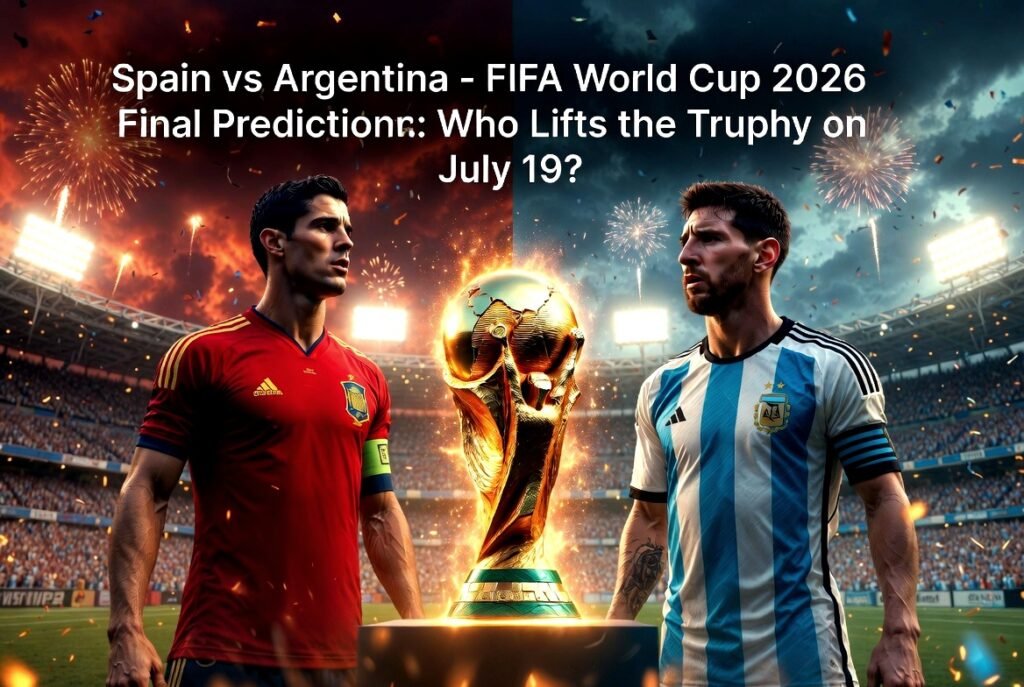
Spain (4-3-3) — Manager: Luis de la Fuente
Goalkeeper: Unai Simón Defenders: Pedro Porro, Pau Cubarsí, Aymeric Laporte, Marc Cucurella Midfield: Fabián Ruiz, Rodri, Dani Olmo Attack: Lamine Yamal, Mikel Oyarzabal, Álex Baena
Substitutes available: Mikel Merino (the man who has won two knockout matches with late goals from the bench), Nico Williams, Pedri, Ferran Torres, Alejandro Grimaldo.
Note: Luis de la Fuente is expected to name the same eleven that destroyed France 2-0 in the semifinal, with one possible change — Álex Baena comes in on the left wing in place of Nico Williams, who played that role against France. No injuries or suspensions for Spain.
Argentina (4-4-2 Diamond) — Manager: Lionel Scaloni
Goalkeeper: Emiliano Martínez Defenders: Nahuel Molina, Cristian Romero, Lisandro Martínez, Nicolás Tagliafico Midfield: Rodrigo De Paul, Leandro Paredes, Alexis Mac Allister, Enzo Fernández Attack: Lionel Messi, Julián Álvarez
Substitutes available: Lautaro Martínez (scorer of the semifinal winner), Giuliano Simeone, Thiago Almada, Ángel Correa.
Note: De Paul returns to the starting eleven after resting in the final group game. Leandro Paredes starts ahead of Giuliano Simeone in a slightly more defensive midfield setup designed to protect against Spain’s positional press. No suspensions — tournament rules cleared cautions after the quarterfinals meaning no player misses the final through yellow card accumulation. No red cards in either semifinal.
How Spain Got Here – Seven Matches, Never Behind
Spain sealed its spot in the final following a 2-0 win over France at Dallas Stadium on July 14. Luis de la Fuente has guided an imperious, structurally flawless La Roja side that has dominated the tournament, never trailing for a single minute on their march to the final.
Seven matches. Seven wins. Thirteen goals scored. One conceded — a penalty by Belgium’s Charles De Ketelaere in the quarterfinal, the only blemish on an otherwise perfect defensive record. Spain have led in every single match they have played. They have never had to come from behind. They have never been in danger of elimination for even thirty consecutive seconds.
The path to this final tells the story completely:
Group Stage: Drew 0-0 with Cape Verde, beat Saudi Arabia 4-0, beat Uruguay 1-0 Round of 32: Beat Austria 3-0 Round of 16: Beat Portugal 1-0 (Merino, stoppage time) Quarterfinal: Beat Belgium 2-1 (Merino, 88th minute) Semifinal: Beat France 2-0 (Porro 34′, Oyarzabal 71′)
The pattern of those knockout results is worth studying. Spain have not produced dominant winning margins — 1-0, 2-1, 2-0 — but they have been the better team in every single match and found the decisive goal through the quality of their squad rather than the brilliance of a single moment. Mikel Merino, the Juventus midfielder who starts on the bench, has now scored the winning goal in two consecutive knockout matches. He enters Sunday’s final as arguably the most dangerous substitute in the history of the tournament.
Fabián Ruiz and especially Rodri delivered a masterclass in midfield against France that allowed for total domination. France’s vaunted attacking trio of Mbappé, Olise and Dembélé were held to almost nothing. If Spain can do to Argentina’s attack what they did to France’s, this final ends before the halftime show.
How Argentina Got Here – Drama, Comebacks and Messi Every Time
Argentina proved resilient yet again with a stunning comeback against England in the final minutes of its semifinal match on July 15. England had been holding onto a 1-0 lead when two late goals from Argentina flipped the score. England was unable to respond and the final score was 2-1.
That result captures Argentina’s entire 2026 campaign in a single sentence. Seven matches. Seven wins. Nineteen goals scored. But not a single knockout match won comfortably. Not a single knockout match where Argentina were not behind or level with fifteen minutes to play.
Their path to the final:
Group Stage: Beat Algeria 3-0, beat Austria 2-0, beat Jordan 3-1 Round of 32: Beat Cape Verde 3-2 after extra time Round of 16: Beat Egypt 3-2 (Messi equaliser in 79th minute) Quarterfinal: Beat Switzerland 3-1 Semifinal: Beat England 2-1 (comeback from 1-0 down, goals in 85th and 92nd minutes)
Argentina have scored the decisive goal late in regulation or extra time in each knockout round. Messi now has eight goals and four assists at this World Cup, but the champions’ resilience has not belonged to him alone. Enzo Fernández has delivered crucial goals. Mac Allister has attacked the penalty area intelligently. Lautaro Martínez — coming off the bench in every knockout match — has become Scaloni’s most dangerous intervention. He scored the semifinal winner against England in the 92nd minute having entered in the 76th.
The finalists enter the short preparation period without a suspension concern. Spain have approximately one additional day of recovery after playing France on July 14, while Argentina’s semifinal against England took place on July 15 — one day later. That one day difference in recovery time, across a team of players averaging 28 years old running at tournament intensity, is a genuine if small factor in the physical equation.
Head to Head – What History Tells Us
Spain and Argentina have met 14 times, with both teams winning six games each and two draws. The record is as level as any international head-to-head between teams of this quality.
Their most recent meeting before this tournament was a friendly in 2018, which Spain won 6-1 — a result that is entirely irrelevant to Sunday’s match but frequently cited because of its extraordinary scoreline. In March 2026, just four months before this World Cup, Spain and Argentina met in the Finalissima in Qatar. Argentina won that match 1-0.
At World Cup level, Spain and Argentina have met only once — in the 1998 group stage, where Spain won 1-0. That result carries no predictive value for a final 28 years later with entirely different squads and different tactical eras.
The meaningful head-to-head context is this: Spain are unbeaten in 36 consecutive international matches — one short of the all-time record that Argentina themselves set between 2019 and 2022. A Spain win or draw on Sunday breaks that record. Argentina’s record of consecutive major tournament wins — Copa América 2021, World Cup 2022, Copa América 2024 — is the most dominant stretch by any nation in the modern era.
One of these streaks ends on Sunday at MetLife Stadium.
Tactical Analysis – The Question That Decides Everything
Spain are the best team. Argentina are the champions. And somewhere in that gap this final will be decided.
Spain’s system is built around territory and control. Rodri anchors the defensive midfield — reading the game before the ball arrives, positioning to intercept rather than tackle, distributing under pressure with the composure that won him the 2024 Ballon d’Or. Pedri and Fabián Ruiz create passing triangles in the spaces between opposition lines. Yamal and Baena stretch the defensive shape wide. Oyarzabal leads the line with intelligent movement rather than physical dominance. The whole system is designed to make the opponent press and chase and tire — and then exploit the spaces their pressing creates.
Argentina’s 4-4-2 diamond packs De Paul, Paredes, Mac Allister, and Fernández into central areas, all building around Messi’s gravity. The theory — which has worked all tournament — is that Spain cannot press all four central midfield players simultaneously. Someone will always be free. When Messi finds that free player at the right moment, Argentina score. The late goals against England, against Egypt, against Cape Verde — all came from exactly this combination play in central areas.
The tactical question that defines this final: can Rodri disrupt Argentina’s central combinations before they reach Messi? If Rodri reads Argentina’s build-up patterns and intercepts before the combination reaches its dangerous phase, Spain win possession and immediately transition into the space Argentina leave behind their diamond shape. If Argentina establish their central overload with five or six passes and find Messi in behind Rodri’s press — something happens.
The matchup within the matchup: Fabián Ruiz against Enzo Fernández. Ruiz has been Spain’s best outfield player at this tournament — his energy, his box-to-box running, and his finishing ability make him the player Scaloni will have spent the most time planning for this week. Fernández, Argentina’s most creative central figure, needs time on the ball to thread passes into Messi’s feet. Ruiz’s job is to deny him that time.
The Closing Ceremony & Halftime Show – What Happens Before and During
The spectacle surrounding this final is unlike anything any World Cup has produced before it.
At 1:30 PM ET — ninety minutes before kickoff — the closing ceremony begins at MetLife Stadium. Post Malone headlines the ceremony, joined by Tom Cruise, singers Laura Pausini, Nicole Scherzinger and Robbie Williams, and streamer IShowSpeed. Jennifer Hudson performs the United States National Anthem immediately before kickoff.
At halftime, the 2026 World Cup final introduces the first ever halftime show in the history of the competition. Madonna, BTS, Shakira and Justin Bieber are the headline performers. The halftime show is expected to run approximately 20 minutes — meaning the second half begins around 75 minutes after the first half ends. Both sets of players will return to their dressing rooms for a longer than usual break, which affects substitution timing and physical recovery for the second half.
The halftime show is a cultural statement as much as a sporting one. The 2026 World Cup, hosted across three North American nations, has been the most commercially ambitious in FIFA’s history. A Super Bowl-style halftime show — with four of the most globally recognisable musical artists on the planet — is the logical conclusion of that ambition.
Key Players – Who Makes the Difference on Sunday
Lamine Yamal (Spain) — 19 years old. One goal and four assists in the tournament. Consistently double-marked by opponents who have never quite managed to neutralise him. His matchup against Nahuel Molina at Argentina’s right back position is the one-on-one duel that most directly creates Spain’s best attacking opportunities. When Yamal receives the ball against Molina, Argentina’s entire defensive shape shifts to cover — which creates the space that Oyarzabal and Baena exploit centrally and on the left.
Lionel Messi (Argentina) — 39 years old. Eight goals. Four assists. The all-time World Cup scoring record. Playing in his last competitive match. The moment that defines this final, if Argentina win it, almost certainly involves Messi — either scoring or producing the decisive pass in the closing minutes when Spain’s defensive focus has fractured under sustained pressure. Every Argentina knockout match has ended with Messi involved in the decisive action. There is no reason to assume Sunday will be different.
Rodri (Spain) — The 2024 Ballon d’Or winner. The best defensive midfielder in world football. The player around whom Spain’s entire system is built. If Rodri performs at his tournament level — as he has in all seven matches — Argentina’s central combinations do not reach their dangerous phase consistently enough to threaten Simón’s goal. If he has an off-night, Argentina’s diamond finds the spaces that have unlocked every other team they have faced.
Emiliano Martínez (Argentina) — The goalkeeper with the best record in high-pressure shootouts in the history of the World Cup. His 2022 final performance — saves at crucial moments, a stopped penalty in the shootout — was one of the defining individual contributions in Argentina’s title win. If this final reaches penalties, Emiliano Martínez gives Argentina an advantage that cannot be quantified by normal statistical models.
Julián Álvarez (Argentina) — Starting his first match of the knockout rounds — he has come off the bench in every elimination game so far. Scaloni’s decision to start him in the final alongside Messi rather than Lautaro Martínez is the biggest selection surprise of the match. Álvarez’s movement, his link play with Messi, and his ability to draw defenders away from Messi’s preferred receiving positions are exactly what Argentina need to unlock Spain’s compressed defensive structure from the first whistle.
Our Prediction – One Last Time
The defining match of the FIFA World Cup 2026 brings together its most complete defensive structure and its most productive attack. Spain have conceded once in seven matches. Argentina have scored 19 times and won every game they have played.
Spain will attempt to remove emotion from the contest. Argentina will attempt to make the contest nothing but emotion. Whichever philosophy wins those first 25 minutes — when the crowd noise is at its absolute peak and both teams are discovering what kind of match this is going to be — likely wins the trophy.
Our final prediction: Spain 1-1 Argentina after 90 minutes. Spain win 4-3 on penalties.
The reasoning in brief: Spain’s defensive record makes it extremely difficult for Argentina to score twice in normal time. Argentina’s character and Messi’s individual quality makes it equally difficult for Spain to keep a clean sheet across 90 minutes in a final. The match goes to penalties — where Unai Simón against Emiliano Martínez is genuinely impossible to predict, but where Spain’s squad depth and the nerve of a team that has never been behind all tournament gives them the marginal edge.
But every prediction about this Argentina team has underestimated them. Every assumption that their tournament would end has been wrong. And Messi in a World Cup final, on his last appearance, at 39 years old, has a track record that statistics cannot capture.
Whatever happens on Sunday at MetLife Stadium — it will be the greatest World Cup final ever played. That is the one prediction made with complete confidence.
Official FIFA Link – Live Score, Lineups & Trophy Ceremony
For live score updates as they happen, official confirmed lineups when released, and the closing ceremony broadcast information:
FIFA World Cup 2026 Official Match Centre: https://www.fifa.com/en/tournaments/mens/worldcup/canadamexicousa2026/articles/match-schedule-fixtures-results-teams-stadiums
FAQ
What time is Spain vs Argentina World Cup 2026 final? Spain vs Argentina kicks off at 3:00 PM ET / 2:00 PM CT / 12:00 PM PT on Sunday July 19. In the UK it is 8:00 PM BST. In India it is 12:30 AM IST on Monday July 20.
Where is the 2026 World Cup final being played? MetLife Stadium in East Rutherford, New Jersey, with a capacity of 82,500. It is the largest venue at the 2026 World Cup and has been the designated final venue since the tournament was awarded to North America.
What channel is the World Cup 2026 final on? In the USA — FOX in English, Telemundo in Spanish. Streaming via FOX One, FOX Sports App and Fubo. In the UK — both BBC One and ITV1 broadcast free to air. In Pakistan and India — Sony Ten and PTV Sports.
Is there a halftime show at the World Cup 2026 final? Yes — for the first time in World Cup history. Madonna, BTS, Shakira and Justin Bieber headline. The closing ceremony before kickoff features Post Malone, Tom Cruise, Robbie Williams, Laura Pausini, Nicole Scherzinger and IShowSpeed from 1:30 PM ET.
What are Spain’s confirmed lineups? Spain: Unai Simón; Pedro Porro, Pau Cubarsí, Aymeric Laporte, Marc Cucurella; Fabián Ruiz, Rodri, Dani Olmo; Lamine Yamal, Mikel Oyarzabal, Álex Baena.
What are Argentina’s confirmed lineups? Argentina: Emiliano Martínez; Nahuel Molina, Cristian Romero, Lisandro Martínez, Nicolás Tagliafico; Rodrigo De Paul, Leandro Paredes, Alexis Mac Allister, Enzo Fernández; Lionel Messi, Julián Álvarez.
Is this Messi’s last World Cup match? Almost certainly yes. At 39, playing in his sixth World Cup, Messi has not officially confirmed retirement but the context makes it near certain that Sunday’s final is the last World Cup match of his career.
What is the head to head record between Spain and Argentina? Spain and Argentina have met 14 times, with both teams winning six games each and two draws. Their most recent competitive meeting before this tournament was the 2026 Finalissima in Qatar, which Argentina won 1-0.